
Palavras-chave
Intestino
Microbiota
Como Citar
Copyright © | Todos os direitos reservados.
A revista detém os direitos autorais exclusivos de publicação deste artigo nos termos da lei 9610/98.
Reprodução parcial
É livre o uso de partes do texto, figuras e questionário do artigo, sendo obrigatória a citação dos autores e revista.
Reprodução total
É expressamente proibida, devendo ser autorizada pela revista.
Resumo
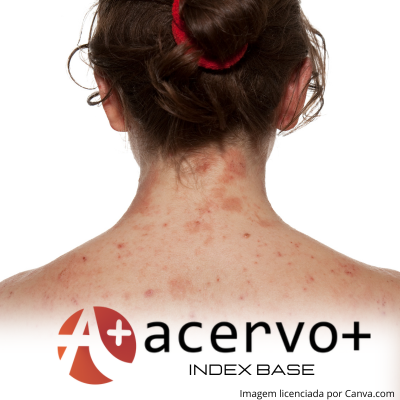
Objetivo: Investigar a relação entre a disbiose intestinal e a dermatite atópica (DA), destacando o papel do eixo pele-intestino na intensificação das manifestações clínicas da doença. Revisão bibliográfica: A DA é uma condição inflamatória crônica da pele que afeta principalmente crianças, estando associada a fatores genéticos, imunológicos, ambientais e emocionais. Alterações na microbiota intestinal influenciam a resposta imune, favorecendo o desequilíbrio entre linfócitos Th1/Th2 e comprometendo a barreira cutânea. Mutações no gene da filagrina, redução de ceramidas e claudinas, além de exposições ambientais e hábitos modernos, são apontados como agravantes. A produção reduzida de ácidos graxos de cadeia curta (AGCCs) em indivíduos com disbiose pode aumentar a permeabilidade intestinal e desencadear respostas inflamatórias sistêmicas. Considerações finais: Considera-se, portanto, que a compreensão dessa relação pode auxiliar no desenvolvimento de terapias integrativas que envolvam modulação da microbiota como abordagem complementar no tratamento da dermatite atópica. Além disso, a consideração dos fatores emocionais e ambientais no manejo da DA é fundamental para melhorar a qualidade de vida dos pacientes e evitar recorrências.
Referências
ALVES G, et al. Neuroimunomodulação: sobre o diálogo entre os sistemas nervoso e imunológico. Revista Brasileira de Psiquiatria, 2007; 29(4): 363-9.
BORREGO AR e BORREGO JJ. Nutritional and microbial strategies for treating acne, alopecia, and atopic dermatitis. Nutrients, 2024; 16(20): 3559.
EICHENFIELD LF, et al. Guidelines of care for the management of atopic dermatitis: section 2. Management and treatment of atopic dermatitis with topical therapies. Journal of the American Academy of Dermatology, 2014; 71: 116–132.
FANG Z, et al. Gut Microbiota, Probiotics, and Their Interactions in Prevention and Treatment of Atopic Dermatitis: A Review. 2021; 2-7.
HONDA R, et al. Influência do estresse emocional nas crises de dermatite atópica. Revista Brasileira de Implantologia e Ciências da Saúde, 2024; 6: 2082–2093.
KALASHNIKOVA I,et al. The Association between Gut Microbiota and Serum Biomarkers in Children with Atopic Dermatitis. 2024; 13-16.
KIM JE e KIM HS. Microbiome of the Skin and Gut in Atopic Dermatitis (AD): Understanding the Pathophysiology and Finding Novel Management Strategies. Journal of Clinical Medicine, 2019; 8(4): 444.
KOH LF, et al. Skin microbiome of atopic dermatitis. Allergology international: official journal of the Japanese Society of Allergology, 2022; 71(1): 31–39.
KONG HH e SEGRE JA. Skin Microbiome: Looking Back to Move Forward. Journal of Investigative Dermatology, 2012; 132: 933–939.
LEE SY, et al. Microbiome in the Gut-Skin Axis in Atopic Dermatitis. Allergy Asthma Immunol Res, 2018; 355-359.
LI W e LI A. Exploring the causal relationship between gut microbiota and atopic dermatitis: A Mendelian randomization study. Medicine, 2024; 103(52): 40193.
LIN, et al. Associação entre estresse e eixo HPA na dermatite atópica. International Journal of Molecular Sciences, 2017; 18: 10.
LIU T, et al. Study of The specificity of gut microbiota in adult patients with delayed-onset of atopic dermatitis. Allergologia et immunopathologia, 2022; 50(6): 128–136.
LUGER T, et al. Atopic dermatitis: Role of the skin barrier, environment, microbiome, and therapeutic agents. Journal of Dermatological Science, 2021; 102: 142–157.
MASHIAH J, et al. Clinical efficacy of fecal microbial transplantation treatment in adults with moderate-to-severe atopic dermatitis. Immunity, inflammation and disease, 2021; 10(3): 570.
MOHAMMAD S, et al. Atopic dermatitis: Pathophysiology, microbiota, and metabolome - A comprehensive review. Microbiological Research, 2024; 281: 127595.
NOLL M, et al. Improvement of atopic dermatitis by synbiotic baths. Microorganisms, 2021; 9(3): 527.
PARK DH, et al. Comparative Analysis of the Microbiome across the Gut–Skin Axis in Atopic Dermatitis. 2017; 22(8): 4228.
PASSERON T, et al. Adult skin acute stress responses to short-term environmental and internal aggression from exposome factor. 2021; 7.
PETERSEN EBM, et al. Role of the Gut Microbiota in Atopic Dermatitis: A Systematic Review. Acta Dermato-Venereologica, 2019; 99(1): 5–11.
SZÁNTÓ M, et al. Targeting the gut-skin axis-Probiotics as new tools for skin disorder management? Experimental dermatology, 2019; 28(11): 1210–1218.
WRZEŚNIEWSKA M, et al. The role of the Microbiota in the pathogenesis and treatment of atopic dermatitis-A literature review. International journal of molecular sciences, 2024; 25(12): 6539.