
Keywords
Contraceptive
Contraceptives
How to Cite
Copyright © | All rights reserved.
The journal holds the exclusive copyright for the publication of this article under the terms of Brazilian law 9610/98.
Partial reproduction
The use of parts of the texts, figures and questionnaire of the article is free, being mandatory the citation of the authors and journal.
Total reproduction
It is expressly prohibited and must be authorized by the journal.
Abstract
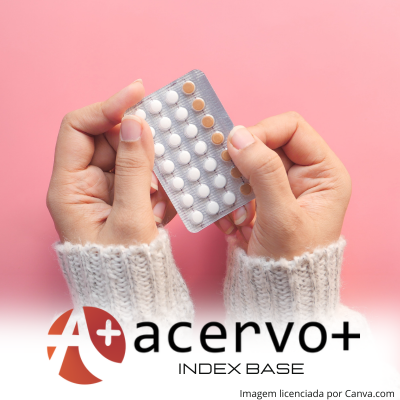
Objective: To analyze and synthesize the available scientific evidence on the side effects and negative impacts of contraceptive pill use on women's health. Methods: This is an integrative literature review, which adopted the Preferred Reporting Items for Systematic Reviews and Meta-Analyses (PRISMA) protocol. The central question used was: “How does the continuous use of contraceptive pills affect women's physical and mental health, considering its adverse effects and long-term impacts?”. The literature search was conducted in the following databases: BVS, Embase, PUBMED, SciELO, and LILACS. To ensure efficient retrieval of studies, Health Sciences Descriptors (DeCS) were used, both in Portuguese and English, according to the database consulted, combined using the Boolean operator “AND”. Results: Seven articles were included in the review, ensuring the selection of relevant and methodologically rigorous studies to support the research. Final considerations: The individual use of birth control pills can cause various side effects and negative impacts on physical and mental health. Continuous use is associated with risks such as venous thromboembolism, hormonal changes, weight gain, headaches, nausea, among other adverse effects.
References
BALKUS JE, et al. Oral and injectable contraceptive use and HIV acquisition risk among women in 4 African countries: a secondary analysis of data from a microbicide trial. Contraception, 2016; 93(1): 25-31.
BARACAT EC, et al. Avaliação da Tolerabilidade e do Controle de Ciclo de Dois Contraceptivos Orais de Baixa Dose: Estudo Comparativo Aberto. Revista Brasileira de Ginecologia e Obstetrícia, 1998; 20(5): 273-280.
BRASIL. Diário Oficial da União. Lei nº 12305. 2010. Disponível em: https ://www.planalto.gov.br/cci vil_03/_ato2007-2010/2010/lei/l12305.htm. Acessado em: 25 de abril de 2025.
BRASIL. Ministério da Agricultura, Pecuária e Abastecimento. Regras para análise de sementes. 2009.
Disponível em: https ://www.gov.br/agricultura/pt-br/assuntos/insumos-agropecuarios/arquivos-publicaco es-insumos/2946_regras_analise__sementes.pdf. Acessado em: 25 de abril de 2025.
BRYNHILDSEN J, et al. Oral contraceptive use among female elite athletes and age‐matched controls and its relation to low back pain. Acta Obstetricia et Gynecologica Scandinavica,1997; 76(9): 873-878.
CARRIAS DTS, et al. Efeitos adversos associados a uso de contraceptivos orais em discentes. Revista da Sociedade Brasileira de Clínica Médica, 2020; 17(3): 142-146.
DONATO H e DONATO M. Stages for Undertaking a Systematic Review. Acta Médica Portuguesa, 2019; 32(3): 227–235.
HEFFRON R, et al. Hormonal contraceptive use and risk of HIV-1 transmission: a prospective cohort analysis. Lancet Infectious Diseases, 2012; 12(1): 19-26.
JADAD AR, et al. Assessing the quality of reports of randomized clinical trials: is blinding necessary? Controlled clinical trials, 1996; 17(1): 1-12.
KEMMEREN JM, et al. Effect of second- and third-generation oral contraceptives on the protein C system in the absence or presence of the factor VLeiden mutation: a randomized trial. Blood, 2004; 103(3): 927-933.
LEMOS A. Cibercultura: tecnologia e vida social na cultura contemporânea. Porto Alegre: Sulina, 2015; 7: 296.
MENETON P, et al. Links between dietary salt intake, renal salt handling, blood pressure, and cardiovascular diseases. Physiological Reviews, 2005; 85(2): 679-715.
MIOLA AC, et al. Técnicas de randomização e alocação para estudos clínicos. Jornal Vascular Brasileiro, 2024; 23: 20240046.
OKSANEN J, et al. Vegan: Community Ecology Package. R package version 2.5-6. R Core Team, 2019. Disponível em: https ://cran.r-project.org/package=vegan. Acesso em: 25 abr. 2025.
PETITTI DB, et al. Blood pressure levels before dementia. Archives Neurology, 2005; 62(1): 112-116.
RIFFENBURGH RH. Statistics in medicine. 2nd ed. Amsterdam: Elsevier Academic Press, 2006; 672.
ROJKO JL e HARDY WD JR. Feline leukemia virus and other retroviruses. In: Sherding RG. The cat: diseases and clinical management. New York: Churchill Livingstone, 1989; 229-332.
SANTOS CS, et al. Efeitos adversos e fatores de risco associados ao uso contínuo de contraceptivos orais. Revista Educação em Saúde, 2020; 8(2).
SILVA CP, et al. Impactos fisiológicos do uso prolongado de contraceptivos hormonais em acadêmicas da Faculdade Guaraí-TO: uma análise dos potenciais efeitos colaterais. Facit Business and Technology Journal, 2024; 55(1): 118-131.
SILVA PCS, et al. Avaliação dos efeitos colaterais dos contraceptivos orais. Revista Multidisciplinar do Sertão, 2023; 5(3): 351-360.
SOUZA BC e ANDRADE LG. Atenção farmacêutica no uso de contraceptivos de emergência. Revista Ibero-Americana De Humanidades, Ciências E Educação, 2023; 9(11): 198–210.
SOUZA MS, et al. Anticoncepcionais hormonais orais e seus efeitos colaterais no organismo feminino: uma revisão integrativa. Journal of Education Science and Health, 2022; 2(2).
TOZETTO HCM, et al. Eventos adversos relacionados ao uso de anticoncepcionais hormonais orais em estudantes de graduação em farmácia: um estudo transversal. Brazilian Journal of Pharmaceutical Sciences, 2022; 58: 21335.
VLIEG VH, et al. Oral contraceptives and the risk of venous thromboembolism: a meta-analysis. The Lancet, 2009; 373(9675): 1498-1503.