
Keywords
Plasmodium
Epidemiology
Risk factors
Brazilian Amazon
How to Cite
Copyright © | All rights reserved.
The journal holds the exclusive copyright for the publication of this article under the terms of Brazilian law 9610/98.
Partial reproduction
The use of parts of the texts, figures and questionnaire of the article is free, being mandatory the citation of the authors and journal.
Total reproduction
It is expressly prohibited and must be authorized by the journal.
Abstract
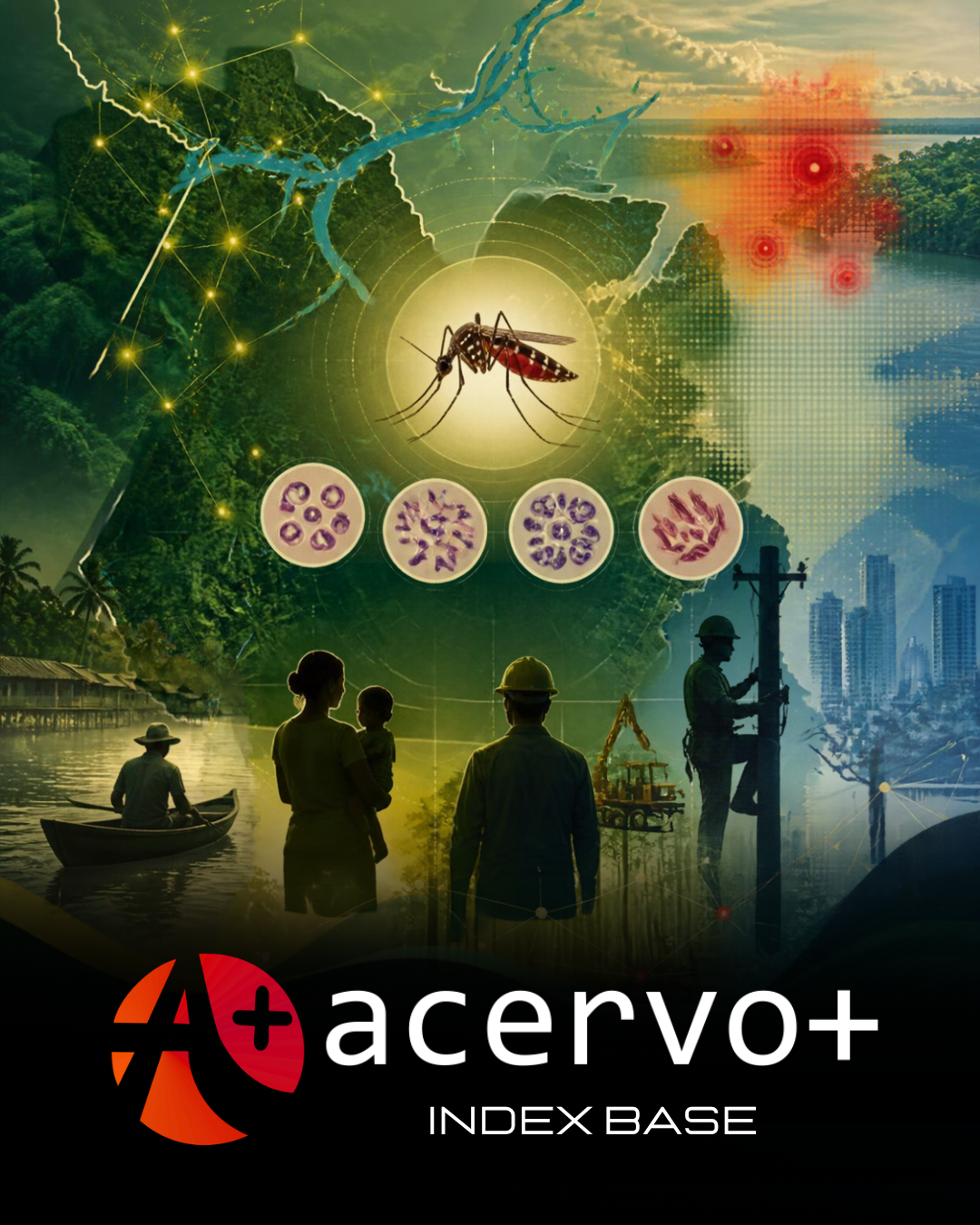
Objective: To evaluate the association between sociodemographic and occupational characteristics and the occurrence of malaria according to parasite species in the state of Pará, from 2020 to 2024. Methods: Observational, analytical, quantitative epidemiological study of data extracted from SIVEP-Malaria. The following were analyzed: year of notification, age group, sex, race/color, education level, occupation, and type of malaria. Associations were performed using the chi-square test and Poisson regression. Results: 119,999 positive cases of malaria were analyzed, of which 86.2% corresponded to vivax, 12.4% falciparum, 1.2% mixed malaria, and 0.1% non-falciparum malaria. Falciparum malaria was more likely in the elderly (RR=1.77). In indigenous individuals, mixed malaria (RR=1.38) had a higher probability. Among occupational factors, artisanal mining (RR=3.07), logging (RR=3.05), and mining (RR=2.22) stood out, while mixed infections showed a strong association with artisanal mining activity (RR=4.66). Conclusion: The different types of malaria showed a heterogeneous distribution in Pará, being associated with age, race/indigenous color, and, mainly, with artisanal mining, logging, and mining activities, showing the need for control strategies directed at vulnerable groups.
References
AMARAL PST, et al. Malaria in areas under mining activity in the Amazon: a review. Revista da Sociedade Brasileira de Medicina Tropical, 2024; 57: 1–9.
ATUSINGWIZE E, et al. Social determinants of malaria in low- and middle-income countries: a mixed-methods systematic review. Malar J., 2026; 24(165).
BRASIL. Conselho Nacional de Saúde. Resolução nº 466, de 12 de dezembro de 2012. Aprova as diretrizes e normas regulamentadoras de pesquisas envolvendo seres humanos. Diário Oficial da União: seção 1, Brasília, DF. 2013, 12(59).
BRASIL. Conselho Nacional de Saúde. Resolução nº 510, de 7 de abril de 2016. Dispõe sobre as normas aplicáveis a pesquisas em Ciências Humanas e Sociais. Diário Oficial da União: seção 1, Brasília, DF. 2016, 98: 44-46
BRASIL. Ministério da Saúde. Painel Malária. 2026.
BRASIL. Ministério da Saúde. Secretaria de Vigilância em Saúde e Ambiente. Boletim epidemiológico: caracterização da malária em áreas especiais da região amazônica. 2024; 55(14).
BRASIL. Ministério da Saúde. Secretaria de Vigilância em Saúde e Ambiente. Panorama epidemiológico da malária no Brasil: um enfoque na população negra. Boletim epidemiológico: saúde da população negra. 2023; 2: 28–33.
BRASIL. Ministério da Saúde. Secretaria de Vigilância em Saúde. Situação epidemiológica da malária. 2022; 42–57.
BRASIL. Ministério da Saúde. Situação Epidemiológica da Malária. 2026.
BRIGGS J, et al. Sex-based differences in clearance of chronic Plasmodium falciparum infection. Elife, 2020; 27(9).
DUNCOMBE CJ. Sex-based differences in Plasmodium infection in the control groups of controlled human malaria infection trials in malaria-naive populations in the USA and the Netherlands: a pooled analysis. The Lancet Microbe, 2026; 7(2).
EBHUOMA O, et al. Socio-economic status as predictors of malaria transmission in KwaZulu-Natal, South Africa. A retrospective study. African Health Sciences, 2022; 22(2).
ESCALANTE AA, et al. Andreína. Why Plasmodium vivax and Plasmodium falciparum are so different? A tale of two clades and their species diversities. Malaria Journal, 2022; 22(2).
FERREIRA UM, et al. Relative contribution of low-density and asymptomatic infections to Plasmodium vivax transmission in the Amazon: pooled analysis of individual participant data from population-based cross-sectional surveys. The Lancet Regional Health – Americas, 2022; 9.
GARCIA CGR, et al. Assessing the spatial influence of deforestation on malaria incidence in Pará State, Amazon region, Brazil, 2008–2019. Memórias do Instituto Oswaldo Cruz, 2025; 120: 1–10.
GEBREEGZIABHER E, et al. Identifying and characterizing high-risk populations in pilot malaria elimination districts in Madagascar: a mixed-methods study. Malaria Journal, 2024; 23(121).
GONÇALVES NV, et al. Malaria and environmental, socioeconomics and public health conditions in the municipality of São Félix do Xingu, Pará, Brazil: an ecological and cross-sectional study. Revista da Sociedade Brasileira de Medicina Tropical, 2023; 56: 1–8.
GUINOVART C, et al. The epidemiology of severe malaria at Manhiça District Hospital, Mozambique: a retrospective analysis of 20 years of malaria admissions surveillance data. The Lancet Global Health, 2022; 10(6).
HASYIM H, et al. Risk factors of malaria transmission in mining workers in Muara Enim, South Sumatra, Indonesia. Scientific Reports, 2023; 13.
KAMAU A, et al. Malaria infection, disease and mortality among children and adults on the coast of Kenya. Malaria Journal, 2020; 19(210).
KASSIE AT, et al. Alebachew Ferede. Determinants of malaria prevalence among children under 5 years of age in 17 sub-Saharan African countries: insights from malaria indicator surveys. Global Health Action, 2026; 19(1).
KHAN N, DAILY JP. Update on pathogenesis, management, and control of Plasmodium vivax. Current Opinion In Infectious Diseases, 2022; 35(5).
KIGOZI SP, et al. Rapid shifts in the age-specific burden of malaria following successful control interventions in four regions of Uganda. Malaria Journal. 2020, 19(128).
MASUDA K. Length of maternal schooling and children’s risk of malaria infection: evidence from a natural experiment in uganda. Bmj Global Health, 2020; 5(2).
MONSON RR. Occupational Epidemiology. 2. ed. Boca Raton: CRC Press, 1990; 51.
MOSHI IR, et al. Outdoor malaria transmission risks and social life: a qualitative study in south-eastern tanzania. Malaria Journal, 2018; 17(397).
OKIRING J, et al. Gender difference in the incidence of malaria diagnosed at public health facilities in Uganda. Malaria Journal, 2022; 21(22).
OLIVEIRA-NETO FM, et al. Changes in the malaria transmission profile in a low-endemic area of the Brazilian Amazon: a cause for concern. Rev Inst Med Trop São Paulo, 2025; 13: 67-70.
OSEGHALE OE. Gender Disparities in Malaria Outcomes amongst Residents of Edo South Senatorial District, Edo State, Nigeria. Journal Of Applied Sciences And Environmental Management, 2025; 29(2).
QUARESIMA V, et al. Are Malaria Risk Factors Based on Gender? A Mixed-Methods Survey in an Urban Setting in Ghana. Tropical Medicine And Infectious Disease, 2021; 6(3).
SAEUNG M, et al. Estimating malaria risk behaviours and their determinants among at-risk populations in a pre-elimination setting, Sisaket Province, Thailand–Cambodia border. Malaria Journal, 2025; 24(293).
SAYRE D, et al. Baseline malaria prevalence and care-seeking behaviours in rural Madagascar prior to a trial to expand malaria community case management to all ages. Malaria Journal, 2021; 20(422).
TOURE AA, et al. Seni. Inequity in the transmission of malaria infection among children and adolescents: a cohort study in rural guinea. Scientific Reports, 2025; 15.
UENO TMRL, et al. Socio-epidemiological features and spatial distribution of malaria in an area under mining activity in the Brazilian Amazon Region. International Journal of Environmental Research and Public Health, 2021; 18(19): 1–10
WHO - WORDL HEALTH ORGANIZATION. Malaria. 2025.
WU Y, et al. The Immunomodulatory Role of Estrogen in Malaria: a review of sex differences and therapeutic implications. Immunity, Inflammation And Disease, 2025; 13(2).