
Keywords
Microbiota
Skin
How to Cite
Copyright © | All rights reserved.
The journal holds the exclusive copyright for the publication of this article under the terms of Brazilian law 9610/98.
Partial reproduction
The use of parts of the texts, figures and questionnaire of the article is free, being mandatory the citation of the authors and journal.
Total reproduction
It is expressly prohibited and must be authorized by the journal.
Abstract
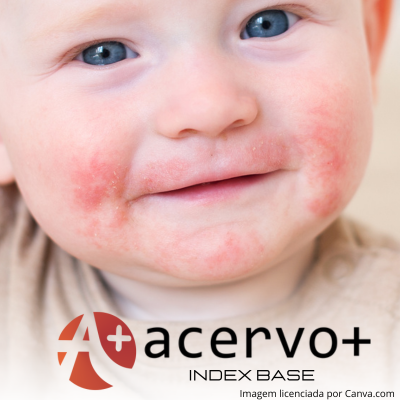
Objective: To analyze the influence of the skin microbiota on pediatric atopic dermatitis. Literature review: Atopic dermatitis (AD) is a skin inflammation that results in lesions and itching, affecting individuals of various ages, especially children. Due to constant exposure to the external environment, the epidermis has mechanisms that act as a natural barrier, such as the skin microbiota. Composed of commensal microorganisms, this microbiome is influenced by various factors, which, when imbalanced, make the region susceptible to the development of atopic dermatitis. Studies show that patients with AD exhibit a certain dominance in skin colonization by Staphylococcus aureus, indicating a correlation between the intensity of inflammation and the quantity of bacteria in the lesions. Final considerations: The lack of exposure to a diverse microbial environment in childhood results in low immune tolerance, which may influence the development of atopic dermatitis in pediatric patients.
References
ABREU DB, el al. Microbioma cutâneo e dermatite atópica, Revista Portuguesa de Imunoalergologia, 2022; 30(3):169-189.
ALIAGA GLC, et al. Adverse effects of using cyclosporine in patients with severe atopic dermatitis. Arquivos de Asma, Alergia e Imunologia, 2020; 4.
EDSLEV S, et al. Skin microbiome in atopic dermatitis. Acta dermato-venereologica, 2020;100(12):00164.
EICHENFIELD LF, et al. Recent developments and advances in atopic dermatitis: A focus on epidemiology, pathophysiology, and treatment in the pediatric setting. Paediatric drugs,2022;24(4): 293–305.
DELIOS S, et al. Probiotics in the prevention and treatment of atopic dermatitis. Pediatric allergy and immunology: official publication of the European Society of Pediatric Allergy and Immunology, 2020; 31(26): 43–45.
FALCON MM, et al. Síndrome da pele vermelha: a consequência do uso crônico de corticoides tópicos. Cuadernos de Educación y Desarrollo, 2024; 16(2).
FANG Z, et al. Gut Microbiota, probiotics, and their interactions in prevention and treatment of atopic dermatitis: A review. Frontiers in Immunology, 2021; 12:720393.
HALLING AS, et al. Reduced skin microbiome diversity in infancy is associated with increased risk of atopic dermatitis in high-risk children. The Journal of Investigative Dermatology, 2023; 143(10):2030-2038.e6.
KIM J, et al. Alterations of epidermal lipid profiles and skin microbiome in children with atopic dermatitis. Allergy, Asthma & Immunology Research, 2023; 15(2):186–200.
LARA MF, et al. Os probióticos podem desempenhar um papel na prevenção e tratamento da dermatite atópica pediátrica. Revista Médica de Minas Gerais, 2015; 25.
LI H, et al. Update on the pathogenesis and therapy of atopic dermatitis. Clinical reviews in allergy & immunology, 2021;61(3):324–338.
LIU Y, et al. Distinct skin Microbiota imbalance and responses to clinical treatment in children with atopic dermatitis. Frontiers in cellular and infection microbiology,2020;10:336.
QUADROS BF, et al. Dermatite Atópica: perspectivas atuais em diagnóstico, manejo terapêutico, controle de recorrências e prevenção de complicações. Zenodo, 2024.
OLIVEIRA AMF, et al. Atopic dermatitis pediatric patients show high rates of nasal and intestinal colonization by methicillin-resistant Staphylococcus aureus and coagulase-negative staphylococci. BMC microbiology, 2024; 24(1): 42.
RUSU E, et al. Prebiotics and probiotics in atopic dermatitis. Experimental and therapeutic medicine, 2019.
SIVIERI K, et al. Microbiota da pele: Novos desafios. Arquivos Catarinenses de Medicina, 2021;50(1): 93–112.
SUN Z, et al. A microbiome-based index for assessing skin health and treatment effects for atopic dermatitis in children. MSystems, 2019;4 (4).
STACEY SK e MCELENEY M. Corticosteróides tópicos: escolha e aplicação. American Family Physician, 2021; 103(6):337–343.
SROKA TJ e TRZECIAK M. Molecular mechanisms of atopic dermatitis pathogenesis. International Journal of Molecular Sciences, 2021; 22(8):4130.
SHI B, et al. The skin microbiome is different in pediatric versus adult atopic dermatitis. The Journal of Allergy and Clinical Immunology, 2016; 138(4):1233–1236.
THAM EH, et al. The skin microbiome in pediatric atopic dermatitis and food allergy. Allergy, 2024; 79(6):1470–1484.
VANDEPUTTE D, et al. Probióticos e prebióticos na prevenção e tratamento de doenças em lactentes e crianças. Jornal de Pediatria, 2011; 87(4):292–300.
WRZEŚNIEWSKA M, et al. The role of the Microbiota in the pathogenesis and treatment of atopic dermatitis-A literature review. International journal of molecular sciences, 2024;25(12):6539.
XUE X, et al. Efficacy of probiotics in pediatric atopic dermatitis: A systematic review and meta-analysis. Clinical and translational allergy, 2023;13(7): e12283.