
Palabras clave
Dieta
Remisión
Cómo citar
Copyright © | Todos los derechos reservados.
La revista posee los derechos de autor exclusivos para la publicación de este artículo en los términos de la ley brasileña 9610/98.
Reproducción parcial
El uso de partes de los textos, figuras y cuestionario del artículo es libre, siendo obligatoria la citación de los autores y revista.
Reproducción total
Está expresamente prohibido y debe ser autorizado por la revista.
Resumen
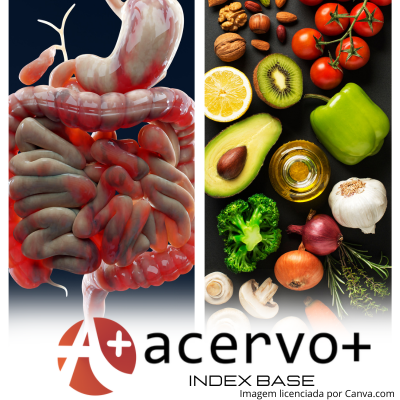
Objetivo: Analizar cómo diferentes patrones alimentarios influyen en las fases de crisis y remisión de la enfermedad de Crohn. Revisión bibliográfica: La enfermedad de Crohn (EC) es una condición inflamatoria crónica que afecta el tracto gastrointestinal, caracterizándose por fases de crisis y remisión. En este sentido, la alimentación juega un papel esencial en el manejo de esta enfermedad, impactando directamente la microbiota intestinal y la respuesta inflamatoria. Durante las crisis, una dieta equilibrada puede ayudar a mitigar los síntomas y evitar el agravamiento de la inflamación, mientras que en la fase de remisión, una alimentación adecuada puede favorecer un ambiente microbiano saludable, reduciendo el riesgo de recaída. Consideraciones finales: La alimentación es un componente fundamental en la gestión de la enfermedad de Crohn. Dietas específicas y bien balanceadas, adaptadas a las necesidades de cada fase, no solo alivian los síntomas durante las crisis, sino que también fortalecen el organismo para prolongar los períodos de remisión. La inclusión de fibras y alimentos antiinflamatorios es una estrategia prometedora para estabilizar la microbiota intestinal y reducir la inflamación, promoviendo una mejor calidad de vida para los pacientes con EC.
Referencias
AVIELLO G, et al.ROS in gastrointestinal inflammation: Rescue or Sabotage? British Journal of Pharmacology, 2017; 174(12): 1704–1718.
BAÊTA OM, et al. Doença de Crohn - uma revisão abrangente sobre a epidemiologia, fisiopatologia e patogênese, fatores de risco, diagnóstico clínico, diagnóstico imagiológico, manifestações extra intestinais, tratamento, nutrição e dieta. Brazilian Journal of Health Review, 2023; 6(4): 17438–17454.
BARBERIO B, et al. Prevalence of symptoms of anxiety and depression in patients with inflammatory bowel disease: a systematic review and meta-analysis. The Lancet Gastroenterology & Hepatology, 2021; 6(5): 359-370.
BASSON A, et al.Nutrition management in the adult patient with Crohn’s disease. South African J Clin Nutr, 2012; 25(4): 164–72.
CASTRO AM, et al.Parâmetros gerais da Doença de Crohn: fisiopatologia, fatores de desenvolvimento e incidência. JNT Facit Business and Technology Journal, 2023;1:3-18
COSTESCU S, et al. Does Magnesium Provide a Protective Effect in Crohn’s Disease Remission? A Systematic Review of the Literature. Nutrients, 2024; 16(1662).
DANIEL H, et al. The role of diet in the modulation of the gut microbiota. Nature Reviews Gastroenterology & Hepatology, 2019; 16(1): 1-15.
GEDIIB, et al. Grupo de Estudo da Doença Inflamatória Intestinal do Brasil. Atualização em Doenças Inflamatória Intestinais: Conectando a ciência à prática diária, 2019; p.172.
GHOSH S, et al. Dietary interventions in inflammatory bowel disease: A review. Journal of Gastroenterology and Hepatology, 2020; 35(5): 789-797.
GOUVEIA EC e ÁVILA LA. Aspectos emocionais associados a disfunções gastroenterológicas. Psicologia em Estudo, 2010; 15(2): 265-273.
GU P e FEAGINS LA. Diet in the pathogenesis and management of Crohn’s disease. Gastroenterology Clinics of North America, 2022; 51: 319-335.
GUTIERREZ A, et al. Dietary fibers and their role in the modulation of gut microbiota. Nutrients, 2020; 12(5): 1-15.
HENDY P e HART A. A Review of Crohn’s Disease. Eur Med J, 2013; 1: 116–23.
HENRY CJ, et al. Nutrition education and dietary interventions for patients with inflammatory bowel disease. Journal of Crohn's and Colitis, 2021; 15(1): 1-10.
INSFRAN LFL,et al. Contribuição genética para o entendimento da fisiopatologia da doença de Crohn / Genetic contribution to understanding the pathophysiology of Crohn’s disease. Brazilian Journal of Health Review, 2022; 5(2): 6265–6278
KAMMERMEIER J, et al. Management of Crohn’s disease. Arch Dis Child, 2015; 475–80.
MALIK A, et al. Gut microbiota and obesity: a review. Journal of Clinical Gastroenterology, 2018; 52(1): 1-10.
SANDERS ME, et al. Probiotics and prebiotics in intestinal health and disease: from biology to the clinic. Nature Reviews Gastroenterology & Hepatology, 2019; 16(1): 1-15.
SANTOS JE, et al. Manifestações clínicas e dermatológicas da doença de Crohn em pacientes imunossuprimidos, 2023.
SARLO RS, et al.Compreendendo a vivência do paciente portador da doença de Crohn. Acta Paul. Enferm., 2008; 21(4): 629-635.
SZCZUBEŁEK M, et al. Effectiveness of Crohn’s Disease Exclusion Diet for Induction of Remission in Crohn’s Disease Adult Patients. Nutrients, 2021; 13(4112).
VADLAPUDI SS, et al. Dietary interventions in Crohn’s disease: A simple solution to refractory disease. Indian Journal of Gastroenterology, 2024; 43(1): 18-21.
WĘDRYCHOWICZ A, et al. Advances in nutritional therapy in inflammatory bowel diseases: Review. World J Gastroenterol, 2016; 22(3): 1045–66.
YAMAMOTO FJK, et al. Diagnóstico y tratamiento de la enfermedad inflamatoria intestinal: Primer Consenso Latinoamericano de la Pan American Crohn’s and Colitis Organisation. Rev Gastroenterol México, 2016.
ZALTMAN C, et al. As Doenças Inflamatórias Intestinais na Atualidade Brasileira. Office Publicações Científicas Ltda, 2018.
ZHANG JL, et al. The effect of solid food diet therapies on the induction and maintenance of remission in Crohn’s disease: a systematic review. BMC Gastroenterology, 2024; 24(250).