
Keywords
Anti-Inflammatory Agents, Non-steroidal
General Surgery
How to Cite
Copyright © | All rights reserved.
The journal holds the exclusive copyright for the publication of this article under the terms of Brazilian law 9610/98.
Partial reproduction
The use of parts of the texts, figures and questionnaire of the article is free, being mandatory the citation of the authors and journal.
Total reproduction
It is expressly prohibited and must be authorized by the journal.
Abstract
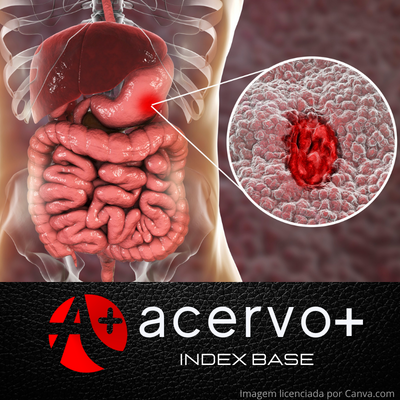
Objective: To describe the correlation between the chronic use of anti-inflammatory drugs and the incidence of peptic ulcer. Bibliographic review: Peptic ulcer is a lesion in the mucosa of the upper digestive tract, which can generate a series of complications, among them, gastrointestinal bleeding, perforation and obstruction. There are numerous causes for the development of this pathology, the most prevalent being the widespread use of anti-inflammatory drugs. These are the most used class of drugs in the world, mainly due to easy access and elderly people with comorbidities. However, in the long term, it is one of the main causative agents of peptic ulcer disease. Thus, prevention plays an important role by identifying the risk factors that can lead to the formation of gastric lesions, since NSAIDs can cause direct topical lesions in the gastrointestinal mucosa. The diagnosis is made through detailed anamnesis and upper digestive endoscopy, while the reference treatment is the use of proton pump inhibitors, in order to promote healing of the ulcer by reducing local acidity. Final considerations: Most peptic ulcers are caused by the chronic use of anti-inflammatory drugs. Therefore, patients should be diagnosed and treated early to avoid complications.
References
ALHAMADI N, et al. Gastrointestinal Complications Associated With Non-Steroidal Anti-Inflammatory Drug Use Among Adults: A Retrospective, Single-Center Study. Cureus, 2022; 14(6): 1-10.
BAIGENT C, et al. Effects of gastroprotectant drugs for the prevention and treatment of peptic ulcer disease and its complications: a meta-analysis of randomised trials. The lancet. Gastroenterology & hepatology, 2018; 3(4): 231–241.
CARVALHO MMCM. Úlcera péptica: Etiopatogenia, diagnóstico, aspetos clínicos e tratamento. Faculdade Ciências da Saúde, Universidade Fernando Pessoa, Porto, 2013.
CHAN FKL, et al. Gastrointestinal Safety of Celecoxib versus Naproxen in Patients with Cardiothrombotic Diseases and Arthritis after Upper Gastrointestinal Bleeding (CONCERN): An Industry-Independent, Double-Blind, Double-Dummy, Randomised Trial. The Lancet, 2017; 389(10087):2375-82.
CHINZON D, et al. Vonoprazan in the management of erosive oesophagitis and peptic ulcer-induced medication: a systematic review. Gastroenterology Review, 2022; 17(3): 183–189.
CORDEIRO H, et al. Atualizações sobre o tratamento cirúrgico da Úlcera péptica. Brazilian Journal of Health Review, 2022; 5(5): 19904-19920.
DRINI M, et al. Peptic ulcer disease and non-steroidal anti-inflammatory drugs. Aust Prescr, 2017; 40(3): 91-93.
GONG Y, et al. Teprenone Improves Gastric Mucosal Injury and Dyspeptic Symptoms in Long-Term Nonsteroidal Anti-Inflammatory Drug Users: The Protective Effects of Teprenone. Journal of Gastroenterology and Hepatology, 2019; 34(8):1344–50.
JOO MK, et al. Helicobacter pylori Eradication in Drug-related Peptic Ulcer. Korean Journal Gastroenterol, 2020; 76(5):227–231.
KAMADA T, et al. Evidence-based clinical practice guidelines for peptic ulcer disease 2020. Journal of Gastroenterology, 2021; 56(4):303-322.
KAVITT RT, et al. Diagnosis and Treatment of Peptic Ulcer Disease. The American Journal of Medicine, 2019; 132(4):447-456.
KAWAI T, et al. Vonoprazan Prevents Low-Dose Aspirin-Associated Ulcer Recurrence: Randomised Phase 3 Study. Gut, 2018; 67(6):1033–41
KOIKE K, et al. Evidence-based clinical practice guidelines for peptic ulcer disease 2020. Journal of gastroenterology, 2021; 56(4), 303–322.
LANAS A, CHAN FKL. Peptic Ulcer Disease. The Lancet, 2017; 390(10094):613–624.
OLIVEIRA MMC, et al. O Uso Crônico De Anti-Inflamatórios Não Esteroidais E Seus Efeitos Adversos. Revista Caderno de Medicina, 2019; 2(2).
PITTAYANON R, et al. Cytoprotective Agent for Peptic Ulcer Prevention in Patients Taking Dual Antiplatelet Agents: A Randomized, Double-blind Placebo-controlled Trial. Journal of Gastroenterology and Hepatology, 2019; 34(9):1517–22.
PODDAR U. Diagnostic and therapeutic approach to upper gastrointestinal bleeding. Paediatrics and International Child Health, 2019; 39(1):18–22.
SHIN SJ, et al. Non-steroidal anti-inflammatory drug-induced enteropathy. Intestinal Research, 2017; 15(4):446-455
SILVA MM, et al. O Uso Crônico De Anti-Inflamatórios Não-Esteroidais E Seus Efeitos Adversos. Cadernos da Medicina - UNIFESO, 2019; 2(2).
TAI FWD e MCALINDON ME. Non-steroidal anti-inflammatory drugs and the gastrointestinal tract. Clinical Medicine, 2021; 21(2): 131-134.
TARASCONI A, et al. Perforated and bleeding peptic ulcer: WSES guidelines. World Journal of Emergency Surgery, 2020; 15(3): 1-24.
TRAORÉ O, et al. The clinical and endoscopic aspects of peptic ulcers secondary to the use of nonsteroidal anti-inflammatory drugs of various origins. Pan African Medical Journal, 2021; 38: 170.
VAKIL NB, FELDMAN M. Peptic ulcer disease: Treatment and secondary prevention. UpToDate, 2022.