
Keywords
Sedentary lifestyle
Pandemic
How to Cite
Copyright © | All rights reserved.
The journal holds the exclusive copyright for the publication of this article under the terms of Brazilian law 9610/98.
Partial reproduction
The use of parts of the texts, figures and questionnaire of the article is free, being mandatory the citation of the authors and journal.
Total reproduction
It is expressly prohibited and must be authorized by the journal.
Abstract
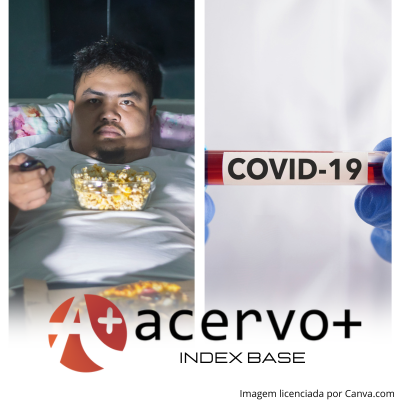
Objective: To verify the impact of the Covid-19 pandemic on people's lifestyles. Methods: This article was written through qualitative bibliographic research, constituting an integrative review. The databases used were the National Library of Medicine (PubMed) and Latin American and Caribbean Literature in Health Sciences (LILACS). The search for articles was performed using the descriptors “Covid-19”, “sedentary lifestyle” and “pandemic” using the Boolean operator “and”. Results: The search resulted in 844 articles. 796 articles were found in PubMed and 48 in LILACS, of which 18 were excluded for straying from the topic. In three selected studies that included family (parents, mothers and children) or a form of encouragement, such as video classes, there was a lower prevalence of sedentary lifestyle. However, most studies have shown that people have become or become more sedentary, either by decreasing physical activity or by increasing the time spent sitting, as well as by increasing screen time. Final considerations: It can be considered that there was an increase in the prevalence of sedentary lifestyle during the pandemic. However, physical activity was greater when it involved family groups or when guided by video classes.
References
ABDON APV, et al. Tempo de uso do smartphone e condições de saúde relacionadas em idosos durante a pandemia da covid-19. Rev bras geriatr gerontol, 2022; 25(6):210194-210207
ARAR FC, et al. Qualidade de vida e saúde mental de estudantes de Medicina na pandemia da Covid-19. Rev bras educ med, 2023; 47(1): 40-49
RODRIGUEZ PAF, et al. Manifestação de sintomas sugestivos de ansiedade e depressão durante a pandemia de covid-19 e associações com a prática de atividades físicas e fatores sociodemográficos no estado do Rio de Janeiro. Pensar a Prática, 2022; 25(1): 38184-38208
BARONE GIBBS B, et al. Covid-19 shelter-at-home and work, lifestyle and well-being in desk workers. Occup Med (Lond), 2021; 71(2):86-94.
BOTERO JP, et al. Impact of the COVID-19 pandemic stay at home order and social isolation on physical activity levels and sedentary behavior in Brazilian adults. Einstein (São Paulo), 2021; 19:1-6.
BRAGA LHR, et al. Fatores associados à piora no estilo de vida durante a pandemia de COVID-19 na população brasileira de lésbicas, gays, bissexuais, transexuais, travestis e identidades relacionadas: estudo transversal. Epidemiol Serv Saúde, 2022; 31(1): 752-766
BRITO LMS, et al. Physical activity, eating habits and sleeo during social isolation: from young adult to elderly. Rev Bras Med Esporte, 2021; 27(1): 21–25.
BROWNE RAV, et al. Initial impact of the COVID-19 pandemic on physical activity and sedentary behavior in hypertensive older adults: An accelerometer-based analysis. Exp Gerontol, 2020; 142: 111121-111130
BRZĘK A, et al. Physical Activity, Screen Time, Sedentary and Sleeping Habits of Polish Preschoolers during the COVID-19 Pandemic and WHO's Recommendations: An Observational Cohort Study. Int J Environ Res Public Health, 2021; 18(21): 11173-11188
CASTRO BM DE, et al. The impact of quarantine on body image and lifestyle habits in resistance training practitioners. Rev Bras Med Esporte, 2021; 27(1): 16–20.
CHEVAL B, et al. Relationships between changes in self-reported physical activity, sedentary behaviour and health during the coronavirus (COVID-19) pandemic in France and Switzerland. J Sports Sci, 2021; 39(6): 699-704
Coronavirus disease 2019 (COVID-19) Situation Report -51 SITUATION IN NUMBERS total and new cases in last 24 hours. DIsponível em: https://apps.who.int/iris/bitstream/handle/10665/331475/nCoVsitrep11Mar2020-eng.pdf . Acessado em 19 de fevereiro de 2025.
CRUZ-AUSEJO L e ROSALES RIMACHE J. Complications associated with remote work during the COVID-19 pandemic: a rapid review. Revista de la Facultad de Medicina Humana, 2022; 22(4): 857–864.
DESCHASAUX-TANGUY M, et al. Diet and physical activity during the coronavirus disease 2019 (COVID-19) lockdown (March-May 2020): results from the French NutriNet-Santé cohort study. Am J Clin Nutr, 2021; 113(4): 924-938.
DING D, et al. Lancet Physical Activity Series 2 Executive Committee. The economic burden of physical inactivity: a global analysis of major noncommunicable diseases. Lancet, 2016; 388(10051): 1311-1324
ESPINOZA-GUTIERREZ GERALDINE A., et al. Hábitos alimentarios y estilos de vida de los estudiantes de medicina a inicios de la pandemia Covid-19. Rev. Fac. Med, 2022; 22(2): 319-326.
Estado do Rio de Janeiro. Decreto nº 46.966, de 13 de março de 2020. Dispõe sobre medidas para enfrentamento da emergência de saúde pública de importância internacional decorrente do coronavírus, e dá outras providências. Diário oficial do estado do Rio de Janeiro. Disponível em: https://leisestaduais.com.br/rj/decreto-n-46966-20202020. Acessado em 19 de fevereiro de 2025.
FALK GE, et al. Effects of Sedentary Behavior Interventions on Mental Well-Being and Work Performance While Working from Home during the COVID-19 Pandemic: A Pilot Randomized Controlled Trial. Int J Environ Res Public Health, 2022; 19(11): 6401-15
FAULKNER J, et al. Physical activity, mental health and well-being of adults during initial COVID-19 containment strategies: A multi-country cross-sectional analysis. J Sci Med Sport, 2021; 24(4): 320-326.
FERNANDEZ DAISY, et al. Hábitos alimentarios y estrés académico en estudiantes universitarios durante la pandemia del COVID-19, Paraguay 2021. Rev. chil. Nutr., 2022; 49(5): 616-624
FERNÁNDEZ-SÁNCHEZ A, et al. Conocimientos, prácticas y estilos de vida durante COVID-19 entre estudiantes universitarios en México: encuesta en línea. Rev enferm neurol, 2021; 20(3): 167–178.
GARCIA MC, et al. Change in the quantity and quality of sleep during the period of the Covid-19 pandemic and association with physical activity and sedentary behavior. Am J Hum Biol, 2022; 8443(1): 53-80.
HADIANFARD AM, et al. Physical activity and sedentary behaviors (screen time and homework) among overweight or obese adolescents: a cross-sectional observational study in Yazd, Iran. BMC Pediatr., 2021; 21(1): 421-431.
HALLMAN DM, et al. Working from home during the COVID-19 outbreak in Sweden: effects on 24-h time-use in office workers. BMC Public Health, 2021; 21(1): 528-538
HASKELL WL, et al. Physical Activity and Public Health: Updated Recommendation for Adults from the American College of Sports Medicine and the American Heart Association. Med. Sci. Sports Exerc., 2007; 39(8): 1423–1434.
HE Z, et al. COVID-19 Pandemic Impact on Cardiometabolic Markers in Adults in Chongqing, China: A Retrospective Cohort Study. Front Public Health, 2022; 10: 859488-859496.
KOVACS VA, et al. Physical activity, screen time and the COVID-19 school closures in Europe - An observational study in 10 countries. Eur J Sport Sci, 2022; 22(7): 1094-1103.
LATOMME J, et al. Effects of a family-based lifestyle intervention on co-physical activity and other health-related outcomes of fathers and their children: the 'Run Daddy Run' intervention. BMC Public Health, 2023; 23(1): 342-357.
LEE IM, et al. Lancet Physical Activity Series Working Group. Effect of physical inactivity on major non-communicable diseases worldwide: an analysis of burden of disease and life expectancy. Lancet, 2012; 380 (9838): 219-229
LEVENTOĞLU E, et al. The effect of COVID-19 restriction on metabolic syndrome in primary hypertension. Pediatr Int, 2022; 64(1): 15144.
MALTA DC, et al. The COVID-19 pandemic and changes in the lifestyles of Brazilian adolescents. Rev Bras Epidemiol, 2021; 24: 210012-210025
MALTA DC, et al. A pandemia da COVID-19 e as mudanças no estilo de vida dos brasileiros adultos: um estudo transversal, 2020. Epidemiol Serv Saúde, 2020; 29(4): 407-420.
MCDONOUGH DJ, et al. Effects of a remote, YouTube-delivered exercise intervention on young adults' physical activity, sedentary behavior, and sleep during the COVID-19 pandemic: Randomized controlled trial. J Sport Health Sci, 2022; 11(2): 145-156.
MENEGUCI J, et al. Comportamento sedentário: conceito, implicações fisiológicas e os procedimentos de avaliação. Motricidade, 2015; 11(1): 160-174.
MUSA S, et al. COVID-19 and screen-based sedentary behaviour: Systematic review of digital screen time and metabolic syndrome in adolescents. PLoS One, 2022; 17(3): 265560-265578
NOWICKA P, et al. Explaining the complex impact of the Covid-19 pandemic on children with overweight and obesity: a comparative ecological analysis of parents' perceptions in three countries. BMC Public Health, 2022; 22(1): 1000-1014
POLO TCF, et al. Impacto da pandemia covid19 no comportamento alimentar e rotina de atividade física, no Brasil: um inquérito baseado na internet. SALUSVITA, 2023; 40(2): 11–24.
PEREIRA AS, et al. Metodologia da pesquisa científica. 1. ed. Santa Maria: Universidade Federal de Santa Maria, Núcleo de Tecnologia Educacional, 2018.
RICHARDSON DL, et al. The influence of COVID-19 measures in the United Kingdom on physical activity levels, perceived physical function and mood in older adults: A survey-based observational study. J Sports Sci, 2021; 39(8): 887-899.
ROMERO-BLANCO C, et al. Physical Activity and Sedentary Lifestyle in University Students: Changes during Confinement Due to the COVID-19 Pandemic. Int J Environ Res Public Health, 2020; 17(18): 6567-6580
RUISSEN MM, et al. Increased stress, weight gain and less exercise in relation to glycemic control in people with type 1 and type 2 diabetes during the COVID-19 pandemic. BMJ Open Diabetes Res Care, 2021; 9(1): 2035-2042
RUÍZ-ROSO MB, et al. Changes of Physical Activity and Ultra-Processed Food Consumption in Adolescents from Different Countries during Covid-19 Pandemic: An Observational Study. Nutrients, 2020; 12(8): 2289-2302
SANTANA WF DE, et al. The decrease in the physical activity levels during the COVID-19 social distancing period. Motriz: rev educ fis, 2022; 28: 10220016521-10220016531.
SILVA DRPD, et al. Changes in the prevalence of physical inactivity and sedentary behavior during COVID-19 pandemic: a survey with 39,693 Brazilian adults. Cad Saude Publica, 2021; 37(3): 221920-221934
SILVA LCB, et al. Sleep, sedentary behavior and physical activity: changes on children’s routine during the COVID-19. Revista Brasileira de Atividade Física & Saúde, 2020; 25:1–9.
SILVA MN, et al. Towards an In-Depth Understanding of Physical Activity and Eating Behaviours during COVID-19 Social Confinement: A Combined Approach from a Portuguese National Survey. Nutrients. 2021; 13(8): 2685-2704
SIQUEIRA E. Tempo de tela aumentou 62% na pandemia, aponta pesquisa do ELSA-Brasil, 2021. Disponível em: http://www.isc.ufba.br/tempo-de-tela-aumentou-62-na-pandemia-aponta-pesquisa-do-elsa-brasil/. Acessado em 25 de maio de 2023.
SONZA A, et al. Brazil before and during COVID-19 pandemic: Impact on the practice and habits of physical exercise. Acta Biomed, 2020; 92(1): 27-37.
SOTAQUIRÁ L, et al. Social Capital and Lifestyle Impacts on Mental Health in University Students in Colombia: An Observational Study. Front Public Health, 2022; 10: 840292-840306.
WILKE J, et al. Train at home, but not alone: a randomised controlled multicentre trial assessing the effects of live-streamed tele-exercise during COVID-19-related lockdowns. Br J Sports Med, 2022; 56(12): 667-675.
YAMADA Y, et al. Regional Difference in the Impact of COVID-19 Pandemic on Domain-Specific Physical Activity, Sedentary Behavior, Sleeping Time, and Step Count: Web-Based Cross-sectional Nationwide Survey and Accelerometer-Based Observational Study. JMIR Public Health Surveill, 2023; 9: 39992-40015.