
Palabras clave
Función cognitiva
Eje cerebro-intestino
Cómo citar
Copyright © | Todos los derechos reservados.
La revista posee los derechos de autor exclusivos para la publicación de este artículo en los términos de la ley brasileña 9610/98.
Reproducción parcial
El uso de partes de los textos, figuras y cuestionario del artículo es libre, siendo obligatoria la citación de los autores y revista.
Reproducción total
Está expresamente prohibido y debe ser autorizado por la revista.
Resumen
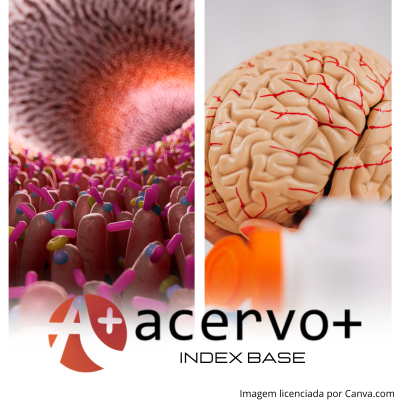
Objetivo: Identificar situaciones y patologías que afectan la interacción de la microbiota intestinal y la función cognitiva y así responder si existen formas viables de beneficiar esta relación, os métodos para prevenir resultados futuros de dichas enfermedades. Métodos: Se realizó una búsqueda sistemática en el Portal Regional de las bases de datos de la Biblioteca Virtual en Salud (BVS) y de la Biblioteca Nacional de Medicina (PubMed), realizada entre los años 2019 y 2024, cuyos descriptores fueron “Funciones Cognitivas”; “microbioma intestinal”, utilizando el operador booleano “Y”. Resultados: La muestra final estuvo conformada por 25 artículos, la mayoría de los cuales mostraron resultados positivos de alimentos utilizados con el propósito de actuar sobre el microbioma intestinal con un resultado aceptable en la función cognitiva, además de cambios en el estilo de vida en pacientes con patologías que comprometen el sistema cognitivo. system., también fue posible resaltar enfermedades que se desarrollaron con deterioro cognitivo y el consiguiente daño a la composición de la microbiota intestinal. Consideraciones finales: En los estudios abordados las patologías mostraron relación con cambios intestinales, ya sea en la permeabilidad o en la cantidad y especies que componen la microbiota y también se pudo determinar tipos de alimentos/probióticos, procedimientos y práctica de ejercicios físicos. actividad como factores viables para la interacción del eje intestino-cerebro.
Referencias
BAJAJ JS, et al. Microbial functional change is linked with clinical outcomes after capsular fecal transplant in cirrhosis. JCI insight, 2019; 4(24): 133410.
BELL L, et al. A randomized, placebo-controlled trial investigating the acute and chronic benefits of American Ginseng (Cereboost®) on mood and cognition in healthy young adults, including in vitro investigation of gut microbiota changes as a possible mechanism of action. European journal of nutrition, 2022; 61(1): 413-428.
DALILE B, et al. Colon-delivered short-chain fatty acids attenuate the cortisol response to psychosocial stress in healthy men: a randomized, placebo-controlled trial. Neuropsychopharmacology: official publication of the American College of Neuropsychopharmacology, 2020; 45(13): 2257-2266.
ENAUD R, et al. Gut Microbiota and Mycobiota Evolution Is Linked to Memory Improvement after Bariatric Surgery in Obese Patients: A Pilot Study. Nutrients, 2021; 13(11): 4061.
FEI Y, et al. Probiotic intervention benefits multiple neural behaviors in older adults with mild cognitive impairment. Geriatric nursing, 2023; 51: 167-175.
GAO W, et al. Gut microbiome and brain functional connectivity in infants-a preliminary study focusing on the amygdala. Psychopharmacology, 2019; 236(5): 1641–1651.
GHOSH TS et al. Mediterranean diet intervention alters the gut microbiome in older people reducing frailty and improving health status: the NU-AGE 1-year dietary intervention across five European countries. Gut, 2020; 69(7): 1218–1228.
GURIAN MBF, et al. Rastreamento da função cognitiva de idosos não-institucionalizados. Revista brasileira de geriatria e gerontologia, 2012; 15(2).
HASKELL-RAMSAY CF, et al. Mixed Tree Nuts, Cognition, and Gut Microbiota: A 4-Week, Placebo-Controlled, Randomized Crossover Trial in Healthy Nonelderly Adults. The Journal of nutrition, 2022; 152(12): 2778-2788.
HWANG YH, et al. Efficacy and Safety of Lactobacillus Plantarum C29-Fermented Soybean (DW2009) in Individuals with Mild Cognitive Impairment: A 12-Week, Multi-Center, Randomized, Double-Blind, Placebo-Controlled Clinical Trial. Nutrients, 2019; 11(2): 305.
KHINE WWT, et al. Mental awareness improved mild cognitive impairment and modulated gut microbiome. Aging, 2020; 12(23): 24371–24393.
KIM C-S, et al. Probiotic Supplementation Improves Cognitive Function and Mood with Changes in Gut Microbiota in Community-Dwelling Older Adults: A Randomized, Double-Blind, Placebo-Controlled, Multicenter Trial. The journals of gerontology. Series A, Biological sciences and medical sciences, 2021; 76(1): 32–40.
KONG XJ, et al. Probiotic and Oxytocin Combination Therapy in Patients with Autism Spectrum Disorder: A Randomized, Double-Blinded, Placebo-Controlled Pilot Trial. Nutrients, 2021; 13(5): 1552.
LEYROLLE Q, et al. Prebiotic effect on mood in obese patients is determined by the initial gut microbiota composition: A randomized, controlled trial. Brain, behavior, and immunity, 2021; 94: 289-298.
LI Y-M, et al. Correlations Between Gut Microbiota Changes and Cognitive Function in Patients with Post-Stroke Cognitive Impairment in the Early Stage. Sichuan Da Xue Xue Bao Yi Xue Ban, 2022; 53(5): 857-865.
LIANG X, et al. Gut microbiome, cognitive function and brain structure: a multi-omics integration analysis. Transl Neurodegener, 2022; 11: 49.
LIU P, et al. Altered microbiomes distinguish Alzheimer’s disease from amnestic mild cognitive impairment and health in a Chinese cohort. Brain, Behavior, and Immunity, 2019; 80: 633-643.
MEDAWAR E, et al. Prebiotic diet changes neural correlates of food decision-making in overweight adults: a randomised controlled within-subject cross-over trial. Gut, 2024; 73(2): 298-310.
MEYER K, et al. Association of the Gut Microbiota With Cognitive Function in Midlife. JAMA Netw Open, 2022; 5(2): 2143941.
PEREIRA AS et al. Metodologia da pesquisa científica. 2018.
REININGHAUS EZ, et al. PROVIT: Supplementary Probiotic Treatment and Vitamin B7 in Depression-A Randomized Controlled Trial. Nutrients, 2020; 12(11): 3422.
REITER A, et al. Interleukin-6 Gene Expression Changes after a 4-Week Intake of a Multispecies Probiotic in Major Depressive Disorder-Preliminary Results of the PROVIT Study. Nutrients, 2020; 12(9): 2575.
SOMETTI D, et al. Effects of the antibiotic rifaximin on cortical functional connectivity are mediated through insular cortex. Scientific reports, 2021; 11: 4479.
SOUZA SC. Revisão integrativa: o que é e como fazer. Einstein, 2010; 8(1): 102-6.
VAN SOEST APM, et al. Associations between Pro- and Anti-Inflammatory Gastro-Intestinal Microbiota, Diet, and Cognitive Functioning in Dutch Healthy Older Adults: The NU-AGE Study. Nutrients, 2020; 12(11): 3471.
WATTANATHOMN J, et al. A Randomized, Double-Blind, Placebo-Controlled Study of an Anthocyanin-Rich Functional Ingredient on Cognitive Function and Eye Dryness in Late Adulthood Volunteers: Roles of Epigenetic and Gut Microbiome Modulations. Nutrients 2023; 15(16): 3499.
YANG Y, et al. Altered fecal microbiota composition in individuals who abuse methamphetamine. Scientific reports, 2021; 11(1): 18178.
ZHU Y, et al. The impact of aerobic exercise training on cognitive function and gut microbiota in methamphetamine-dependent individuals in the community. Physiol Behav, 2023; 270: 114302.
ZORZO RA. Impacto do microbioma intestinal no Eixo Cérebro-Intestino. Jornal Internacional de Nutrologia, 2022; 10 (1): 298–305.