
Keywords
Sleep deprivation
Musculoskeletal injuries
Athletes
How to Cite
Copyright © | All rights reserved.
The journal holds the exclusive copyright for the publication of this article under the terms of Brazilian law 9610/98.
Partial reproduction
The use of parts of the texts, figures and questionnaire of the article is free, being mandatory the citation of the authors and journal.
Total reproduction
It is expressly prohibited and must be authorized by the journal.
Abstract
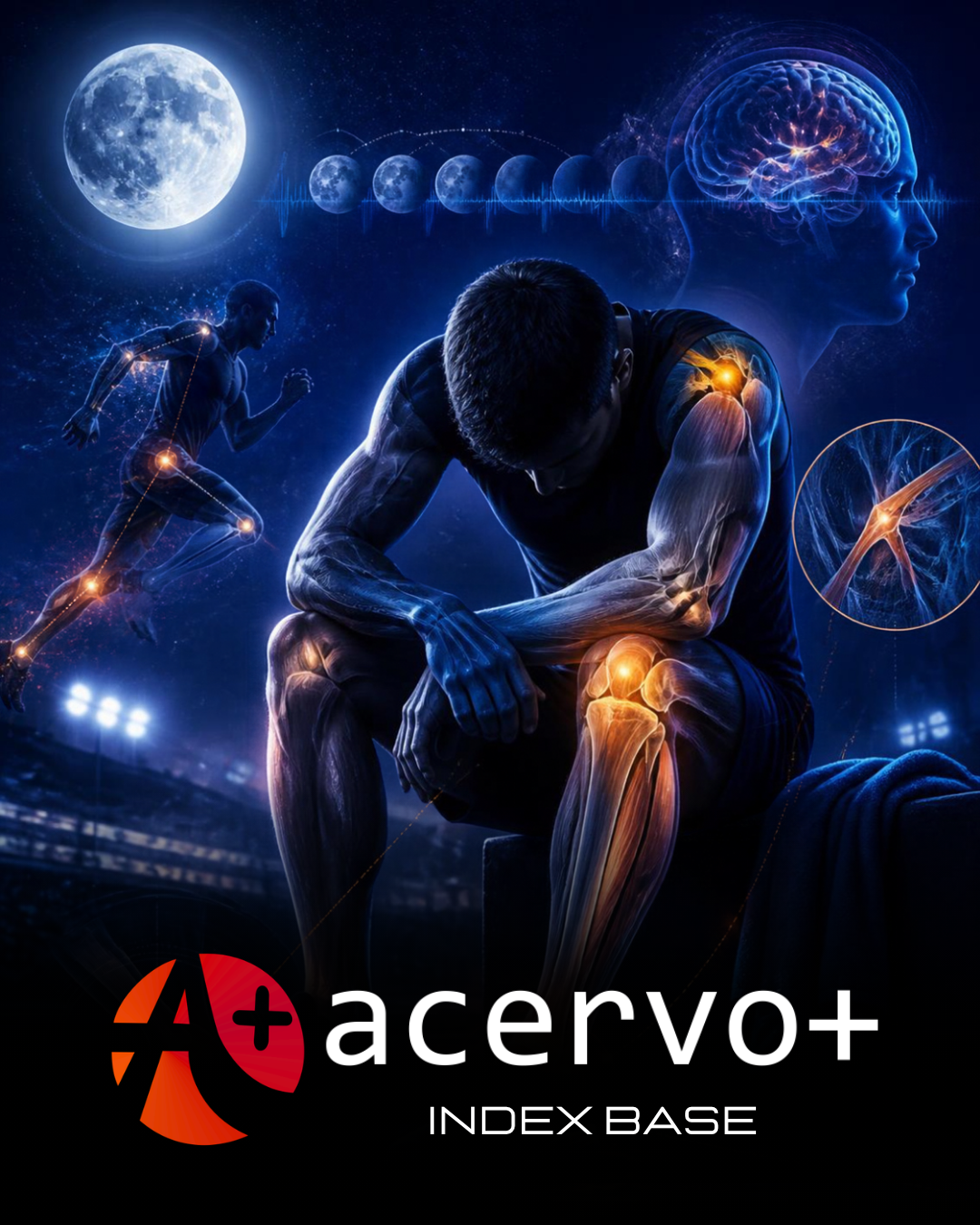
Objective: To analyze the association between sleep deprivation and the risk of musculoskeletal injuries in athletes, considering the physiological, hormonal, cognitive, and neuromuscular mechanisms involved. Literature review: Sleep plays an essential role in metabolic recovery, tissue repair, and hormonal regulation. Sleep deprivation is associated with reduced growth hormone secretion, increased cortisol levels, and impairment of anabolic processes responsible for muscle recovery. In addition, alterations in sleep architecture negatively affect cognitive and neuromuscular functions, including motor coordination, reaction time, and motor control, increasing the risk of sports-related injuries. Among athletes, the combination of high training loads and inadequate recovery contributes to chronic neuromuscular fatigue and a higher incidence of overuse injuries. Final considerations: Insufficient sleep is an important risk factor associated with musculoskeletal injuries in athletes, making the implementation of strategies aimed at improving sleep quality and duration essential for injury prevention and optimal athletic performance.
References
ADAN A, et al. Circadian typology: a comprehensive review. Chronobiology International. 2012; 29(9):1153-1175.
CLEMENTE FM, et al. Relationships between sleep, athletic and match performance, training load, and injuries: a systematic review of soccer players. Healthcare. 2021; 9(7):808.
DATILLO M, ANTUNES HKM, MEDEIROS A, MÔNICO NETO M, SOUZA HS, TUFIK S, et al. Sleep and muscle recovery: endocrinological and molecular basis for a new and promising hypothesis. Medical Hypotheses. 2011; 77(2):220-222.
FINK AM, et al. Circadian rhythm and sleep disturbances in young adult athletes: a review about risk factors, consequences, and interventions. Brain Sciences. 2026; 16(2):212.
FULLAGAR HHK, SKORSKI S, DUFFIELD R, HAMMES D, COUTTS AJ, MEYER T. Sleep and athletic performance: the effects of sleep loss on exercise performance, and physiological and cognitive responses to exercise. Sports Medicine. 2015; 45(2):161-186.
GONG M, et al. Sleep deprivation and its effects on cognitive and physical performance in athletes: implications for injury risk. Sports Medicine. 2024; 54(1):45-58.
HAMLIN MJ. The effect of sleep quality and quantity on athlete’s health and perceived training quality. Frontiers in Sports and Active Living. 2021; 3:705650.
HAMLIN MJ, et al. Sleep, fatigue, and recovery in athletic performance: interactions with training load. International Journal of Sports Physiology and Performance. 2021; 16(4):567-574.
HARALDSDOTTIR K, et al. Decreased sleep and subjective well-being as independent predictors of injury in female collegiate volleyball players. Orthopaedic Journal of Sports Medicine. 2021; 9:23259671211029285.
HATIA M, et al. A narrative review of the impact of sleep on athletes: sleep restriction causes and consequences, monitoring, and interventions. Cureus. 2024; 16:e76635.
KILLGORE WDS. Effects of sleep deprivation on cognition. Progress in Brain Research. 2010; 185:105-129.
KIM TW, et al. The impact of sleep and circadian disturbance on hormones and metabolism. International Journal of Endocrinology. 2015; 2015:1-10.
LEPROULT R, et al. Role of sleep and sleep loss in hormonal release and metabolism. Endocrine Development. 2010; 17:11-21.
MASON L, et al. Sleep restriction impairs muscle recovery and anabolic signaling in athletes. European Journal of Sport Science. 2023; 23(5):789-798.
MASON L, et al. Sleep, nutrition, and injury risk in adolescent athletes: a narrative review. Nutrients. 2024; 15:5101.
MILEWSKI MD, et al. Chronic lack of sleep is associated with increased sports injuries in adolescent athletes. Journal of Pediatric Orthopaedics. 2014; 34(2):129-133.
RIEGLER KE, et al. Sleep as a predictor of injury risk in athletes: a systematic review. British Journal of Sports Medicine. 2023; 57(9):542-548.
ROENNEBERG T, ALLEBRANDT KV, MERROW M, VETTER C. Social jetlag and obesity. Current Biology. 2012; 22(10):939-943.
SIMPSON NS, et al. Optimizing sleep to maximize performance: implications and recommendations for elite athletes. Scandinavian Journal of Medicine & Science in Sports. 2017; 27(3):266-274.
VAN CAUTER E, LEPROULT R, KUPFER DJ. Effects of gender and age on the levels and circadian rhythmicity of plasma cortisol. Journal of Clinical Endocrinology & Metabolism. 2000; 81(7):2468-2473.
VIEGAS F, et al. The sleep as a predictor of musculoskeletal injuries in adolescent athletes. Nutrients. 2022; 14:4012.
VITALE JA, BONATO M, GALASSO L, LA TORRE A, MERATI G, MONTARULI A, et al. Sleep quality and high intensity interval training at two different times of day: a crossover study on the influence of the chronotype in male collegiate soccer players. Chronobiology International. 2019; 36(2):260-268.
VON ROSEN P, et al. Poor sleep quality is associated with injuries among adolescent athletes. Scandinavian Journal of Medicine & Science in Sports. 2017; 27(11):1365-1371.
WALKER MP. Why we sleep: unlocking the power of sleep and dreams. New York: Scribner; 2017.
WALSH NP, et al. Sleep and the athlete: narrative review and 2021 expert consensus recommendations. British Journal of Sports Medicine. 2021; 55(7):356-368.
WATSON AM. Sleep and athletic performance. Current Sports Medicine Reports. 2017; 16(6):413-418.
WATSON NF, et al. Recommended amount of sleep for a healthy adult: a joint consensus statement of the American Academy of Sleep Medicine and Sleep Research Society. Sleep. 2015; 38(6):843-844.