
Palavras-chave
Eletrocardiograma
Sistemas inteligentes
Máquinas de aprendizagem extrema
Como Citar
Copyright © | Todos os direitos reservados.
A revista detém os direitos autorais exclusivos de publicação deste artigo nos termos da lei 9610/98.
Reprodução parcial
É livre o uso de partes do texto, figuras e questionário do artigo, sendo obrigatória a citação dos autores e revista.
Reprodução total
É expressamente proibida, devendo ser autorizada pela revista.
Resumo
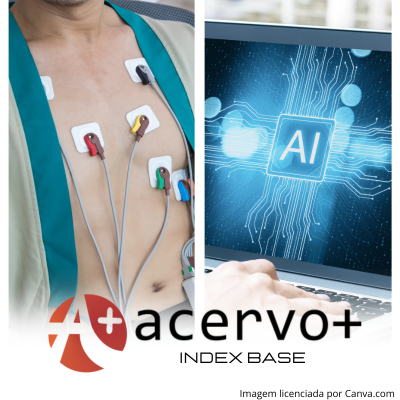
Objetivo: Analisar, com base em publicações recentes (2015–2025), a eficácia da Inteligência Artificial (IA) na interpretação de eletrocardiogramas (ECGs) para fins diagnósticos. Revisão bibliográfica: Os estudos analisados demonstram que a IA pode transformar o ECG em uma ferramenta poderosa para triagem e predição, ao identificar padrões subclínicos que muitas vezes não são detectados por métodos convencionais. A incorporação de algoritmos de aprendizado de máquina e redes neurais profundas tem aumentado significativamente a precisão e a agilidade na detecção de anormalidades cardíacas. Destaca se, ainda, a importância da alfabetização em inteligência artificial (IA) e machine learning (ML) por parte dos profissionais de saúde, visando sua implementação clínica segura e eficaz. Em muitos contextos, os modelos baseados em IA apresentaram desempenho comparável ou superior ao de especialistas humanos, ampliando a aplicabilidade do ECG em ambientes clínicos diversos. Considerações finais: Embora desafios como validação externa, privacidade de dados e interpretabilidade dos algoritmos ainda persistam, o uso da IA na análise de ECGs mostra grande potencial para melhorar o diagnóstico precoce, a estratificação de risco e a tomada de decisão em cardiologia preventiva.
Referências
ABDAR M, et al. A survey of uncertainty in deep neural networks: techniques, applications and challenges. Artificial Intelligence Review, [S.l.]: Springer, 2023.
AKBILGIC O, et al. ECG-AI: electrocardiographic artificial intelligence model for prediction of heart failure. European Heart Journal – Digital Health, 2021; 2(4): 576–585.
ANSARI Y, et al. Deep learning for ECG arrhythmia detection and classification: an overview of progress for period 2017–2023. Frontiers in Physiology, Lausanne, 2023; 14: 1246746.
ATTIA ZI, et al. Application of artificial intelligence to the electrocardiogram. European Heart Journal, 2021; 42(46): 4717–4730.
ATTIA ZI, et al. Artificial intelligence–enhanced electrocardiography in cardiovascular disease management. Nature Reviews Cardiology, 2020; 17(6): 348–358.
ATTIA ZI e FRIEDMAN PA. Explainable AI for ECG-based prediction of cardiac resynchronization therapy outcomes: learning from machine learning? European Heart Journal, 2023; 44(8): 693–695.
BALADRÓN C, et al. Big data and new information technology: what cardiologists need to know. Revista Española de Cardiología, 2021; 74(1): 81–89.
BOERSMA LVA, et al. Personalized monitoring of electrical remodelling during atrial fibrillation progression via remote transmissions from implantable devices. Europace, 2020; 22(12): 1762–1770.
BREEN CJ, et al. ECG interpretation skill acquisition: A review of learning, teaching and assessment. Journal of Electrocardiology, 2022; 73: 125–128.
BROWNLEE J. Parametric and nonparametric machine learning algorithms. Machine Learning Mastery.com, 2020.
BUTLER L, et al. A generalizable electrocardiogram-based artificial intelligence model for 10-year heart failure risk prediction. Cardiovascular Digital Health Journal, 2023; 4(3): 183–190.
CHITUMBA HO, RAFAEL, EJM. Inteligência Artificial no campo da saúde: desafios e oportunidades. Revista Angolana de Ciências da Saúde, 2022; 3(2): 1–3.
CHRISTOPOULOS G, et al. Artificial intelligence–electrocardiography to predict incident atrial fibrillation: a population-based study. Circulation: Arrhythmia and Electrophysiology, 2020; 13(12): e009355.
CHO J, et al. Artificial Intelligence Algorithm for Screening Heart Failure with Reduced Ejection Fraction Using Electrocardiography. ASAIO Journal, 2020; 67: 314–321.
COOK DA, et al. Accuracy of physicians’ electrocardiogram interpretations: a systematic review and meta-analysis. JAMA Internal Medicine, 2020; 180(11): 1558–1566.
GROGAN M, et al. Artificial Intelligence–Enhanced Electrocardiogram for the Early Detection of Cardiac Amyloidosis. Mayo Clinic Proceedings, 2021; 96: 2768–2778.
HAN L, et al. Atrial Fibrillation Burden Signature and Near-Term Prediction of Stroke: A Machine Learning Analysis. Circ Cardiovasc Qual Outcomes, 2019; 12(10): e005595.
IGNATOV A, et al. AI Benchmark: Running deep neural networks on Android smartphones. arXiv preprint arXiv, 2018; 1810.01109.
KASHOU AH, et al. Artificial Intelligence-Enabled ECG: a Modern Lens on an Old Technology. Current Cardiology Reports, 2020; 22(8): 57.
KHUNTE A, et al. Detection of left ventricular systolic dysfunction from single-lead electrocardiography adapted for portable and wearable devices. NPJ Digital Medicine, 2023; 6: 124.
KO WY, et al. Detection of Hypertrophic Cardiomyopathy Using a Convolutional Neural Network-Enabled Electrocardiogram. Journal of the American College of Cardiology, 2020; 75(7): 722–733.
KOSARAJU E e SHANMUGANATHAN PP, Predicting Pulmonary Hypertension by Electrocardiograms Using Machine Learning. arXiv preprint, 2023.
KWON JM, et al. Comparing the performance of artificial intelligence and conventional diagnosis criteria for detecting left ventricular hypertrophy using electrocardiography. Europace, 2020; 22(3): 412–419.
LANUTI SM, et al. Inteligência artificial para interpretação de eletrocardiograma no diagnóstico de infarto do miocárdio. Brazilian Journal of Health Review, 2024; 7(2): e69305.
LEE J, et al. Detecting structural heart disease from electrocardiograms using AI. Nature, 2025.
LIN C, et al. Point-of-care artificial intelligence-enabled ECG for dyskalemia: a retrospective cohort analysis for accuracy and outcome prediction. NPJ Digital Medicine, 2022; 5: 8.
LIU CW, et al. Left ventricular hypertrophy detection using electrocardiographic signal. Scientific Reports, 2023; 13: 2556.
MARTÍNEZ-SELLÉS M e MARINA-BREYSSE, M. Current and Future Use of Artificial Intelligence in Electrocardiography. Journal of Cardiovascular Development and Disease, 2023; 10(4): 175.
MUZAMMIL MA, et al. Artificial intelligence-enhanced electrocardiography for accurate diagnosis and management of cardiovascular diseases. Journal of Electrocardiology, 2024; 83: 30–40.
NARAYANAN HN, et al. Deep learning–based fusion of electrocardiogram and echocardiogram for improved prediction of left ventricular hypertrophy. NPJ Digital Medicine, 2023; 6(1): 22.
NOSEWORTHY PA, et al. Artificial intelligence–enabled ECG to identify silent atrial fibrillation in high-risk patients: the Mayo Clinic experience. Circulation: Arrhyth Electrophysiology, 2020; 13(3): e008658.
PAIXÃO GMM, et al. Introdução ao aprendizado de máquina: princípios e aplicações. Revista Científica Multidisciplinar Núcleo do Conhecimento, 2022; 2(5): 1–8.
RIBEIRO ALP, et al. An ensemble deep learning algorithm for structural heart disease screening using electrocardiographic images: PRESENT SHD. Journal of the American College of Cardiology, 2025; 85(12): 1302–1313.
ROJEK B, et al. Development of AI-Based Prediction of Heart Attack Risk as an Element of Preventive Medicine. Electronics, 2024; 13(2): 272.
SIONTIS KC, et al. Artificial intelligence enhanced electrocardiography in cardiovascular disease management. Nature Reviews Cardiology, 2021; 18(7): 465–478.
SOMANI R, et al. A systematic review: Effectiveness of interventions to de escalate workplace violence against nurses in healthcare settings. Safety and Health at Work, 2021; 12(3): 289–295.
THAO V, et al. Cost-Effectiveness of Artificial Intelligence-Enabled Electrocardiograms for Early Detection of Low Ejection Fraction. Mayo Clinic Proceedings: Digital Health, 2024; 2(4): 620–631.
TORRES F, et al. Inteligência artificial aplicada à cardiologia: avanços recentes. Arquivos Brasileiros de Cardiologia, 2024; 123(5): 450–460.
TSENG AS, et al. Cost effectiveness of an electrocardiographic deep learning algorithm to detect asymptomatic left ventricular dysfunction. Mayo Clinic Proceedings, 2021; 96(8): 2112–2123.
WU Z e GUO C. Deep learning and electrocardiography: systematic review of current techniques in cardiovascular disease diagnosis and management. BioMedical Engineering OnLine, 2025; 24.