
Keywords
Spinal cord diseases
Spinal cord injuries
Graduate nursing education
How to Cite
Copyright © | All rights reserved.
The journal holds the exclusive copyright for the publication of this article under the terms of Brazilian law 9610/98.
Partial reproduction
The use of parts of the texts, figures and questionnaire of the article is free, being mandatory the citation of the authors and journal.
Total reproduction
It is expressly prohibited and must be authorized by the journal.
Abstract
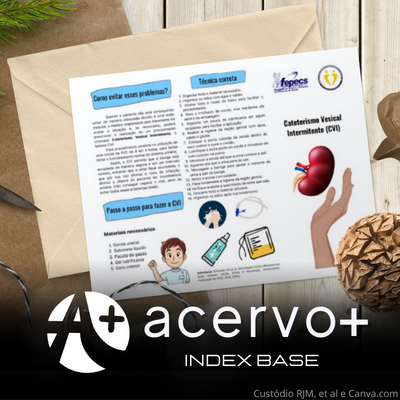
Objective: To describe the elaboration of an educational folder about intermittent urethral catheterization for patients with neurogenic bladder after spinal cord injury. Experience report: Descriptive and qualitative study, an experience report based on the experiences of six nursing residents in a rehabilitation reference hospital in Brasília, Distrito Federal. The study was conducted based on the Problematization Methodology using the Maguerez Arch. The final product of the intervention consisted of the elaboration of an educational folder and a moment of health education at the bedside with the patients and their respective companions. Final considerations: The adaptation to the new reality after a spinal cord injury is full of challenges, since this condition can affect different domains of the lives of the affected individuals and their families. The development of educational materials such as the folder discussed in this study has the potential to alleviate some of these difficulties and improve the patients’ quality of life.
References
ANJUM A, et al. Spinal Cord Injury: Pathophysiology, Multimolecular Interactions, and Underlying Recovery Mechanisms. Int J Mol Sci, 2020; 21 (20):7533.
BENÍCIO CDAV, et al. Fatores associados ao conhecimento de pacientes e cuidadores acerca do cateterismo vesical intermitente limpo: revisão integrativa. Rev Esc Enferm USP, 2018; 52: e03362.
BERBEL NAN. A utilização da Metodologia da Problematização com o Arco de Maguerez no Cuidar em Saúde. Cap. 5. In: FRANÇA FCV, et al. (org.). O processo de ensino e aprendizagem de profissionais de saúde: A Metodologia da Problematização por meio do Arco de Maguerez. Volume Brasília: Universidade de Brasília, Faculdade de Ciências da Saúde, 2016; 266p.
BRASIL. Ministério da Saúde. Secretaria de Atenção à Saúde. Departamento de Ações Programáticas Estratégicas. Diretrizes de Atenção à Pessoa com Lesão Medular. 2ª ed. Brasília, Ministério da Saúde. 2015. 68 p.
BRASIL. Ministério da Saúde. Secretaria de Ciência, Tecnologia, Inovação e Insumos Estratégicos. Cateter hidrofílico para cateterismo vesical intermitente em indivíduos com lesão medular e bexiga neurogênica. Comissão Nacional de Incorporação de Tecnologias no SUS (CONITEC). Relatório de recomendação N° 459. 2019.
CEREZETTI CRN, et al. Lesão Medular Traumática e estratégias de enfrentamento: revisão crítica. O Mundo da Saúde, 2012; 36 (2): 318-326.
CONTI A, et al. A. Barriers and facilitators of education provided during rehabilitation of people with spinal cord injuries: A qualitative description. PLoS One, 2020; 15 (10): e0240600.
FREITAS FV, REZENDE FILHO LA. Modelos de comunicação e uso de impressos na educação em saúde: uma pesquisa bibliográfica. Interface - Comunicação, Saúde, Educação, 2010; 15 (36): 243-256.
FUMINCELLI L, et al. Quality of life of patients using intermittent urinary catheterization. Rev Lat Am Enfermagem, 2017; 10 (25): e2906.
GARCIA DO, et al. Tratamentos fisioterapêuticos para bexiga neurogênica: uma revisão da literatura. Research, Society And Development, 2021; 10 (16): 1-11.
HENTZEN C, et al. Intermittent Self-catheterization in Older Adults: Predictors of Success for Technique Learning. Int Neurourol J, 2018; 22 (1): 65-71.
KHANJARI S, et al. The effect of family-centered education on the quality of life of adolescents with spinal cord injuries. J Family Med Prim Care, 2019; 8 (2): 711-716.
LOPES MAL, LIMA EDRP. Continuidade do cateterismo vesical intermitente: pode o suporte social contribuir? Rev. Latino-Am. Enfermagem, 2014; 22 (2): 461-6.
LUCAS E. Medical Management of Neurogenic Bladder for Children and Adults: A Review. Top Spinal Cord Inj Rehabil, 2019; 25 (3): 195-204.
ORLANDIN L, et al. Dificuldades de pacientes e cuidadores na realização do cateterismo intermitente limpo: revisão de escopo. ESTIMA, Braz. J. Enterostomal Ther, 2020; 18: e1520.
SCHOELLER SD, et al. Abordagem multiprofissional em lesão medular: saúde, direito e tecnologia. Instituto Federal de Educação, Ciência e Tecnologia de Santa Catarina (IFSC). Florianópolis: publicação do IFSC, 2016; 304 p.
TRUZZI JC, et al. Neurogenic bladder - concepts and treatment recommendations. Int Braz J Urol, 2022; 48 (2): 220-243.
VIDEIRA LGN. Reabilitação da bexiga neurogênica: métodos de manejo, complicações urológicas, estilo de vida e satisfação pessoal em pessoas com lesão medular. Dissertação (Mestrado em Enfermagem Fundamental) - Escola de Enfermagem de Ribeirão Preto. Universidade de São Paulo, Ribeirão Preto, 2022; 104p.
VIEIRA CENK, et al. Autocuidado para bexiga neurogênica em pessoas com lesão medular: Revisão integrativa. Rev enferm UFPE online, 2014; 8(1):128-36.
WALTER M, et al. Prevalence of self-reported complications associated with intermittent catheterization in wheelchair athletes with spinal cord injury. Spinal Cord, 2021; 59(9): 1018-1025.