
Keywords
Anxiety
Primary Health Care
COVID-19
How to Cite
Copyright © | All rights reserved.
The journal holds the exclusive copyright for the publication of this article under the terms of Brazilian law 9610/98.
Partial reproduction
The use of parts of the texts, figures and questionnaire of the article is free, being mandatory the citation of the authors and journal.
Total reproduction
It is expressly prohibited and must be authorized by the journal.
Abstract
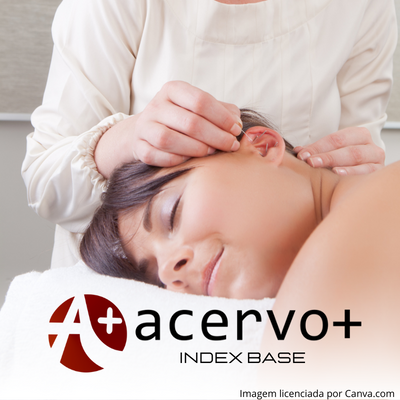
Objective: To evaluate the effectiveness of auricular acupuncture as a complementary therapy for depression, anxiety and stress in professionals of a Primary Health Care during the COVID-19 pandemic. Methods: A quasi-experimental study with a sample of 29 professionals identified with a moderate or higher level of anxiety. To map the levels of depression, anxiety and stress before and after the intervention, the Depression, Anxiety and Stress Scale (DASS-21) and the salivary cortisol biomarker were used. A weekly auricular acupuncture protocol was used at the Shenmen, Kidney, Sympathetic Nervous System, Heart, Brainstem, Liver Yang 1 and 2, Lung and Spleen points. Data were analyzed using descriptive and inferential statistics, considering a significance level of 5%. Results: It was found that auricular acupuncture reduced the levels of depression (p=0.000), anxiety (p=0.000) and stress (p=0.000) of professionals, evidencing its effectiveness as a complementary therapy for these mental disorders. Cortisol levels in the morning (p=0.011) and night (p=0.010) showed a slight increase after the intervention. Conclusion: Auricular acupuncture can be an ally in mental health care, but more studies are needed that cover this practice and the salivary cortisol biomarker.
References
ABUYE NO e SÁNCHEZ-PÉREZ I. Efectividad de la acupuntura y la auriculoterapia para reducir el nivel de depresión, ansiedad y estrés en personal sanitario de urgencias durante la pandemia de COVID-19. Revista Internacional de Acupuntura, 2021; 15(2): 43-50.
APÓSTOLO JLA, et al. Adaptação para a língua portuguesa da Depression, Anxiety and Stress Scale (DASS). Revista Latino-Americana de Enfermagem, 2006; 14(6).
ARAGONÈS E, et al. Psychological impact of the COVID-19 pandemic on primary care workers: a cross-sectional study. British Journal of General Practice, 2022; 72(720): e501-e510.
ARAÚJO JS, Domingos TS, Braga EM. Auriculoterapia para o estresse da equipe de enfermagem na média complexidade hospitalar. Revista de Enfermagem UFPE online, 2018; 12(2): 371-8.
BEZERRA GD, et al. O impacto da pandemia por COVID-19 na saúde mental dos profissionais da saúde: revisão integrativa. Revista Enfermagem Atual, 2020; Edição Especial COVID-19: e-020012.
BORTOLOTTO I, et al. DNA damage, salivary cortisol levels, and cognitive parameters in a nursing team. Mutation Research/Genetic Toxicology and Environmental Mutagenesis, 2021; 861-862: 503300.
BRASIL. Ministério da Saúde. Portaria nº 2.436, de 21 de setembro de 2017. Aprova a Política Nacional de Atenção Básica, estabelecendo a revisão de diretrizes para a organização da Atenção Básica, no âmbito do Sistema Único de Saúde (SUS). Brasília: Ministério da Saúde, 2017. Disponível em: https://bvsms.saude.gov.br/bvs/saudelegis/gm/2017/prt2436_22_09_2017.html Acessado em: 5 de setembro de 2022.
BRASIL. Ministério da Saúde. Secretaria de Atenção à Saúde. Departamento de Atenção Básica. Política Nacional de Práticas Integrativas e Complementares no SUS - PNPIC-SUS / Ministério da Saúde, Secretaria de Atenção à Saúde, Departamento de Atenção Básica. - Brasília: Ministério da Saúde, 2006. Disponível em: https://bvsms.saude.gov.br/bvs/publicacoes/pnpic.pdf. Acessado em: 5 de setembro de 2022.
CORDIOLI DFC, et al. Estresse ocupacional e engagement em trabalhadores da atenção primária à saúde. Revista Brasileira de Enfermagem. 2019; 72(6): 1658-65.
CORREA HP, et al. Effects of auriculotherapy on stress, anxiety and depression in adults and older adults: a systematic review. Revista da Escola de Enfermagem da USP, 2020; 54: e03626.
COSTA AS, et al. Percepção de risco de adoecimento por COVID-19 e depressão, ansiedade e estresse entre trabalhadores de unidades de saúde. Cadernos Saúde Pública, 2022; 38(3): e00198321.
DANTAS ESO. Saúde mental dos profissionais de saúde no Brasil no contexto da pandemia por Covid-19. Revista Interface (Botucatu), 2021; 25(Supl.1): e200203.
JALES RD, et al. A auriculoterapia no controle da ansiedade e do estresse. Enfermeria Global, 2021; 62: 360-374.
KUREBAYASHI LFS, et al. Auriculoterapia para redução de ansiedade e dor em profissionais de enfermagem: ensaio clínico randomizado. Revista Latino-Americana de Enfermagem, 2017; 25: e2843.
KUREBAYASHI LFS e SILVA MJP. Auriculoterapia chinesa para melhoria de qualidade de vida de equipe de enfermagem. Revista Brasileira de Enfermagem, 2015; 68(1): 117-23.
KUREBAYASHI LFS e SILVA MJP. Eficácia da auriculoterapia chinesa para o estresse em equipe de enfermagem: ensaio clínico randomizado. Revista Latino-Americana de Enfermagem, 2014; 22(3): 371-8.
MARTÍN N, et al. Impacto social de la auriculoterapia en pacientes con estrés y ansiedad. Revista Chakiñan de Ciencias Sociales y Humanidades, 2018, 5: 146-156.
MARTINS BG, et al. Escala de depressão, ansiedade e estresse: propriedades psicométricas e prevalência das afetividades. Jornal Brasileiro de Psiquiatria, 2019; 68(1): 32-41.
NORHAYATI MN, et al. Prevalence of Psychological Impacts on Healthcare Providers during COVID-19 Pandemic in Asia. Int J Environ Res Public Health, 2021;18(17): 9157.
OLIVEIRA CMC, et al. Auriculoterapia em profissionais de enfermagem na pandemia do coronavírus: estudo de casos múltiplos. Revista Eletrônica de Enfermagem, 2021; 23: e65678.
PRADO JM, et al. Auriculoterapia verdadeira e placebo para enfermeiros estressados: ensaio clínico randomizado. Revista da Escola de Enfermagem da USP, 2018, 52: e03334.
REILLY PM, et al. Auricular Acupuncture to Relieve Health Care Workers’ Stress and Anxiety: Impact on Caring. Dimensions of Critical Care Nursing, 2014; 33(3): 151-159.
SANTOS WJ, et al. Saúde física e mental de profissionais de unidades de saúde da família na pandemia do COVID-19. Revista Portuguesa de Enfermagem de Saúde Mental, 2022; (27): 111-122.
SILVA CCS, et al. Efeito da auriculoterapia sobre os níveis de cortisol em enfermeiras com Síndrome de Burnout. Research, Society and Development, 2022; 1(8): e40411831229.
SILVA LS, et al. Auriculoterapia para tratamento da ansiedade em estudantes universitários: revisão sistemática. Revista Eletrônica Acervo Saúde, 2021; 13(12): e9507.
TAVARES JP, et al. Relação entre as dimensões do estresse psicossocial e o cortisol salivar em policiais militares. Revista Latino-Americana de Enfermagem, 2017; 25: e2873.
TAWFIK DS, et al. Evidence Relating Health Care Provider Burnout and Quality of Care: A Systematic Review and Meta-analysis. Annals of Internal Medicine, 2019; 171(8): 555-567.
VIEIRA A, et al. The Effect of Auriculotherapy on Situational Anxiety Trigged by Examinations: A Randomized Pilot Trial. Revista Healthcare, 2022; 10(10): 1816.
VIGNOLA RCB e TUCCI AM. Adaptation and validation of the depression, anxiety and stress scale (DASS) to Brazilian Portuguese. Journal of Affective Disorders, 2014; 155: 104–109.