
Keywords
Crohn's Disease
Fistula
How to Cite
Copyright © | All rights reserved.
The journal holds the exclusive copyright for the publication of this article under the terms of Brazilian law 9610/98.
Partial reproduction
The use of parts of the texts, figures and questionnaire of the article is free, being mandatory the citation of the authors and journal.
Total reproduction
It is expressly prohibited and must be authorized by the journal.
Abstract
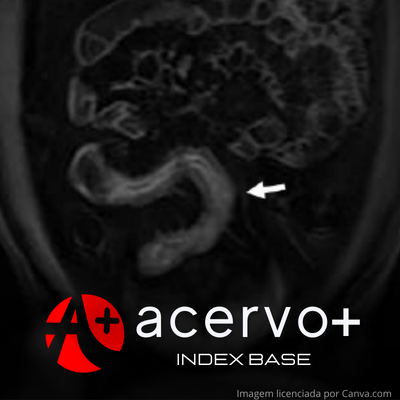
Objective: To report the case of a patient with a diagnosis delay of 15 years for Fibrostenosing-Fistulizing Crohn's Disease (CD), diagnosed at an advanced stage with an entero-sigmoid fistula, describing the clinical course and the interventions performed. Case detail: Male patient, 27 years old, smoker, with report of chronic abdominal pain associated with diarrhea since he was 14 years old. Laboratory tests showing evidence of inflammation and positive anti-Saccharomyces cerevisiae (ASCA) antibody. Colonoscopy showed alterations suggestive of active CD and enteroresonance showed regions of stenosis in the distal ileum and ileo-sigmoid fistula with indication of a surgical approach. The patient had CD refractory to corticosteroid therapy, requiring multiple optimizations and replacement of immunobiologicals from Infliximab (IFX) to Adalimumab (ADA), with resolution of the fistula at the expense of progression of stenosis in the terminal ileum, keeping patterns of exacerbation and remission of the disease. Final considerations: The 15-year diagnostic delay due to nonspecific symptoms, intermittent clinical course and loss of patient follow-up, in addition to smoking, were fundamental for the progression of the cronic inflammatory process and the development of a more aggressive profile of the disease.
References
BECHARA CS, et al. Montreal classification of patient operated for Crohn’s disease and identification of surgical recurrence predictors. Revista Do Colégio Brasileiro de Cirurgiões, 2015; 42(2): 97–104.
BLACKWELL J, et al. Prevalence and Duration of Gastrointestinal Symptoms Before Diagnosis of Inflammatory Bowel Disease and Predictors of Timely Specialist Review: A Population-Based Study. Journal of Crohn's and Colitis, 2021; 15(2): 203–211.
BRAZILIAN STUDY GROUP OF INFLAMMATORY BOWEL DISEASE. Diretrizes de Doença de Crohn Int J Inflamm Bowel Dis., 2018; 4(1): 10–41.
BYE WA, et al. Strategies for Detecting Colorectal Cancer in Patients with Inflammatory Bowel Disease: A Cochrane Systematic Review and Meta-Analysis. Am J Gastroenterol., 2018; 113(12): 1801-1809.
COLOMBEL J-F, et al. Combination Therapy With Infliximab and Azathioprine Improves Infliximab Pharmacokinetic Features and Efficacy: A Post Hoc Analysis. Clinical Gastroenterology and Hepatology, 2019; 17: 1525–1532.
CONSIGNY Y, et al. A simple biological score for predicting low risk of short-term relapse in Crohn’s disease. Inflamm Bowel Dis., 2006; 12: 551–557.
D’INCÀ R, et al. Calprotectin and lactoferrin in the assessment of intestinal inflammation and organic disease. Int J Colorectal Dis., 2007; 22(4): 429-37.
GLASSNER KL, et al. The microbiome and inflammatory bowel disease. J Allergy Clin Immunol., 2020; 145(1): 16-27.
HANAUER SB, et al. Human anti-tumor necrosis factor monoclonal antibody (adalimumab) in Crohn’s disease: the CLASSIC-I trial. Gastroenterology, 2006; 130: 323-33.
HANAUER SB, et al. Maintenance infliximab for Crohn’s disease: the ACCENT I randomised trial. Lancet, 2002; 359: 1541-9 .
HENRIKSEN M, et al. C-reactive protein: a predictive factor and marker of inflammation in inflammatory bowel disease. Results from a prospective population-based study. Gut, 2008; 57: 1518–1523.
HONG Z, et al. Delayed Diagnosis is Associated with Early and Emergency Need for First Crohn's Disease-Related Intestinal Surgery. Med Sci Monit., 2017; 23: 4841-4846.
KISS LS, et al. High-sensitivity C-reactive Protein for identification of disease phenotype, active disease, and clinical relapses in Crohn’s Disease: A marker for patient classification? Inflamm Bowel Dis., 2012; 18: 1647–1654.
KOTZE LM, et al. Fecal Calprotectin: levels for the ethiological diagnosis in Brazilian patients with gastrointestinal symptoms. Arq Gastroenterol., 2015; 52(1): 50-4.
LEE DW, et al. Diagnostic delay in inflammatory bowel disease increases the risk of intestinal surgery. World J Gastroenterol., 2017; 23(35): 6474-6481.
MALHEIROS APR, et al. Tratamento da doença de Crohn com infliximabe: primeira opção? ABCD. Arquivos Brasileiros de Cirurgia Digestiva (São Paulo), 2009; 22(2): 101–104.
MARANHÃO DDA, et al. Características e diagnóstico diferencial das doenças inflamatórias intestinais. JBM, 2015; 103(1): 9-15.
MIKOCKA-WALUS AA, et al. Controversies surrounding the comorbidity of depression and anxiety in inflammatory bowel disease patients. Inflammatory Bowel Diseases, 2007; 13(2): 225–234.
N’GUYEN Y, et al. Fatal Epstein-Barr Virus Primo Infection in a 25-Year-Old Man Treated with Azathioprine for Crohn’s Disease. J Clin Microbiol., 2009; 47(4): 1252-4.
NAHON S, et al. Diagnostic delay in a French cohort of Crohn's disease patients. J Crohns Colitis, 2014; 8(9): 964-9.
NOBREGA VG, et al. The Onset of Clinical Manifestations in Inflammatory Bowel Disease Patients. Arq. Gastroenterol., 2018; 55(3): 290-295.
BOER NKH, et al. Thiopurines in Inflammatory Bowel Disease: New Findings and Perspectives. Journal of Crohn's and Colitis, 2018; 12(5): 610–20.
PERSOONS P, et al. The impact of major depressive disorder on the short- and long-term outcome of Crohn’s disease treatment with infliximab. Alimentary Pharmacology and Therapeutics, 2005; 22(2): 101–110.
PORITZ LS, et al. Remicade® Does Not Abolish the Need for Surgery in Fistulizing Crohn’s Disease. Dis Colon Rectum, 2002; 45(6): 771-5.
QUINTON FJ, et al. Anti-Saccharomyces cerevisiae mannan antibodies combined with antineutrophil cytoplasmic autoantibodies in inflammatory bowel disease: prevalence and diagnostic role. Gut, 1998; 42: 788-791.
SANDBORN WJ, et al. Adalimumab induction therapy for Crohn disease previously treated with infliximab: a randomized trial. Ann Intern Med., 2007; 146(12): 829–38.
SANDBORN WJ, et al. Evaluation of serologic disease markers in a population-based cohort of patients with ulcerative colitis and Crohn's disease. Inflamm Bowel Dis., 2001; 7(3): 192-201.
SANTOS LAA, et al. Terapia nutricional nas doenças inflamatórias intestinais: artigo de revisão. Nutrire 2015; 40(3): 383-396.
SINGH S, et al. Comparative efficacy and safety of biologic therapies for moderate-to-severe Crohn's disease: a systematic review and network meta-analysis. Lancet Gastroenterol Hepatol., 2021; 6(12): 1002-1014.
SIPAHI AM, et al. In: MARTINS MA, et al. Clínica Médica, Volume 4: Doenças do Aparelho Digestivo, Nutrição e Doenças Nutricionais. 2 ed. Editora Manole; 2016; 178-99 p.
SOLEM CA, et al. Correlation of C-reactive protein with clinical, endoscopic, histologic, and radiographic activity in inflammatory bowel disease. Inflamm Bowel Dis., 2005; 11(8): 707–12.
SPICELAND CM, LODHIA N. Endoscopy in inflammatory bowel disease: Role in diagnosis, management, and treatment. World J Gastroenterol., 2018; 24(35): 4014-4020.
VALERIO F, et al. Cancer in Crohn's disease: case report. Câncer em Doença de Crohn: Relato de Caso. Rev bras Coloproct,, 2006; 26(4): 443-6.
VAVRICKA SR, et al. Swiss IBD Cohort Study Group. Systematic evaluation of risk factors for diagnostic delay in inflammatory bowel disease. Inflamm Bowel Dis., 2012; 18(3): 496-505.
WOLTERS FL, et al. Systematic review: has disease outcome in Crohn's disease changed during the last four decades? Aliment Pharmacol Ther., 2004; 20(5): 483-96.
YAMAMOTO T. Factors affecting recurrence after surgery for Crohn’s disease. World Journal of Gastroenterology, 2005; 11(26): 3971.