
Keywords
Periodontics
Connective tissue
Dental implant
How to Cite
Copyright © | All rights reserved.
The journal holds the exclusive copyright for the publication of this article under the terms of Brazilian law 9610/98.
Partial reproduction
The use of parts of the texts, figures and questionnaire of the article is free, being mandatory the citation of the authors and journal.
Total reproduction
It is expressly prohibited and must be authorized by the journal.
Abstract
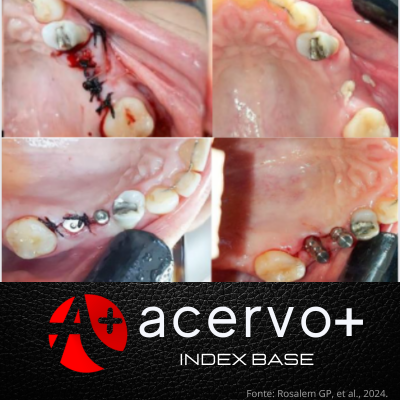
Objective: To present a clinical case of oral rehabilitation in a region of aesthetic defect with implant placement and use of subepithelial connective graft to gain vestibular volume and keratinized tissue. Case detail: A sixty-year-old female patient presented herself on October 11, 2019 for her first clinical consultation in the specialization course in implantology, at the Faculty of Dentistry, seeking treatment rehabilitation with implants.Removal of free gingival tissue from the maxillary tuberosity, de-epithelialization and adaptation of the subepithelial connective tissue graft in the posterior vestibular region of the maxilla were performed, together with the placement of two endosseous implants. After the osseointegration period, implant-supported provisionals were made for adaptation and formation of the peri-implant emergence profile. After the formation of the inter implant papilla, the porcelain crowns were installed. Final considerations: It was considered that the combined technique of implant placement and connective tissue insertion is effective for the rehabilitation of the patient, both in functional and aesthetic aspects.
References
BÄUMER D, et al. Socket Shield Technique for immediate implant placement– clinical, radiographic and volumetric data after 5 years. Clinical Oral Implants Research, 2017; 28(11):1450-1458.
BENNANI V, et al. The periodontal restorative interface: esthetic considerations. Periodontology 2000, 2017; 74(1):74-101.
BOYNUEĞRI D, et al. Yeliz A. Significance of keratinized mucosa around dental implants: a prospective comparative study. Clinical oral implants research, 2013; 24(8): 928-933.
CHUNG D, et al. Significance of keratinized mucosa in maintenance of dental implants with different surfaces. Journal of periodontology, 2006;77(8):1410- 1420.
EDEL A. The use of a free connective tissue graft to increase the width of attached gingiva. Oral Surgery, Oral Medicine, Oral Pathology, 1975;39(3):341-346.
FUNATO A, et al. Timing, positioning, and sequential staging in esthetic implant therapy: a four-dimensional perspective. International Journal of Periodontics & Restorative Dentistry, 2007;27(4): 313-323.
GARBER D, et al. Restoration-driven implant placement with restoration-generated site development. Compendium of continuing education in dentistry (Jamesburg, NJ: 1995), 1995;16(8):798-802.
JUNG U, et al. Histologic observation of soft tissue acquired from maxillary tuberosity area for root coverage. Journal of periodontology, 2008; 79(5):934-940.
LANGER B, CALAGNA L. The subepithelial connective tissue graft. The Journal of prosthetic dentistry, 1980;44(4):363-367.
LANGER B, Burton L. Subepithelial connective tissue graft technique for root coverage. Journal of periodontology, 1985;56(12):715-720.
MISCH C. Divisions of available bone in dentistry. Int J Oral Implantol, 1990;7: 9-17.
PAPADOPOULOS I, et al. Transferring the emergence profile from the provisional to the final restoration. Journal of esthetic and restorative dentistry, 2014;26(3): 154-161.
PEREIRA JR, et al. Transferring conditioned partially edentulous ridge form to a master cast. Journal of Prosthodontics, 2016;25(7):595-598.
PUISYS A, LINKEVICIUS T. The influence of mucosal tissue thickening on crestal bone stability around bone‐level implants. A prospective controlled clinical trial. Clinical oral implants research, 2015;26(2):123-129.
REISER G, et al. The subepithelial connective tissue graft palatal donor site: anatomic considerations for surgeons. International Journal of Periodontics & Restorative Dentistry, 1996;16(2):130-137.
SCHUPBACH P, GLAUSER R. The defense architecture of the human periimplant mucosa: a histological study. The Journal of prosthetic dentistry, 2007;97(6): S15-S25.
SON M, JANG H. Gingival recontouring by provisional implant restoration for optimal emergence profile: report of two cases. Journal of periodontal & implant science, 2011;41(6):302-308.
SONICK M. The dependability of connective Tissue Graft-ing for the Resolution of Full-mouth Recession. Compendium, 2011;32(1):48-53.
STEIGMANN M, et al. Emergence profile design based on implant position in the esthetic zone. International Journal of Periodontics & Restorative Dentistry, 2014; 34(4):559-563.
TAN W, et al. A systematic review of post‐extractional alveolar hard and soft tissue dimensional changes in humans. Clinical oral implants research, 2012;23:1- 21.