
Keywords
Water quality
Xenobiotic agents
Mutations
Cytotoxicity
How to Cite
Copyright © | All rights reserved.
The journal holds the exclusive copyright for the publication of this article under the terms of Brazilian law 9610/98.
Partial reproduction
The use of parts of the texts, figures and questionnaire of the article is free, being mandatory the citation of the authors and journal.
Total reproduction
It is expressly prohibited and must be authorized by the journal.
Abstract
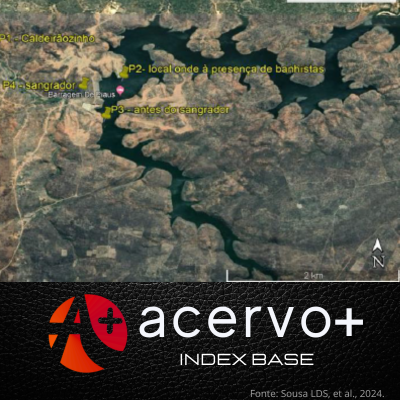
Objective: To evaluate the cytotoxicity and mutagenicity of Piaus barrage waters, using as a test system the meristematic cells of the root of Allium cepa L. together with analyzes of physical-chemical parameters (temperature, cor, turbidity, total dissolved solids and pH) to characterization of water quality. Methods: Water samples were analyzed with a depth of 20 and 80 cm from four different barrel points, using different Exposure times (24, 48 and 72 hours), the sample points and sample collection were selected for a greater relationship. with a human presence. Results: We demonstrate physical-chemical parameters for two values allowed by the national legislation in most of the two points analyzed characterizing the presence of anthropic action. Furthermore, the toxicogenetic evaluation showed cytotoxic and mutagenic effects mainly for the time periods of 48 and 72 hours for all the points analyzed. Conclusion: Piaus barrage water samples show, mainly, xenobiotic agents that interfere with cell division processes, leading to toxicogenetic effects
References
AGUIAR RB e GOMES JRC. Projeto de fontes de abastecimento por água subterrânea, Estado do Piauí: diagnóstico do município de São Julião. 2004. Disponível em: https ://rigeo.cprm.gov.br/bitstream/doc/16362/1/Rel_Picos.pdf. Acessado em: 29 de novembro de 2023.
AIUB CAF e FELZENSWALB I. O uso de Allium cepa como modelo experimental para investigar genotoxicidade de substâncias usadas em conservantes alimentares. Revista Genética na Escola, 2011; 6(1):12-15.
BARBOSA JS, et al. Genotoxicity assessment in aquatic environment impacted by the presence of heavy metals. Ecotoxicology and Environmental Safety, 2010; 73: 320-325.
BIANCHI J, et al. Genotoxicity and mutagenicity of water samples from the Monjolinho River (Brazil) after receiving untreated effluents. Ecotoxicology and Environmental Safety, 2011; 74: 826–833.
BUENO LF, et al. Monitoramento de variáveis de qualidade da água do Horto ouro verde – Conchal – SP. Eng. Agríc., Jaboticabal, 2005; 25(3): 743.
CETESB – Companhia de Tecnologia de Saneamento Ambiental. Relatório da qualidade das águas interiores do Estado de São Paulo. Ed 2005, Ano 2004. São Paulo: CETESB, 2005; 273 p.
CETESB - Companhia de Tecnologia de Saneamento Ambiental. Desenvolvimento de Métodos para o Estabelecimento de Critérios Ecotoxicológicos: Relatório Final. São Paulo: CETESB, 2008; 174 p.
CETESB – Companhia de Tecnologia de Saneamento Ambiental. Guia nacional de coleta e preservação de amostras: água, sedimento, comunidades aquáticas e efluentes líquidas. São Paulo: CETESB, 2011; 327 p.
CONAMA – Conselho Nacional do Meio ambiente. Resolução 357/2005. Disponível em: http ://www.cetesb.sp.gov.br/Agua/praias/res_conama_357_05.pdf . Acessado em: 15 de fevereiro de 2023.
CONAMA – Conselho Nacional do Meio ambiente. 1986. Dispõe sobre critérios básicos e diretrizes gerais para a avaliação de impacto ambiental nº 1. Disponível em: https ://www.ibama.gov.br/sophia/cnia/legislacao/MMA/RE0001-230186.PDF. Acessado em: 29 de outubro de 2023.
COSTA CR, et al. A toxicidade em ambientes aquáticos: discussão e métodos de avaliação. Quim. Nova, 2008; 31:1820-1830.
COSTA RMA e MENK CFM (2008) Biomonitoramento de mutagênese ambiental. Biotecnologia: ciência e desenvolvimento, 2008; 12: 24-26.
DI GIORGIO C, et al. Comparison of two extraction procedures for the assessment of sediment genotoxicity: Implication of polar organic compounds. Mutation Research, 2011; 725: 1– 12.
DÜSMAN E, et al. Allium cepa L. as a bioindicator to measure cytotoxicityof surface water of the Quatorze River, located in Francisco Beltrão, Paraná, Brazil. Environment Monitoring Assessment, 2014;186: 1793–1800.
ESPÍNDOLA EL et al. A bacia hidrográfica do rio do Monjolinho. São Carlos, SP: Rima, 2000; 36-40p.
FARMER PB e SINGH R. Use of DNA adducts to identify human health risk from exposure to hazardous environmental pollutants: the increasing role of mass spectrometry in assessing biologically effective doses of genotoxic carcinogens. Mutation Research, 2008; 659: 68–76.
GUERRA M e SOUZA MJ. Como observar cromossomos – Um guia de técnicas em citogenética vegetal, animal e humana. 1. ed. Ribeirão Preto: FUNPEC, 2002; 131p.
LEME, DM, MARIN-MORALES, MA. Allium cepa test in environmental monitoring: a review on its application. Mutation Research, 2009; 682: 71–81.
LIMA EBNR. Modelagem integrada para gestão da qualidade da água na Bacia do Rio Cuiabá. Tese (Doutorado em Recursos Hídricos). Universidade Federal do Rio de Janeiro, Rio de Janeiro, 2001; 102 p.
MAI H, et al. Environmental concentrations of irgarol, diuron and S-metolachlor induce deleterious effects on gametes and embryos of the Pacific oyster, Crassostrea gigas. Marine Environmental Research, 2013; 89: 1-8.
ANO BC, et al. Evaluation of the genotoxicity of waters impacted by domestic and industrial effluents of a highly industrialized region of São Paulo State, Brazil, by the comet assay in HTC cells. Environment Science Pollution Research, 2015; 22: 1399–1407.
MATSUMOTO ST, et al. Genotoxicity and mutagenicity of water contaminated with tannery effluents and comet assay using the fish Oreochromis niloticus and chromosome alterations in onion root-tips. Genet. Mol. Biol, 2006; 29: 48-158a.
MIHALJEVIĆ Z et al. Assessment of genotoxic potency of sulfate-rich surface waters on medicinal leech and human leukocytes using different versions of the Comet assay. Ecotoxicology and Environmental Safety, 2011; 74 (5): 1416-1426.
OLIVEIRA LM, et al. Potencial mutagênico dos poluentes na água do rio Paraíba do Sul em Tremembé, SP, Brasil, utilizando o teste Allium cepa. Ambiente & Água, Taubaté, 2011; 6 (1): 90-103.
PEREIRA TS. Biomonitoramento de poluições humansa através de avaliação de genotoxicidade em áreas sujeitas a risco ecotoxicológico. Tese (Doutorado em Ecologia) – Pós-Graduação em Ecologia. Universidade Federal do Rio Grande do Sul, Porto Alegre, 2008; 221 p.
SIDDIQUI AH, et al. Validation of plant-based bioassays for the toxicity testing of Indian waters. Environment Monitoring Assessment, 2011; 179: 241–253.
SOARES LM, et al. Avaliação da qualidade da água de rios brasileiros utilizando células meristemáticas de Allium cepa como bioindicador: uma revisão integrativa. Brazilian Journal of Development. Curitiba, 2021; 7(1): 698.
SOUSA JMC, et al. Cytotoxicity and genotoxicity of Guaribas river water (Piauí, Brazil), influenced by anthropogenic action. Environmental monitoring and assessment, 2017;189: 301.
SOUZA AVC. Avaliação citogenotóxica da efluente têxtil tratado por processo biológico e físico – químico. Dissertação (Mestrado em Tecnologia Ambiental). Universidade Federal de Pernanbuco, Pernanbuco, 2017; 95p.
WHO, World Health Organization. Health topics: Water. 2018. Disponível em: . Acesso em: 10 de janeiro de 2023.
YU J, et al. Re-Examination of the Genotoxic Activity of Water Taken from the Songhua River in P. R. China. Arch Environ Contam Toxicol, 2013; 65: 7.