
Keywords
Diagnosis
Immunological tolerance
Dietary intake
Height
How to Cite
Copyright © | All rights reserved.
The journal holds the exclusive copyright for the publication of this article under the terms of Brazilian law 9610/98.
Partial reproduction
The use of parts of the texts, figures and questionnaire of the article is free, being mandatory the citation of the authors and journal.
Total reproduction
It is expressly prohibited and must be authorized by the journal.
Abstract
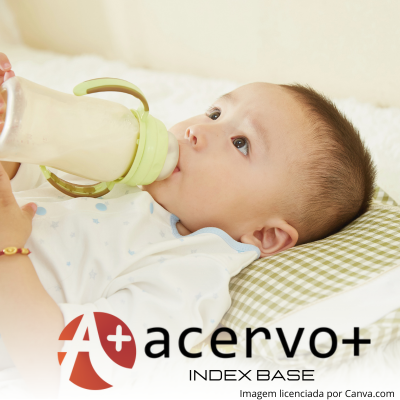
Objectives: To evaluate the nutritional status, food intake and cow's milk substitutes consumed by children with suspected or diagnosed allergy to cow's milk proteins. Methods: Observational and descriptive study with information from 70 children, whose mothers answered the questions through social networks (Facebook, Instagram and WhatsApp). Dietary intake was assessed and compared to Dietary Reference Intakes. Nutritional status was assessed based on weight/age, height/age, weight/height and body mass index/age z-scores. Results: Of the 70 children, 43 were diagnosed with allergy to cow's milk proteins and 27 were suspected. The age groups between 0 and 6 months for boys and girls showed insufficient food intake when compared to the Dietary Reference Intakes. The same occurred at ages between 6 and 12 months for girls. Evolution of nutritional status did not show significant differences between the moment of birth and the current moment. Conclusion: Children with suspected or diagnosed allergy to cow's milk proteins are eutrophic, however, they presented energy and micronutrient deficiencies. Most receive extensively hydrolyzed formula, however, some consume cow's milk, even when following a diet without cow's milk and dairy products.
References
ALVES JQN, et al. Perfil nutricional e consumo dietético de crianças alérgicas à proteína do leite de vaca acompanhadas em um hospital infantil de Brasília/DF, Brasil. Comun. Ciênc. Saúde. 2017; 28(3/4):402-412.
AGUIAR ALO, et al. Avaliação clínica e evolutiva de crianças em programa de atendimento ao uso de fórmulas para alergia à proteína do leite de vaca. Rev Paul Pediatr. 2013;31(2):152-158.
ANTUNES MN, et al. Monitoramento de informação em mídias sociais: o e-Monitor Dengue. TransInformação. 2014; 26(1):9-18.
CONITEC; Relatório de recomendação. Teste de Provocação Oral para Alergia à Proteína do Leite de Vaca. Número 720 Março de 2022. Brasília. Disponível em https://docs.bvsalud.org/biblioref/2022/05/1368904/20220401_relatorio_720_tpo_aplv.pdf acesso em 14/04/2024.
FARIA DPB, et al. Knowledge and practice of pediatricians and nutritionists regarding treatment of cow’s milk protein allergy in infants. Rev Nutr., 2018; 31(6): 535-546.
FRIZZO J, et al. Evaluation of complementary feeding practices, dietary intake, and nutritional status of infants on a cow’s milk protein elimination diet. J Pediatr (Rio J). 2022; 98:256-263.
FARIA DPB, Speridião PGL. Ingestão alimentar e estado nutricional de crianças com dieta de exclusão de leite de vaca: Um estudo de revisão. Rev Port Imunoalergologia. 2023; 31 (4): 257-270.
INSTITUTE OF MEDICINE (IOM). Dietary reference intakes: The essential guide to nutrient requirements. Washington, DC, USA: National Academies Press; 2006. p. 543.30.
INSTITUTE OF MEDICINE. Dietary reference intakes for calcium and vitamin D. Washington, DC: National Academies Press; 2011. p.349-63.
LOUZADA MW. Casos Complexos: Sandra e Sofia. Saúde da criança: Crescimento e desenvolvimento. Brasília, DF:UNA-SUS, 2012. Disponível em: https://www.unasus.unifesp.br/biblioteca_virtual/esf/2/unidades_casos_complexos/unidade23/unidade23.pdf. Acesso em: 06 jan. 2023.
MEDEIROS LCS, et al. Nutrient intake and nutritional status of children following a diet free from cow’s milk and cow’s milk by-products. J Pediatr. 2004; 80: 363-370.
MURARO A, et al. EAACI food allergy and anaphylaxis guidelines: diagnosis and management of food allergy. Allergy. 2014:69:1008-1025.
NATIONAL ACADEMIES OF SCIENCES, Engineering, and Medicine. Dietary reference intakes for energy. Washington, DC: The National Academies Press, 2023.
RODRIGUES VCC, et al. Feeding difficulties in children fed a cow's milk elimination diet. Br J Nutr. 2022; 18: 1-10.
SOLÉ D, et al. Consenso Brasileiro sobre Alergia Alimentar: 2018 - Parte 1 - diagnóstico, tratamento e prevenção. Documento conjunto elaborado pela Sociedade Brasileira de Pediatria e Associacão Brasileira de Alergia e Imunologia. Arq Asma Alerg Imunol. 2018;2(1):7-38.
SOLÉ D, et al. Consenso Brasileiro sobre Alergia Alimentar: 2018 - Parte 2 - diagnóstico, tratamento e prevenção. Documento conjunto elaborado pela Sociedade Brasileira de Pediatria e Associacão Brasileira de Alergia e Imunologia. Arq Asma Alerg Imunol. 2018;2(1):39-82.
THOMPSON FE, BYERS T. Dietary assessment resource manual. J Nutr. 1994;124 Suppl 11:2245-317.
VERDUCI E, et al. Cow's Milk Substitutes for Children: Nutritional Aspects of Milk from Different Mammalian Species, Special Formula and Plant-Based Beverages. Nutrients. 2019; 11(8):1739.
WORLD HEALTH ORGANIZATION. WHO child growth standards: Length/height-for-age, weight-for-age, weight-for-length, weight-for-height and body mass index-for-age. Methods and development. WHO (nonserial publication). Geneva, Switzerland: WHO, 2006.