
Keywords
Primary amenorrhea
Rudimentary uterus
How to Cite
Copyright © | All rights reserved.
The journal holds the exclusive copyright for the publication of this article under the terms of Brazilian law 9610/98.
Partial reproduction
The use of parts of the texts, figures and questionnaire of the article is free, being mandatory the citation of the authors and journal.
Total reproduction
It is expressly prohibited and must be authorized by the journal.
Abstract
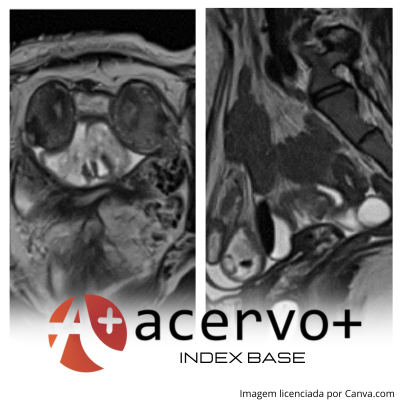
Objective: Presenting a case of a patient with Müllerian malformation and cervix agenesis, which results from an anomalous fusion of the müllerian ducts during embryogenesis. Case detailing: Female, 19 years old, complaining of primary amenorrhea and ciclic pelvic pain for 4 years. At physical examination was noticed that the patient had normal secondary sexual characters and a short blind-folded vagina. Complimentary exams showed two uterine cavities which were completely divided, but with no endocervical canal in both cavities. Furthermore, the endometrium was functioning. The terapeutic plan, besides the psychological following, was perform a hysterectomy accompanied by a salpingectomy followed by treatment with vaginal dilators. Final considerations: It's imprescindible that physicians know how to procede when in presence of a patient with a müllerian malformation. It must be evidenced the importance of an individual avaliation to choose the best therapeutic option, as there are a variable range of how these malformations present themselves.
References
ABDELRAHMAN HM e FELONEY MP. Imperforate Hymen. StatPearls. Treasure Island (FL): StatPearls Publishing, 2022.
ADOLESCENT HEALTH CARE COMMITTEE (2018). Müllerian Agenesis: Diagnosis, Management and Treatment. Obstetrics and Gynecology. ACOG Committee Opinion No. 728, 131(1), e35–e42.
BAGNOLI VR, et al. Management of uterine genital malformations: an evidence-based review, Revista Eletrônica Femina, 2010; 38(4): 217-228.
BHAGAVATH B, et al. Uterine Malformations: An Update of Diagnosis, Management, and Outcomes. Obstet Gynecol Surv., 2017; 72(6): e377-e392.
FERNANDES CE e SILVA DE SÁ MF. Febrasgo Gynecology Treaty. 1st ed. Rio de Janeiro: Elsevier; 2019.
FONTANA L, et al. Genetics of Mayer-Rokitansky-Küster-Hauser (MRKH) syndrome. Clin Genetics, 2017; 91(2): e233-e246.
GASIM T e AL JAMA FE. Massive Hematometra due to Congenital Cervicovaginal Agenesis in an Adolescent Girl Treated by Hysterectomy: A Case Report. Case Rep Obstet Gynecol., 2013: e640214.
HERLIN MK, et al. Mayer-Rokitansky-Küster-Hauser (MRKH) syndrome: a comprehensive update. Revista Eletrônica Orphanet J Rare Dis, 2020; 15(1): e214.
KUMAR S, et al. Bicornuate uterine horns with complete cervical-vaginal agenesis and congenital vesicouterine fístula. Revista Eletrônica Int Urogynecol Pelvic Floor Dysfunct, 2008; 19(5): e739-e741.
LAUFER M. Congenital anomalies of the hymen and vagina. UpToDate, 2022.
LAUFER M e DECHERNEY A. Congenital uterine anomalies: Clinical manifestations and diagnosis. UpToDate, 2022.
LEIS L&B, et al. Avaliação da sexualidade de mulheres inférteis. Reprodução & Climaterio, 2012; 27: e86–e90.
LUDWIN A e PFEIFER SM. Reproductive surgery for müllerian anomalies: a review of progress in the last decade. Fertil Steril, 2019; 112(3): e408-e416.
MOORE KL, et al. Clinical Embryology. 9th edition. Rio De Janeiro: Editora Guanabara Koogan S.A., 2020, 488 p.
PASSOS IMPE e BRITTO RL. Diagnosis and treatment of müllerian malformations. Taiwan J Obstet Gynecol, 2020; 59(2): e183-e188.
PFEIFER SM, et al. ASRM müllerian anomalies classification 2021. Fértil Steril, 2021; 116(5): e1238-e1252.
SARAVELOS SH, et al. Prevalence and diagnosis of congenital uterine anomalies in women with reproductive failure: a critical appraisal. Human Reprod Update, 2008; 14(5): e415-e429.
WU CQ, et al. A Review of Mullerian Anomalies and Their Urologic Associations. Urology, 2021; 151: e98-e106.