
Keywords
Medical education
Splenomegaly
How to Cite
Copyright © | All rights reserved.
The journal holds the exclusive copyright for the publication of this article under the terms of Brazilian law 9610/98.
Partial reproduction
The use of parts of the texts, figures and questionnaire of the article is free, being mandatory the citation of the authors and journal.
Total reproduction
It is expressly prohibited and must be authorized by the journal.
Abstract
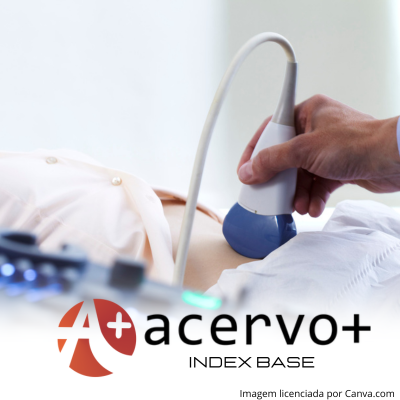
Objective: To compare the identification of splenomegaly through physical examination and POCUS performed by 6th year medical interns and medical clinic residents, after a brief period of training, with the ability to detect splenomegaly using upper abdominal tomography. Methods: This was a prospective, single-center, interventional, comparative study, with bedside data collection in patients admitted to the hepatology reference ward at Fundação Santa Casa de Misericórdia do Pará from July to September 2023. Results: POCUS surpasses physical examination in sensitivity, positive predictive value, and negative predictive value, making it the more reliable choice for correctly identifying splenomegaly, although both techniques have similar specificities. POCUS can be clinically useful comparable to physical examination, even when taught in a short time frame. Conclusion: Despite the lack of relevant disagreement between the methods, the addition of POCUS to the workup demonstrates an accuracy close to the reference, with considerable specificity and can be used in clinical practice for the diagnosis of splenomegaly.
References
ADRIAN AM e LEWIS JK. Management of splenic injury in the adult trauma patient. Uptodate, 2023.
ARORA S, et al. First-year medical students use of ultrasound or physical examination to diagnose hepatomegaly and ascites: a randomized controlled trial. J Ultrasound. 2017; 20: 199-204.
BARIBEU Y, et al. Handheld Point-of-Care Ultrasound Probes: The New Generation of POCUS. J Cardiothorac Vasc Anesth. 2020; 34(11): 3139-3145.
BLOOM BA e GIBBONS RC. Focused Assessment with Sonography for Trauma. [Updated 2023 Jul]. Disponível em: https ://www.ncbi.nlm.nih.gov/books/NBK470479/. Acesso em janeiro de 2023.
CESSFORD T, et al. Comparing Physical Examination with Sonographic Versions of the Same Examination Techniques for Splenomegaly. J Ultrasound Med. 2018; 37(7): 1621-1629.
FENCHEL S, et al. Multislice helical CT of the pancreas and spleen. Eur J Radiol, 2023; 45, 1: 59-72.
GARNER J. The Rational Clinical Examination: Evidence-Based Clinical Diagnosis, edited by David L. Simel, MD, MHS, and Drummond Rennie, MD. Proc (Bayl Univ Med Cent). 2010; 23(1): 0087.
GOLDSMITH AJ, et al. Point-of-care Ultrasound in Morbidity and Mortality Cases in Emergency Medicine: Who Benefits the Most? West J Emerg Med. 2020; 21(6): 172-178.
HUGGINS JT e MAYO PH. Indications of bedside USG in critically ill patients. Uptodate, 2023.
MCCLAIN KL, et al. Approach to the child with enlarged spleen. Uptodate. 2023. Acessado em novembro 2023.
NARULA J, et al. Time to Add a Fifth Pillar to Bedside Physical Examination: Inspection, Palpation, Percussion, Auscultation, and Insonation. JAMA Cardiol. 2018; 3: 346-350.
OLGERS TJ, et al. Teaching point-of-care ultrasound using a serious game: a randomized controlled trial. BMC Med Educ. 2023; 23: 977.
OLGERS TJ, et al. Point-of-care Ultrasound (PoCUS) for the internist in Acute Medicine: a uniform curriculum. Neth J Med, PMID: 31264587. 2019; 77(5): 168-176.
RADONJIC T, et al. Point-of-Care Abdominal Ultrasonography (POCUS) on the Way to the Right and Rapid Diagnosis. Diagnostics (Basel). 2022; 12(9): 2052.
RAMGOBIN D, et al. "POCUS no Cugarrículo de Medicina Interna: Busca pelo Santo Graal da Medicina Moderna," Perspectivas de medicina interna do Journal of 32 Community Hospital: Emissão. 5º, Art. 6º. 2022; 12.
SORENSEN B e HUNSKAAR S. Point-of-care ultrasound in primary care: a systematic review of generalist performed point-of-care ultrasound in unselected populations. Ultrasound J. 2019; 11(1): 31.
TORRES MJ, et al. Positioning document on incorporating point-of-care ultrasound in Internal Medicine departments. Rev Clin Esp (Barc), 2018; 4: 192-198.
VANCAU-WENBERGHE T, et al. Imaging of the spleen: what the clinician needs to know. Singapore Medical Journal, 2015; 56(3): 133-144.
VELASCO JAV, et al. Más allá de la exploración física convencional en hepatología: POCUS. Rev Gastroenterol Mex, 2023; 88: 381-391.
WATSON K, et al. Point of care ultrasound training for internal medicine: a Canadian multi-centre learner needs assessment study. BMC Med Educ, 2018; 18(1): 217.
WILLIAMS JP, et al. Current use, training, and barriers in point‐of‐care ultrasound in hospital medicine: A national survey of VA hospitals. J Hosp Med, 2022; 17: 601‐608.
ZÚÑIGA MAL, et al. Diagnostic capacity of pocket-sized ultrasound devices at point of care by a non-radiologist resident in patients with suspected abdominal pathology. Ultrasound in medicine and biology, 2019; 1-6.