
Keywords
Side effects and adverse reactions related to drugs
Carbamazepine
How to Cite
Copyright © | All rights reserved.
The journal holds the exclusive copyright for the publication of this article under the terms of Brazilian law 9610/98.
Partial reproduction
The use of parts of the texts, figures and questionnaire of the article is free, being mandatory the citation of the authors and journal.
Total reproduction
It is expressly prohibited and must be authorized by the journal.
Abstract
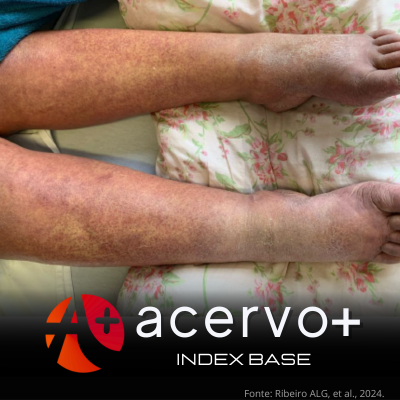
Objective: To report a case of DRESS Syndrome associated with the use of carbamazepine, in the postoperative period of meningioma excision, since this condition of adverse reaction to medication has high mortality rates although low prevalence. Case details: Female, 55 years old, using carbamazepine for about 30 days, after neurosurgery, complaining of exanthema and diffuse itching, in addition to coughing and fever. Results of laboratory tests show eosinophilia, elevation of hepatic and canalicular enzymes and hyperbilirubinemia. Thus, after diagnosing the DRESS Syndrome, corticosteroid therapy and symptomatic medication were started to relieve the intense itching. During hospitalization, the patient evolves with an improvement in the reactional condition, being discharged after completing other treatments inherent to the prolonged hospitalization. Conclusion: Anticonvulsants correspond to the main drug class associated with hypersensitivity syndrome and secondary adverse reactions to the use of medications. A rare condition with a high potential for complications, when recognized early and properly managed, it presents a favorable response in most cases.
References
AQUINO R, et al. Síndrome DRESS induzida por sulfasalazina (erupção cutânea com eosinofilia e sintomas sistêmicos). Revista Médica Paulista 2008; 126: 225-226.
ARELLANO J, et al. Síndrome de DRESS con compromiso pulmonar extenso. Una presentación inhabitual. Revista médica de Chile, 2019; 147: 114-118.
BARRETO E, et al. Síndrome de reacción a medicamento con eosinofilia y síntomas sistémicos (DRESS) asociado a levetiracetam: Reporte de caso. Acta Médica Peruana, 2022; 39: 276-282.
BELAUNDE C, et al. Síndrome de. DRESS asociado al uso de anticonvulsivantes. Revista Cubana de Medicina Militar, 2020; 49.
COSTA, PJCF. Reação Adversa a Fármacos com Eosinofilia e Sintomas Sistêmicos-Síndrome de DRESS. Dissertação (Mestrado Integrado em Medicina) – Faculdade de Medicina da Universidade de Coimbra, 2018; 48.
CRIADO P, et al. Reacao a drogas com eosinofilia e sintomas sistemicos (DRESS)/sindrome da hipersensibilidade induzida por droga (DIHS): Revisão dos conceitos atuais. Anais Brasileiros de Dermatologia, 2012; 87: 435-449.
DÍAZ-MANCEBO R, et al. Síndrome de DRESS y nefritis tubulointersticial aguda tras tratamiento con vancomicina y betalactámicos.: Descripción de un caso y revisión de la literatura. Nefrología (Madrid), 2012; 32: 685-687.
ERCAN N, et al. Síndrome DRESS inducido por ácido valproico em uma niña que respondió a la ciclosporina com análisis de HLA. Archivos argentinos de pediatria, 2022; 120:14-14.
ESTRELLA V, et al. Síndrome de hipersensibilidade a anticonvulsivantes (SHA). Revista Argentina de Dermatologia, 2007; 1: 46-54.
MOREIRA A, et al. Provável síndrome DRESS a meio de constrate iodado. Rev Port Imunoalergologia, 2017; 25: 277-282.
OLIVEIRA A, et al. Hepatotoxicidade e síndrome DRESS induzida por anticonvulsivantes: relato de dois casos e revisão da literatura. GED gastroenterol. endosc. dig, 2011; 1: 174-176.
OQUENDO-GAHONA D, et al. Síndrome DRESS induzida por Losartan. Acta Médica Colombiana, 2021; 4: 49-53.
PAVÓN-ROMERO G, et al. DRESS, una reacción alérgica no mediada por IgE. Revista de la Facultad de Medicina (México), 2023; 66: 7-19.
PREISZ N, et al. Síndrome DRESS asociado a fármacos antituberculosos. Revista argentina de dermatología, 2020; 101: 11-20.
ROBLES L, et al. Síndrome de DRESS asociado al consumo de alopurinol: reporte de caso. Medicina clínica y social, 2023; 7: 119-124.
ROMERO G, et al. Síndrome de DRESS inducido por fármacos antituberculosos: DRESS induced by antituberculosis drugs. Revista Alergia México, 2023; 70: 55-63.
SALAS A, et al. Síndrome DRESS inducido por fármacos antituberculosos en un paciente con diabetes mellitus tipo 2. In: Anales de la Facultad de Medicina. UNMSM. Facultad de Medicina, 2012; 1: 159-164.
SILVA-TIRADO M, et al. Síndrome DRESS. Medicina interna de México, 2019; 35: 325-331.
WASEEM D, et al. Síndrome do vestido: uma revisão e atualização. Skin Dis Skin Care 2016; 1:8-8.