
Keywords
Nursing Care
Patient Care Team
How to Cite
Copyright © | All rights reserved.
The journal holds the exclusive copyright for the publication of this article under the terms of Brazilian law 9610/98.
Partial reproduction
The use of parts of the texts, figures and questionnaire of the article is free, being mandatory the citation of the authors and journal.
Total reproduction
It is expressly prohibited and must be authorized by the journal.
Abstract
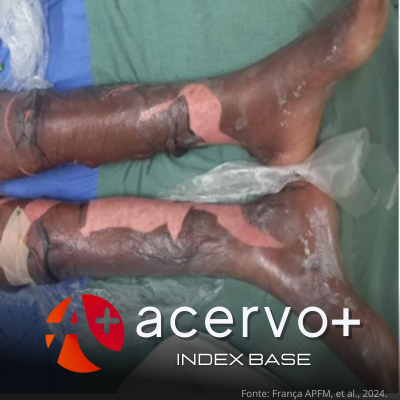
Objective: To describe the multiprofessional team's approach to a case of Toxic Epidermal Necrolysis (TEN) with the use of silver hydrofiber on skin lesions (Nikolsky's sign) in an Intensive Care Unit. Case details: This is a case of NET affecting a young woman who started treatment with Lamotrigine due to a diagnosis of epilepsy. 48 hours after taking the first tablet of the medication in question, the patient developed pruritus and erythematous-squamous lesions all over her body associated with conjunctival hyperemia, episodes of fever, burning skin, generalized myalgia, asthenia and anorexia. In the team's initial assessment, he presented with disseminated erythematous-decamatous and bullous lesions, but soon evolved with Nikolsky's sign which affected 95% of the body area, including the mucous membranes of the oropharynx, genitalia and eyes. Final considerations: We observed that the work of the multi-professional team in investigating the clinical history, thorough physical examination and high suspicion for the diagnosis favors a good prognosis.
References
BLOOM R, AMBER KT. Identifying the incidence of rash, Stevens-Johnson syndrome and toxic epidermal necrolysis in patients taking lamotrigine: a systematic review of 122 randomized controlled trials. Anais Brasileiros de Dermatologia, 2017; 92: 139-141.
BULISSANI ACP, et al. Síndrome de Stevens-Johnson e Necrólise Epidérmica Tóxica em Medicina Intensiva. Revista Brasileira de Terapia Intensiva, 2006; 18 (3): 292-297.
CABRAL L, et al. Necrólise Epidérmica Tóxica (Síndrome de Lyell): uma patologia para as unidades de queimadura. Acta Médica Portuguesa, 2003; 17: 129-140.
CHABY, G. et al. Incidence of and mortality from epidermal necrolysis (Stevens-Johnson syndrome/toxic epidermal necrolysis) in France during 2003-16: a four-source capture-recapture estimate. The British Journal of Dermatology, 2020; 182 (3): 618–624.
CHEN L, et al. Cobertura de hidrofibra com carboximetilcelulose (Aquacel Ag®) em pacientes queimados: Um relato de caso. Revista Brasileira de Queimaduras, 2018; 17 (2): 132-135.
DE MELO MEF, et al. Principais classes farmacológicas relacionadas à farmacodermia. Research, Society and Development, 2022; 11: e8011225492-e8011225492.
EMERICK MFB, et al. Síndrome de Stevens-Johnson e Necrólise Epidérmica Tóxica em um hospital do Distrito Federal. Revista Brasileira de Enfermagem, 2014; 67(4): 898–904.
JÚNIOR JAPR, et al. Síndrome de Lyell em 72% de superfície corporal. Revista Brasileira de Cirurgia Plástica, 2020; 35(2):240-242.
LIPOVÝ B, et al. Case Report: Wound Closure Acceleration in a Patient With Toxic Epidermal Necrolysis Using a Lyophilised Amniotic Membrane. Frontiers in Bioengineering and Biotechnology, 2021; 9: 1-7.
MOSER H, et al.. Evolução dos curativos de prata no tratamento de queimaduras de espessura parcial. Rev Bras Queimaduras, 2013; 12 (2):60 – 67.
NETO FCS, et al. Abordagem Cutânea na Necrólise Epidérmica Tóxica. Revista Brasileira de Cirurgia Plástica, 2017; 32: 128-134.
NOGUEIRA BL, et al. Os curativos a base de prata e sua eficácia em queimaduras: uma revisão integrativa. Brazilian Journal of Development, 2022; 8(2): 8535-8556.
OLIVEIRA FL, et al. Necrólise epidérmica tóxica e síndrome de Stevens Johnson: atualização. Rev Bras Queimaduras, 2012; 11(1): 26-30.
OLIVEIRA A, et al. O espectro clínico Síndrome de Stevens-Johnson e Necrólise Epidérmica Tóxica. Acta Medica Portuguesa, 2011; 24: 995- 1002.
ROVIELLO CF et al. Manifestações e tratamento da necrólise epidérmica tóxica e da síndrome de Stevens Johnson. Journal Health NPEPS, 2019; 4 (1): 319–29.
ROCHA FS, et al. Avaliação comparativa do uso de hidroalginato com prata e o curativo convencional em queimaduras de segundo grau. Rev Bras Queimaduras, 2012; 11:10-110.
SANTOS FC, et al. Abordagem cutânea na necrólise epidérmica tóxica. Rev. Bras. Cir. Plást., 2017; 32 (1): 128-134.
SANTOS GF, et al.. Doença de Parkinson: Padrão epidemiológico de internações no Brasil. Research, Society and Development, 2022; 11: 1-9.
SHANBHAG SS,. et al. Multidisciplinary care in Stevens-Johnson syndrome. Therapeutic Advances in Chronic Disease, 2020; 11:.2040622319894469.
SINGH N, PHILLIPS M. Toxic Epidermal Necrolysis: A Review of Past and Present Therapeutic Approaches. Skin Therapy Letter, 2022; 27(5): 7–13.