
Keywords
Long-Acting Reversible Contraception
Contraception
How to Cite
Copyright © | All rights reserved.
The journal holds the exclusive copyright for the publication of this article under the terms of Brazilian law 9610/98.
Partial reproduction
The use of parts of the texts, figures and questionnaire of the article is free, being mandatory the citation of the authors and journal.
Total reproduction
It is expressly prohibited and must be authorized by the journal.
Abstract
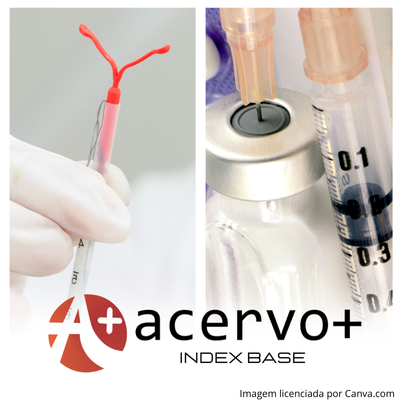
Objective: To evaluate the frequency of side effects in users of long-acting reversible contraceptives (LARC). Methods: This was a pilot, longitudinal study, with medical records of 86 patients treated in a private clinic, users of LARC (T Cu 380A, Mirena, Implanon or Kyleena). Results: The mean age of the patients was 32.1 + 6.61 years. Among the LARCs, the use of Diu T Cu 380 A (30.2%), Implanon (20.9%), Mirena (46.5%), Kyleena (2.3%) was identified. Among the side effects identified by patients, irregular menstrual bleeding (n=19; 22.1%), abdominal cramps (n=5; 5.8%), weight gain (n=5; 5.8%) stood out and acne (n=3; 3.9%). Implanon was associated with irregular bleeding (p=0.01; X2= 10.6), weight gain was associated with Mirena (p=0.01; X2= 9.9) and acne was common in all methods with progestin. There was one case of pregnancy with the TCu 380 A. Conclusio: Irregular bleeding was associated with Implanon and weight gain with the use of Mirena, therefore, patients should be guided when choosing a long-acting contraceptive.
References
AGARWAL M, et al. Comparison of Bleeding Pattern and Quality of Life Before and After the Insertion of a Levonorgestrel Intrauterine System for Heavy Menstrual Bleeding: A Seven-Year Review. Cureus, 2023; 15(3): e36142.
AGARWAL N, CHOPRA S. Mirena: Just a contraceptive device? or A modality with diverse clinical applications! J Family Med Prim Care, 2022;11(9): 5031-5037.
AJONG AB, et al. Contraceptive method mix and preference: A focus on long-acting reversible contraception in Urban Cameroon. PLoS One, 2018: 23;13(8): e0202967.
BAYER. Kyleena. DIU. Dispositivo intrauterino – 19,5 mg levonogestrel. Bula aprovada pela Anvisa em 19/09/2022. Disponível em <https://www.bayer.com.br/sites/bayer_com_br/files/kyleena-profissionais.pdf. Acessado em 22 fev. 2024.
BAYER. Mirena. Endoceptivo. DIU – Dispositivo intrauterino – 52 mg levonogestrel. Bula aprovada pela Anvisa em 09/06/2022. Disponível em <https://www.bayer.com.br/sites/bayer_com_br/files/mirena-pacientes.pdf. Acessado em 22 fev. 2024.
BRANDÃO ER. Contracepção reversível de longa duração (Larc): solução ideal para tempos pandêmicos. Saúde Debate, 2022; 46 (1): 237-47.
BRASIL. Implante subdérmico de etonogestrel na prevenção da gravidez não planejada por mulheres adultas em idade reprodutiva entre 18 e 49 anos. Relatório de recomendação do medicamento. 2021; 599: 1-87.
BRASIL. Ministério da Saúde. Manual técnico para profissionais de saúde – DIU com cobre T CU 380 A. 2018, 72p.
CHENG L, et al. Interventions for emergency contraception. Cochrane Database Syst Rev, 2012.
DAL'AVA N et al. Body weight and composition in users of levonorgestrel-releasing intrauterine system. Contraception. 2012; 86(4): 350-3.
FEBRASGO. Federação Brasileira de Ginecologia e Obstetrícia. Contracepção Reversível de Longa Ação. Disponível em: https://www.febrasgo.org.br/media/k2/attachments/SerieZ1-2022-Contracepcao.pdf. Acessado em 22 de março de 2024.
MADDEN T. Intrauterine Contraception: Background and device types. UpToDate. 2023. Disponível on line: https://medilib.ir/uptodate/show/116579. Acessado em 01 abr. 2024.
GIORDANO MV, et al. Dispositivo intrauterino de cobre. Femina, 2015; 43 (1): 1-6.
LAZORWITZ A, et al. Relationship Between Etonogestrel Concentrations and Bleeding Patterns in Contraceptive Implant Users. Obstet Gynecol, 2019; 134(4): 807-813
MANSOUR D, et al. Can initial vaginal bleeding patterns in etonogestrel implant users predict subsequent bleeding in the first 2 years of use? Contraception, 2019; 100(4): 264-268.
MANSOUR D, et al. The effects of Implanon on menstrual bleeding patterns. Eur J Contracept Reprod Health Care. 2008; 13; 1:13-28.
MORAY KV, et al. A systematic review on clinical effectiveness, side-effect profile and meta-analysis on continuation rate of etonogestrel contraceptive implant. Reprod Health, 2021; 6;18 (1): 4.
PARADISE SL, et al. Evidence-Based Contraception: Common Questions and Answers. Am Fam Physician, 2022; 106(3): 251-259.
SECURA GM, et al. The Contraceptive CHOICE Project: reducing barriers to long-acting reversible contraception. Am J Obstet Gynecol, 2010; 203(2): 115.e1-7.
TESFAYE H, et al. Early implanon discontinuation and associated factors among women ever used implanon in Mettu district, Oromia regional state, southwest Ethiopia, 2021. Reprod Health, 2021; 18: 176.
ZACCARON R, et al. Estudo piloto: um processo importante de adaptação e refinamento para uma pesquisa quase experimental em aquisição de I2. Revista do Gelne, 2018; 20(1): 1-12.
ZIMMERMMANN JB et al. Condutas em Obstetrícia para gestantes de baixo risco. 2018.
ZIMMERMMNN JB, et al. Gestação de alto risco: Do pré-natal ao puerpério. Curitiba; 2021.880p.