
Keywords
Cashew tree
Neurodegeneration
How to Cite
Copyright © | All rights reserved.
The journal holds the exclusive copyright for the publication of this article under the terms of Brazilian law 9610/98.
Partial reproduction
The use of parts of the texts, figures and questionnaire of the article is free, being mandatory the citation of the authors and journal.
Total reproduction
It is expressly prohibited and must be authorized by the journal.
Abstract
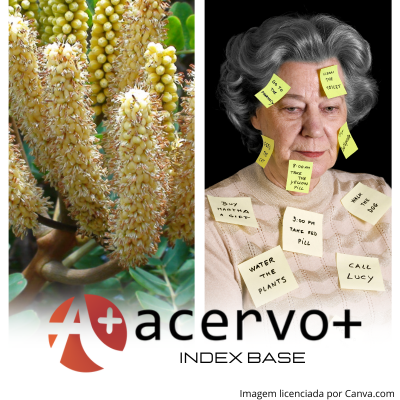
Objective: To analyze the therapeutic potential of Dimorphandra gardneriana Tulasne and Anacardium occidentale L. in Alzheimer's Disease (AD) and the possible mechanisms of action involved. Methods: This is an integrative literature review, with searches conducted in the following databases: Medline/PubMed, Lilacs, Embase, Cochrane, and Scopus. Additionally, articles in English, primary studies, in vivo, published from 2003 to 2023 were included. Results: Nineteen publications were selected that investigated the effects of the phytoconstituents rutin, troxerutin, quercetin, and isoquercitrin present in D. gardneriana Tu. in the treatment of AD in rats or mice. It was observed that these substances promoted a reduction in oxidative stress, neuroinflammation, β-amyloid (Aβ) synthesis, tau phosphorylation, and Acetylcholinesterase (AChE), leading to improvement in cognitive deficits and brain damage. Final considerations: This review revealed that there is still no effective clinical treatment for this condition and no way to prevent the death of brain cells. However, it is evident that flavonoids from D. gardneriana Tu. have shown promising results for treating AD symptoms.
References
ALAQEEL NK, et al. Quercetin Nanoemulsion Ameliorates Neuronal Dysfunction in Experimental Alzheimer's Disease Model. Antioxidants (Basel), 2022; 11(10): 1986.
ALCÂNTARA MS. Cadeia produtiva, manejo e conservação da Fava D’anta (Dimorphandra Gardneriana Tulasne) da Floresta Nacional do Araripe-Apodi, região semi-árida do Nordeste do Brasil. 2018.
AMIDFAR M, et al. The role of CREB and BDNF in neurobiology and treatment of Alzheimer's disease. Life Sci, 2020; 257: 118020.
BADALZADEH R, et al. Beneficial Effect of Troxerutin on Diabetes-Induced Vascular Damages in Rat Aorta: Histopathological Alterations and Antioxidation Mechanism. Int J Endocrinol Metab, 2015; 13(2): 25969.
CARMONA V, et al. Several targets involved in Alzheimer's disease amyloidogenesis are affected by morin and isoquercitrin. Nutr Neurosci, 2020; 23(8): 575-90.
CHEN L, et al. Protective effects of isoquercitrin on streptozotocin-induced neurotoxicity. J Cell Mol Med, 2020; 24(18): 10458-10467.
COE FG e ANDERSON GJ. Ethnobotany of the garifuna of eastern nicaragua. Econ Bot, 1996; 50(1): 71–107.
ELREEDY HA, et al. Neuroprotective effect of quercetin through targeting key genes involved in aluminum chloride induced Alzheimer’s disease in rats. Egypt. j. basic appl. sci, 2023; 10(1): 174-184.
FARAJDOKHT F, et al. Troxerutin protects hippocampal neurons against amyloid beta-induced oxidative stress and apoptosis. EXCLI J, 2017; 16: 1081-1089.
FIDELES LS, et al. Investigação científica e tecnológica do efeito protetor da rutina na mucosite intestinal induzida por 5-fluorouracil. Res., Soc. Dev, 2021; 10(6).
HUANG XL, et al. Hepatoprotective potential of isoquercitrin against type 2 diabetes-induced hepatic injury in rats. Oncotarget, 2017; 8(60): 101545–101559.
HUEBBE P, et al. Effect of dietary quercetin on brain quercetin levels and the expression of antioxidant and Alzheimer's disease relevant genes in mice. Pharmacol Res, 2010; 61(3): 242-46.
IBGE - INSTITUTO BRASILEIRO DE GEOGRAFIA E ESTATÍSTICA. Levantamento sistemático da produção agrícola. 2014. Disponível em: . Acessado em: 28 de março de 2023.
ISHOLA IO, et al. Rutin ameliorates scopolamine-induced learning and memory impairments through enhancement of antioxidant defense system and cholinergic signaling. Drug Metab Pers Ther, 2020.
JAIN J, et al. Neuroprotective effect of quercetin against rotenone-induced neuroinflammation and alterations in mice behavior. J Biochem Mol Toxicol, 2022; 36(10): 23165.
KARIMIPOUR M, et al. Quercetin promotes learning and memory performance concomitantly with neural stem/progenitor cell proliferation and neurogenesis in the adult rat dentate gyrus. Int J Dev Neurosci, 2019; 74: 18-26.
KIM EK e CHOI EJ. Compromised MAPK signaling in human diseases: an update. Arch Toxicol, 2015; 89(6): 867-82.
LI Y, et al. Activation of Nrf2 signaling by sitagliptin and quercetin combination against β-amyloid induced Alzheimer's disease in rats. Drug Dev Res, 2019; 80(6): 837-45.
MIRANDA JA, et al. Protective effect of Cashew Gum (Anacardium occidentale L.) on 5-Fluorouracil-Induced Intestinal Mucositis. Pharmaceuticals (Basel), 2019; 12(1): 51.
MIRANDA JA, et al. Troxerutin Prevents 5-Fluorouracil Induced Morphological Changes in the Intestinal Mucosa: Role of Cyclooxygenase-2 Pathway. Pharmaceuticals (Basel), 2020; 13(1): 10.
MOGHBELINEJAD S, et al. Rutin activates the MAPK pathway and BDNF gene expression on beta-amyloid induced neurotoxicity in rats. Toxicol Lett, 2014; 224(1): 108-13.
MORENO LC, et al. Effect of the oral administration of nanoencapsulated quercetin on a mouse model of Alzheimer's disease. Int J Pharm, 2017; 517(1-2): 50-57.
OLAYINKA J, et al. Quercetin mitigates memory deficits in scopolamine mice model via protection against neuroinflammation and neurodegeneration. Life Sci, 2022; 292: 120326.
QU J, et al. Rutin protects against cognitive deficits and brain damage in rats with chronic cerebral hypoperfusion. Br J Pharmacol, 2014; 171(15): 3702-15.
RAMALINGAYYA GV, et al. Naringin and Rutin Alleviates Episodic Memory Deficits in Two Differentially Challenged Object Recognition Tasks. Pharmacogn Mag, 2016; 12(1): S63-70.
SANTOS CM, et al. The PICO strategy for the research question construction and evidence search. Rev Latino-Am Enfermagem, 2007; 15(3): 508–11.
SINGH NK e GARABADU D. Quercetin Exhibits α7nAChR/Nrf2/HO-1-Mediated Neuroprotection Against STZ-Induced Mitochondrial Toxicity and Cognitive Impairments in Experimental Rodents. Neurotox Res, 2021; 39(6): 1859-79.
WANG DM, et al. Effects of long-term treatment with quercetin on cognition and mitochondrial function in a mouse model of Alzheimer's disease. Neurochem Res, 2014; 39(8): 1533-43.
WANG L, et al. Quercitrin improved cognitive impairment through inhibiting inflammation induced by microglia in Alzheimer's disease mice. Neuroreport, 2022; 33(8): 327-335.
XU PX, et al. Rutin improves spatial memory in Alzheimer's disease transgenic mice by reducing Aβ oligomer level and attenuating oxidative stress and neuroinflammation. Behav Brain Res, 2014; 264: 173-80.
YANG S, et al. Quercetin is protective against short-term dietary advanced glycation end products intake induced cognitive dysfunction in aged ICR mice. J Food Biochem, 2020; 44(4): 13164.