
Keywords
Early Weaning
Breast feeding
How to Cite
Copyright © | All rights reserved.
The journal holds the exclusive copyright for the publication of this article under the terms of Brazilian law 9610/98.
Partial reproduction
The use of parts of the texts, figures and questionnaire of the article is free, being mandatory the citation of the authors and journal.
Total reproduction
It is expressly prohibited and must be authorized by the journal.
Abstract
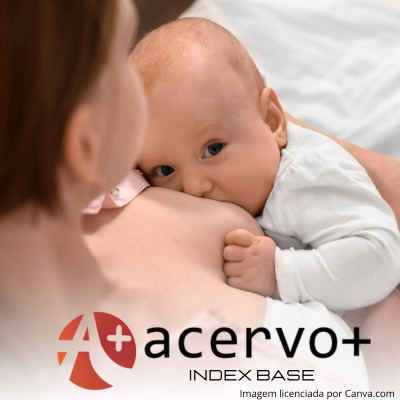
Objective: To analyze the impact of early weaning on the health of the mother and baby. Method: This is an integrative review, with data collection from secondary sources and qualitative analysis through bibliographic research. Results: After searching for evidence in the selected databases (LILACS, BDENF, SCIELO) and applying the filters, 14 articles were found that met the theme and objectives of the research. The year with the highest number of publications among the selected articles was 2021, and it was observed that the Brazilian Journal of Maternal and Child Health published the most. Discussion: Breastfeeding is crucial in the first months of a baby's life, providing multiple protective functions for their health and offering immunological factors that promote healthy growth and development, providing a better start in life. It becomes the most important meal for the baby. Conclusion: Of the studies analyzed, the vast majority found that the early introduction of other foods before the age of six months was the main reason for early weaning, and almost all the studies observed the ingestion of milk formulas by infants between 3 and 5 months of age.
References
ALMEIDA LM, et al. Desmame precoce: principais causas e consequências para o bebê e para a mãe, uma revisão literária. Temas em saúde, 2019; 19(3): 214-228.
ALVARENGA SC, et al. Fatores que influenciam o desmame precoce. Aquichan, 2017; 17(1): 93-103.
ANTUNES LS et al. Amamentação natural como fonte de prevenção em saúde. Ciência & Saúde Coletiva, 2008; 13(1): 1303-109.
AREIA JS, et al. As principais motivações elencadas para o desmamem precoce por lactantes adultas: revisão integrativa da literatura. Revista Eletrônica Acervo Saúde, 2020; 41:2568-2568.
ARAÚJO VGS, et al. Transtorno mental comum e interrupção precoce do aleitamento materno exclusivo em mulheres quilombolas: estudo de base populacional. Revista Brasileira de Saúde Materno Infantil, 2021; 21:485-496.
BAUER DFV, et al. Orientação profissional e aleitamento materno exclusivo: um estudo de coorte. Cogitare enfermagem, 2019; 24; 56532.
CASTELO-RIVAS WP, et al. Fatores que influenciam o desmame precoce em bebês pertencentes ao Centro de Saúde Augusto Egas, Equador. Revista Informação Científica, 2021; 100(5): 1-9.
COELHO AS, et al. A importância da amamentação na formação de vínculos afetivossaudáveis entre mamãe/bebê. BIUS-Boletim Informativo Unimotrisaúde em Sociogerontologia, 2019; 12(5): 1-15.
FERREIRA APM, et al. Tecnologias educacionais direcionadas ao aleitamento materno produzidas na pós-graduação em enfermagem brasileira. Arquivos de Ciências da Saúde da UNIPAR, 2023; 27(2):720-736.
HOLANDA ER, SILVA IL. Fatores associados ao desmame precoce e padrão espacial do aleitamento materno em território na Zona da Mata de Pernambuco, Brasil. Revista Brasileira de Saúde Materno Infantil, 2023; 22(4): 803-812.
LIMA APE, et al. Aleitamento materno exclusivo de prematuros e motivos para sua interrupção no primeiro mês pós-alta hospitalar. Revista Gaúcha de Enfermagem, 2019; 40: e20180406.
LODI JC, et al. Impacto da autoeficácia materna e fatores associados na manutenção do aleitamento materno exclusivo no município de Piracicaba-SP: Estudo de Coorte. Revista O Mundo da Saúde, 2019; 43(2): 326-343.
MARTINS FA, et al. Padrões de amamentação e fatores associados ao desmame precoce na Amazônia ocidental. Revista de Saúde Pública, 2021; 55: 21.
MERCÊS RO, et al. Fatores associados à introdução alimentar precoce em um município baiano. Revista de Ciências Médicas e Biológicas, 2022; 21(2): 243-251.
MOHER D, et al. Prefered reporting items for systematic reviews and meta-analyses: the PRISMA statement. PLoS Med, 2009; 6(7): e1000097.
MONTEIRO YR, et al. Fatores clínicos e sociodemográficos em lactentes com desmame precoce. Revista Cubana de Pediatria, 2020; 92(4).
NASS EMA, et al. Maternal factors and early weaning from exclusive breastfeeding/Atores maternos e o desmame precoce do aleitamento materno exclusivo. Revista de Pesquisa Cuidado é Fundamental Online, 2021;13: 1698-1703.
NERI VF, et al. Prevalência de desmame precoce e fatores relacionados em crianças do Distrito Federal e entorno. REVISA (Online), 2019; 8(4): 451-459.
PINHEIRO JMF, et al. Práticas alimentares e desmame precoce no período neonatal: um estudo de coorte. Revista de Saúde Pública, 2021; 55: 63.
SOUZA BS, et al. Fatores associados ao desmame precoce no contexto brasileiro, 2023.
SANTOS VL, et al. Fatores sociodemográficos e obstétricos associados à interrupção do aleitamento materno em até 45 dias pós-parto-Estudo de Coorte Maternar. Revista Brasileira de Saúde Materno Infantil, 2021; 21: 575-586.
TAVARES AMC, et al. Fatores que interferem na duração do aleitamento materno de crianças na Região Metropolitana do Cariri cearense. DEMETRA: Alimentação, Nutrição & Saúde, 2020; 15: 47367-47367.
VIEIRA FS, et al. Influência do parto sobre o desmame no puerpério. Revista de Pesquisa Cuidado é Fundamental Online, 2019; 11(2): 425-431.
WHITTEMORE R, KNAFL K. The integrative review: updated methodology. Journal of advanced nursing, 2005; 52(5): 546-553.