
Keywords
Sezary Syndrome
Non-Hodgkin's Lymphoma
How to Cite
Copyright © | All rights reserved.
The journal holds the exclusive copyright for the publication of this article under the terms of Brazilian law 9610/98.
Partial reproduction
The use of parts of the texts, figures and questionnaire of the article is free, being mandatory the citation of the authors and journal.
Total reproduction
It is expressly prohibited and must be authorized by the journal.
Abstract
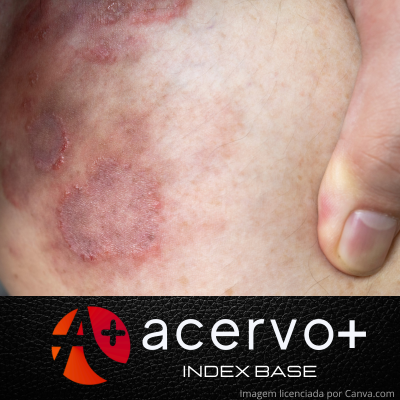
Objective: To analyze the characteristics of Mycosis Fungoides (MF). Literature review: MF is the most common type of cutaneous lymphoma, despite its rare incidence in the general population. It is more prevalent in men, black individuals, adults, and the elderly, and presents with heterogeneous manifestations, commonly characterized by three clinical phases: patch, plaque, and tumor stage. MF is suspected in cutaneous lesions refractory to target therapies or when there is polymorphic involvement in typical distribution (sun-protected areas). This pathology brings with it various differential diagnoses, such as infectious, oncological, and autoimmune skin diseases, requiring a thorough anamnesis and histopathological analysis for confirmation. Histopathological findings, in turn, depend on the disease stage at which the biopsy is performed, with epidermotropism being a characteristic hallmark of the disease. Treatment of this condition is guided by its staging, which takes into account disease extent, lymph node involvement, metastasis, and blood alterations. Final considerations: Despite representing a disease of low population incidence, MF should be recognized by the scientific community, considering its impact on individuals' quality of life when not identified early, as it shares differential diagnosis with more common dermatoses and requires a more e clinical and histopathological investigation.
References
BELTRAMINELLI H. Cutaneous T‐cell lymphoma—Focus on some problems, and some solutions. Hematological Oncology, 2023; 41: 20-24.
CERRONI LMD. Mycosis fungoides—clinical and histopathologic features, differential diagnosis, and treatment. Seminars in Cutaneous Medicine and Surgery, 2018; 37(1): 2-10.
ELSAYAD K, et al. Total skin electron beam for primary cutaneous T-cell lymphoma. International Journal of Radiation Oncology* Biology* Physics, 2015; 93(5): 1077-1086.
HEALD P, et al. Topical bexarotene therapy for patients with refractory or persistent early-stage cutaneous T-cell lymphoma: results of the phase III clinical trial. Journal of the American Academy of Dermatology, 2003; 49(5): 801-815.
HODAK E and AMITAY-LAISH I. Mycosis fungoides: A great imitator. Clinics in Dermatology, 2019; 37(3): 255-267.
HORWITZ SM, et al. Review of the treatment of mycosis fungoides and Sézary syndrome: a stage-based approach. Journal of the National Comprehensive Cancer Network, 2008; 6(4): 436-442.
LAROCCA C and KUPPER T. Mycosis fungoides and Sézary syndrome: an update. Hematology/ Oncology Clinics, 2019; 33(1): 103-120.
MARTA GN, et al. Micose fungoide: relato de caso tratado com radioterapia. Anais Brasileiros de Dermatologia, 2011; 86: 561-564.
MITTELDORF C. Folliculotropic mycosis fungoides. Deutsche Dermatologische Gesellschaft, 2018; 16(5): 543-557.
MORRIS S, et al. The results of low-dose total skin electron beam radiation therapy (TSEB) in patients with mycosis fungoides from the UK Cutaneous Lymphoma Group. International Journal of Radiation Oncology Biology Physics, 2017; 99(3): 627-633.
MUÑOZ-GONZÁLEZ H, et al. Clinicopathologic variants of mycosis fungoides. Actas Dermo-Sifiliográficas (English Edition), 2017; 108(3): 192-208.
OLSEN E, et al. Revisions to the staging and classification of mycosis fungoides and Sezary syndrome: a proposal of the International Society for Cutaneous Lymphomas (ISCL) and the cutaneous lymphoma task force of the European Organization of Research and Treatment of Cancer (EORTC). Blood, The Journal of the American Society of Hematology, 2007; 110(6): 1713-1722.
SANCHES JA, et al. Mycosis fungoides and Sézary syndrome: focus on the current treatment scenario. Anais brasileiros de dermatologia, 2021; 96: 458-471.
SEGAL O, et al. Illness perception, coping, and quality of life in early-stage Mycosis fungoides. An Bras Dermatol. 2021; 96: 27-33.
SPACCARELLI N and ROOK AH. The use of interferons in the treatment of cutaneous T-cell lymphoma. Dermatologic clinics, 2015; 33(4): 731-745.
TRAUTINGER F, et al. European Organisation for Research and Treatment of Cancer consensus recommendations for the treatment of mycosis fungoides/Sézary syndrome – Update, 2017. European Journal of Cancer, 2017; 77: 57-74.
VAN SANTEN S, et al. Clinical staging and prognostic factors in folliculotropic mycosis fungoides. JAMA dermatology, 2016; 152(9): 992-1000.
WILLEMZE R. Mycosis fungoides variants-clinicopathologic features, differential diagnosis, and treatment. Seminars in Cutaneous Medicine and Surgery, 2018; 37(1): 11-17.
YAMASHITA T, et al. Mycosis fungoides and Sézary syndrome: clinical, histopathological and immunohistochemical review and update. Anais brasileiros de dermatologia, 2012; 87: 817-830.
ZACKHEIM HS, et al. Low-dose methotrexate to treat erythrodermic cutaneous T-cell lymphoma: results in twenty-nine patients. Journal of the American Academy of Dermatology, 1996; 34(4): 626-631.
ZHANG XY and WANG P. Mycosis Fungoides Exhibits the Features of Skin Tags: A Case Report. Clinical, Cosmetic and Investigational Dermatology, 2023; 16: 1765-1768.
ZINZANI PL, et al. Mycosis fungoides. Critical Reviews in Oncology/Hematology, 2008; 65(2): 172-182.