
Keywords
Maternal and child health
Rooming-in care
Infant newborn
How to Cite
Copyright © | All rights reserved.
The journal holds the exclusive copyright for the publication of this article under the terms of Brazilian law 9610/98.
Partial reproduction
The use of parts of the texts, figures and questionnaire of the article is free, being mandatory the citation of the authors and journal.
Total reproduction
It is expressly prohibited and must be authorized by the journal.
Abstract
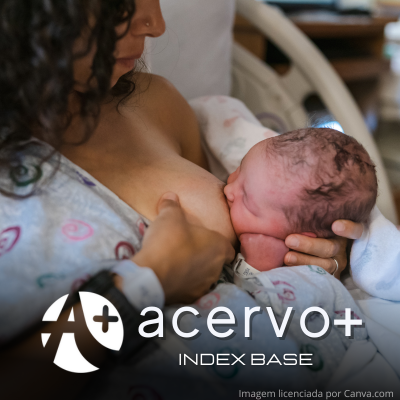
Objective: To analyze the prevalence and factors associated with breastfeeding in the first hour of life (AMPHV) in a municipality in the Western Brazilian Amazon, Acre. Methods: Cross-sectional study that evaluated 419 postpartum women admitted to rooming-in at the municipality's reference maternity hospital, between September 28, 2021 and January 1, 2022. Maternal and newborn data were collected through interviews with women and consultations with medical records. Poisson regression with hierarchical robust variance was used to identify factors associated with stage. Results: The prevalence of breastfeeding in the first hour after birth was 78.3%, being positively associated with marital status with a partner, primiparity and skin-to-skin contact, while the need for admission to the Neonatal Intensive Care Unit (NICU) associated with a negative outcome. Conclusion: The breastfeeding rate in the first hour of life was considered “good” according to the WHO. Strategies that promote AMPHV for primiparous women, mothers without partners, as well as measures to encourage skin-to-skin contact and minimize the need for NICU admission may be effective for AMPHV practice.
References
ALVES RV, et al. Breastfeeding in the first hour of life in Brazilian private hospitals participating in a quality-of-care improvement project. Reproductive Health, 2023; 20(2): 1-10.
APPIAH F, et al. Maternal and child factors associated with timely initiation of breastfeeding in sub-Saharan Africa. International Breastfeeding Journal, 2021; 16(1): 55-66.
ARAUJO LR, et al. Presença de acompanhante na sala de parto e aleitamento materno na primeira hora de vida: há associação? Revista Brasileira de Saúde Materno Infantil, 2023; 23(1): e20220055.
BLENCOWE H, et al. Born Too Soon: The global epidemiology of 15 million preterm births. Reproductive Health, 2013; 10(1): S2.
BOCCOLINI CS, et al. Fatores associados à amamentação na primeira hora de vida. Revista de Saúde Pública, 2011; 45(1): 69–78.
BOCCOLINI CS, et al. Breastfeeding during the first hour of life and neonatal mortality. Jornal De Pediatria, 2013; 89(1): 131–136.
BRASIL. Ministério da Saúde. Pesquisa nacional de demografia e saúde da criança e da mulher: PNDS 2006, dimensões do processo reprodutivo e da saúde da criança. Brasília, 2009a. Disponível em: https ://bvsms.saude.gov.br/bvs/publicacoes/pnds_crianca_mulher.pdf. Acessado em: 20 de janeiro de 2024.
BRASIL. Ministério da Saúde. Pesquisa de Prevalência de Aleitamento Materno Em Municípios Brasileiros: Situação do Aleitamento materno em 227 municípios brasileiros. Brasília, 2010. Disponível em: https ://bvsms.saude.gov.br/bvs/publicacoes/pesquisa_aleitamento_municipios_brasileiros.pdf. Acessado em 15 de fevereiro de 2024.
BRASIL. Ministério da Saúde. II Pesquisa de Prevalência de Aleitamento Materno nas Capitais Brasileiras e Distrito Federal. Brasília, 2009b. Disponível em: https ://bvsms.saude.gov.br/bvs/publicacoes/pesquisa_prevalencia_aleitamento_materno.pdf. Acessado em: 15 de março de 2024.
BRASIL. Ministério da Saúde. Portaria No 1.153, DE 22 DE MAIO DE 2014. Redefine os critérios de habilitação da Iniciativa Hospital Amigo da Criança (IHAC), como estratégia de promoção, proteção e apoio ao aleitamento materno e à saúde integral da criança e da mulher, no âmbito do Sistema Único de Saúde (SUS). Diário Oficial da União, Brasília, 2014a. Disponível em: . Acesso em: 9 abr. 2024.
BRASIL. Ministério da Saúde. Portaria no 371, de 7 de maio de 2014. Institui diretrizes para a organização da atenção integral e humanizada ao recém-nascido (RN) no Sistema Único de Saúde (SUS). Diário Oficial da União, Brasília, 2014b. Disponível em: . Acessado em: 23 abr. 2024.
BRASIL. Ministério da Saúde. Cadernos de atenção básica: saúde da criança, aleitamento materno e alimentação complementar. Brasília, 2015. Disponível em: https ://portaldeboaspraticas.iff.fiocruz.br/wp-content/uploads/2019/07/saude_crianca_aleitamento_materno_cab23.pdf. Acessado em: 12 de março de 2024.
CAMPOS PM, et al. Skin-to-skin contact and breastfeeding of newborns in a university hospital. Revista Gaúcha de Enfermagem, 2020; 41(1): e20190154.
COZMA-PETRUŢ A, et al. Determinants of Early Initiation of Breastfeeding among Mothers of Children Aged Less than 24 Months in Northwestern Romania. Nutrients, 2019; 11(12): 2988-3000.
15. GÓES FGB, et al. Amamentação na primeira hora de vida na maternidade: fatores intervenientes [Factors intervening in breastfeeding in the first hour of life on the maternity ward] [Factores interventores en la lactancia materna en la primera hora de vida en la maternidad]. Revista Enfermagem UERJ, 2022; 30(1): e698387.
GONÇALVES-FERRI WA, et al. The impact of coronavirus outbreak on breastfeeding guidelines among Brazilian hospitals and maternity services: a cross-sectional study. International Breastfeeding Journal, 2021; 16(1): 30-41.
HOLANDA SM, et al. Influência da participação do companheiro no pré-natal: satisfação de primíparas quanto ao apoio no parto. Texto & Contexto Enfermagem, 2018; 27(1): e3800016.
IBGE. Instituto Brasileiro de Geografia e Estatística. Cidades e Estados. Cruzeiro do Sul 2024. Disponível em: . Acesso em: 27 mar. 2024.
JESUS AS, et al. Amamentação na primeira hora de vida entre mulheres do Nordeste brasileiro: prevalência e fatores associados. Revista Eletrônica de Enfermagem, 2020; 22(1): 58772.
KARIMI FZ, et al. The effect of mother-infant skin to skin contacts on success and duration of first breastfeeding: A systematic review and meta-analysis. Taiwanese Journal of Obstetrics and Gynecology, 2019; 58(1): 1–9.
LEMOS GG, et al. Protective factors for early initiation of breastfeeding among Brazilian nursing mothers. Frontiers in Pediatrics, 2023; 11(1): 1203575.
LUCCHESE, I. et al. Amamentação na primeira hora de vida em município do interior do Rio de Janeiro: fatores associados. Escola Anna Nery, 2023; 27(1): e20220346.
MACIEL VBS, et al. Amamentação em menores de dois anos em uma cidade da Região Amazônica. Acta Paulista de Enfermagem, 2022; 35(1): eAPE02487.
MARTINS FA. et al. Breastfeeding patterns and factors associated with early weaning in the Western Amazon. Revista de Saúde Pública, 2021; 55(1): 21.
MOSQUERA PS. et al. Factors affecting exclusive breastfeeding in the first month of life among Amazonian children. Plos One, 2019; 14(7): e0219801.
MOSQUERA PS. et al. Prevalence and predictors of breastfeeding in the MINA-Brazil cohort. Revista de Saúde Pública, 2023; 57(1): 2s.
MUKORA-MUTSEYEKWA F et al. Predictors of early initiation of breastfeeding among Zimbabwean women: secondary analysis of ZDHS 2015. Maternal Health, Neonatology and Perinatology, 2019; 5(1): 2.
OPAS. Organização Pan-americana de Saúde, OMS. Organização Mundial da Saúde. Aleitamento materno e a doença causada pelo novo coronavírus (COVID-19). Disponível em: . Acessado em: 18 de agosto de 2022.
PEREIRA CRVR. et al. Avaliação de fatores que interferem na amamentação na primeira hora de vida. Revista Brasileira de Epidemiologia, 2013; 16(1): 525–534.
RAMALHO AA, et al. Fatores associados à amamentação na primeira hora de vida em Rio Branco, Acre. DEMETRA: Alimentação, Nutrição & Saúde, 2019; 4(1): 43809.
RAMIRO NCMP, et al. Os benefícios do aleitamento materno na primeira hora de vida. Global Clinical Research Journal, 2021; 1(1): e7.
SILVA CF, et al. Implicações da pandemia da COVID-19 no aleitamento materno e na promoção da saúde: percepções das lactantes. Ciência & Saúde Coletiva, 2023; 28(1): 2183–2192.
SILVA JLP, et al. Fatores associados ao aleitamento materno na primeira hora de vida em um hospital amigo da criança. Texto & Contexto - Enfermagem, 2019; 27(1): e4190017.
SOKOU R, et al. Breastfeeding in Neonates Admitted to an NICU: 18-Month Follow-Up. Nutrients, 2022; 14(18): 3841.
SOUSA PKS, et al. Prevalência e fatores associados ao aleitamento materno na primeira hora de vida em nascidos vivos a termo no sudoeste da Bahia, 2017. Epidemiologia dos Serviços de Saúde, 2020; 29(2): e2018384.
UNICEF. United Nations International Children's Emergency Fund, WHO. World Health Organization. Capture the Moment – Early initiation of breastfeeding: The best start for every newborn. New York: Unicef, 2018. Disponível em: https ://fctc.who.int/publications/i/item/capture-the-moment---early-initiation-of-breastfeeding-the-best-start-for-every-newborn#:~:text=The%20World%20Health%20Organization%20(WHO,liquids%20are%20provided%2C%20including%20water. Acessado em: 7 de abril de 2024.
UN. United Nations. Transforming our World: The 2030 Agenda for Sustainable Development. New York: UN, 2022. Disponível em: . Acesso em: 13 ago. 2022.
UNIVERSIDADE FEDERAL DO RIO DE JANEIRO. Faculdade de Nutrição. Aleitamento materno: Prevalência e práticas de aleitamento materno em crianças brasileiras menores de 2 anos 4: ENANI 2019. Disponível em: . Acessado em: 18 de agosto de 2022.
VICTORA CG, et al. Breastfeeding in the 21st century: epidemiology, mechanisms, and lifelong effect. The Lancet, 2016; 387(10017): 475–490.
WHO. World Health Organization. Who: Recommended Definitions, Terminology and Format for Statistical Tables Related to The Perinatal Period and Use of A New Certificate For Cause of Perinatal Deaths. Acta Obstetricia et Gynecologica Scandinavica, 1977; 56(3): 247–253.