
Keywords
Carbamazepine
Case reports
How to Cite
Copyright © | All rights reserved.
The journal holds the exclusive copyright for the publication of this article under the terms of Brazilian law 9610/98.
Partial reproduction
The use of parts of the texts, figures and questionnaire of the article is free, being mandatory the citation of the authors and journal.
Total reproduction
It is expressly prohibited and must be authorized by the journal.
Abstract
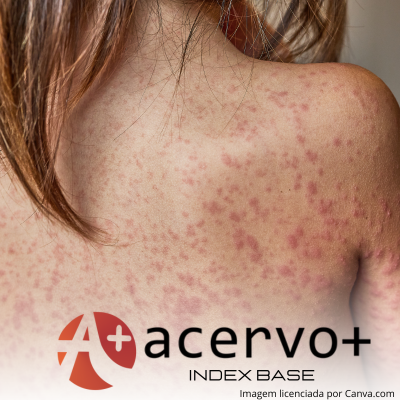
Objective: To describe a case report on Drug Reaction Syndrome with Eosinophilia and Systemic Symptoms (DRESS). Case report: A previously healthy 46-year-old male patient developed DRESS after using carbamazepine to treat neuralgia associated with herpes zoster. After 40 days of treatment, he presented with skin rashes, high fever and marked lymphadenopathy, and was diagnosed with DRESS in hospital. Immediate treatment involved discontinuing carbamazepine and administering hydrocortisone and promethazine, resulting in significant clinical and laboratory improvement. The medical team closely monitored his progress, ensuring that interventions were appropriate. Final considerations: DRESS syndrome, although rare, is a clinically relevant condition due to its significant morbidity and mortality. It is often associated with the use of various medications, but can also be related to common viral agents, such as the Epstein-Barr virus and other pathogens. Accurate diagnosis of this syndrome depends on health professionals recognizing the clinical criteria, which is essential for starting appropriate treatment and avoiding serious complications.
References
BOCQUET H, et al. Drug-induced pseudolymphoma and drug hypersensitivity syndrome (drug rash) with eosinophilia and systemic symptoms: DRESS. Semin Cutan Med Surg, 1996; 15(1): 250-257.
CALLE AM, et al. DRESS syndrome: A literature review and treatment algorithm. World Allergy Organ J, 2023; 16(3): 100673.
CARDONES AR. Drug reaction with eosinophilia and systemic symptoms (DRESS) syndrome. Clin Dermatol, 2020; 38(6): 702-711.
CHAPMAN S, et al. Apremilast-associated drug reaction with eosinophilia and systemic symptoms. Journal of the American Academy of Dermatology Case Reports, 2020; 6(4): 302-304.
CHHITI S, et al. DRESS syndrome with carbamazepine and Epstein–Barr virus reactivation. Our Dermatol Online, 2023; 14(1): 92-94.
DENG L, et al. Financial Burden and Health Care Utilization of Drug Reaction with Eosinophilia and Systemic Symptoms (DRESS): A Comprehensive Review. Journal of Health Economics, 2023; 85(1): 102578.
HAMA N, et al. Drug-Induced Hypersensitivity Syndrome (DIHS) / Drug Reaction With Eosinophilia and Systemic Symptoms (DRESS): Clinical Features and Pathogenesis. J Allergy Clin Immunol Pract, 2022; 10(5): 1155-1167.
HSU CY, et al. Psychological Impact and Quality of Life in Patients with DRESS Syndrome: A Longitudinal Study. Journal of Psychosomatic Research, 2021; 144(10): 110415.
KARDAUN SH, et al. Variability in the clinical pattern of cutaneous side-effects of drugs with systemic symptoms: does a DRESS syndrome really exist. Br J Dermatol, 2007; 156(12): 609–11.
MIYAGAWA F e ASADA H. Current Perspective Regarding the Immunopathogenesis of Drug-Induced Hypersensitivity Syndrome/Drug Reaction with Eosinophilia and Systemic Symptoms (DIHS/DRESS). Int J Mol Sci, 2021; 22(4): 2147.
MIYAGAWA F, et al. Correlation between Expression of CD134, a Human Herpesvirus 6 Cellular Receptor, on CD4+ T cells and Th2-type Immune Responses in Drug-induced Hypersensitivity Syndrome. Acta Derm. Venereol, 2020; 100(6): 5724.
PHILLIPS EJ, et al. Controversies in drug allergy: Testing for delayed reactions. J Allergy Clin Immunol, 2019; 143(1): 66 – 73.
PINTO LS, et al. Drug Reaction with Eosinophilia and Systemic Symptoms associada ao Alopurinol: um relato de caso. Acervo Saúde, 2020; 12(10): 4702.
RAMIREZ GA, et al. Drug Reaction with Eosinophilia and Systemic Symptoms (DRESS): Focus on the Pathophysiological and Diagnostic Role of Viruses. Microorganisms, 2023, 11(2): 346.
RODRÍGUEZ M, et al. DRESS syndrome secondary to carbamazepine. Rev Esp Enferm Dig, 2023; 115(2): 96-97.
SAPER VE, et al. Severe delayed hypersensitivity reactions to IL-1 and IL-6 inhibitors link to common HLA-DRB1*15 alleles. Ann Rheum Dis, 2022; 81(3): 406-415.
SCHUNKERT EM e DIVITO SJ. Updates and Insights in the Diagnosis and Management of DRESS Syndrome. Curr Dermatol Rep, 2021; 10(4): 192-204.
SCHWARTZ RA, et al. Drug Reaction with Eosinophilia and Systemic Symptoms (DRESS) Syndrome: An Update on Clinical Management and Economic Impact. Journal of Clinical Dermatology, 2022; 35(4): 455-467.
SHARMA A, et al. Carbamazepine-associated Drug Reaction with Eosinophilia and Systemic Symptoms Syndrome. J Pediatr Neurosci, 2021; 16(1): 55-57.
SHIOHARA T, et al. The diagnosis of a DRESS syndrome has been sufficiently established on the basis of typical clinical fea-tures and viral reactivations. Br J Dermatol, 2007; 156(5): 1083–1084.
VRINCEANU D, et al. Severe DRESS syndrome after carbamazepine intake in a case with multiple addictions: A case report. Exp Ther Med, 2020; 20(3): 2377-2380.