
Keywords
Qualitative research
Methods
Data Collection
How to Cite
Copyright © | All rights reserved.
The journal holds the exclusive copyright for the publication of this article under the terms of Brazilian law 9610/98.
Partial reproduction
The use of parts of the texts, figures and questionnaire of the article is free, being mandatory the citation of the authors and journal.
Total reproduction
It is expressly prohibited and must be authorized by the journal.
Abstract
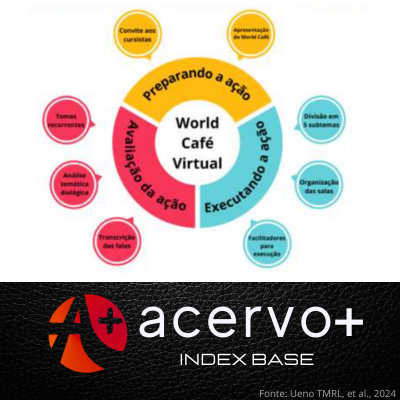
Objective: to describe the experience of using the virtual World Cafe as a teaching-learning method during a online course on qualitative health research. Experience report: This is an experience report on the remote teaching process using the virtual World Cafe active methodology. A group of 21 students and professors experienced the methodology. The transition to the virtual environment did not compromise the dynamics, and the technique was praised for its versatility. Challenges such as unstable connectivity were remedy, highlighting the active participation of those involved in the virtual rooms. Experiences with the virtual World Cafe can be used as a strategy for collecting qualitative data. The technique allows participants to reflect, discuss, and share experiences in a full and enriching way, even in an online environment. Final considerations: During and after the technical application the positive statements and engagement of the participants showed no disadvantages to using it online highlighting a valuable tool for qualitative health research.
References
ALBRECHT J, et al. Hosting an Online World Café to Develop an Understanding of Digital Health Promoting Settings from a Citizen’s Perspective—Methodological Potentials and Challenges. International Journal of Environmental Research and Public Health. 2022; 19(16): 1–19.
ASSUNÇÃO AA. Metodologias ativas de aprendizagem: práticas no ensino da Saúde Coletiva para alunos de Medicina. Revista Brasileira de Educação Médica. 2021; 45(3): 1–8.
BANFIELD M, GULLIVER A, MORSE AR. Virtual world café method for identifying mental health research priorities: Methodological case study. International Journal of Environmental Research and Public Health. 2022; 19(1): 1–8.
BATISTA NA, BATISTA SHSDS. Educação interprofissional na formação em Saúde: Tecendo redes de práticas e saberes. Interface - Comunicação, Saúde, Educação. 2016; 20(56): 204–6.
BATISTA NA, et al. Interprofessional health education: The experience of the Federal university of Sao Paulo, Baixada Santista campus, Santos, Brazil. Interface - Comunicação, Saúde, Educação. 2018; 22: 1705–15.
BATISTA NA. Educação Interprofissional em Saúde: Concepções e Práticas. Caderno FNEPAS. 2012; 2: 25–8
BRAUN V, CLARKE V. Using thematic analysis in psychology. Qualitative Research in Psychology. 2006; 3(2): 77–101.
BROOM M, et al. World Café Methodology engages stakeholders in designing a Neonatal Intensive Care Unit. Journal of Neonatal Nursing. 2013; 19(5): 253–8.
BROWN J, ISAACS D. O World Café: dando forma ao nosso futuro por meio de conversações significativas e estratégicas. 1st ed. Cutrix. 2007. 1–256 p.
COSTA JJS. A educação segundo Paulo Freire: uma primeira análise filosófica. Theoria - Revista Eletrônica de Filosofia. 2015; 7(18): 72–88.
COSTA MV. A educação interprofissional no contexto brasileiro: Algumas reflexões. Interface - Comunicação, Saúde, Educação. 2016; 20(56): 197–8.
FOUCHÉ C, LIGHT G. An invitation to dialogue: “The world café” in social work. Qualitative Social Work. 2011; 10(1): 28–48.
KAVANAGH ON, et al. More than coffee – a World Café to explore enablers of pharmacy practice research. International Journal of Pharmacy Practice. 2020;28(5):512–21.
LAINE-GOSSIN J, DEKOVEN S, BORDMAN R. Making connections: exploring residents’ perspectives on a virtual World Café as a novel approach for teaching Indigenous health issues. Canadian Medical Education Journal. 2022; 13(2): 92–5.
LEITE KNS, et al. Utilização da metodologia ativa no ensino superior da saúde: revisão integrativa. Arquivos de Ciências da Saúde da UNIPAR. 2021; 25(2): 133–44.
LÖHR K, WEINHARDT M, SIEBER S. The “World Café” as a Participatory Method for Collecting Qualitative Data. International Journal of Qualitative Methods. 2020; 19.
MACFARLANE A, et al. Participatory methods for research prioritization in primary care: an analysis of the World Café approach in Ireland and the USA. Family Practice. 2017; 34(3): 278–84.
MACHADO MPM, PASSOS MFD. O uso do world café como método de pesquisa junto às equipes de saúde. Revista Brasileira em Promoção da Saúde. 2018; 31: 1–10.
MARQUES HR, et al. Inovação no ensino: uma revisão sistemática das metodologias ativas de ensino-aprendizagem. Avaliação: Revista da Avaliação da Educação Superior. 2021; 26(3): 718–41.
MARTINS RX. A COVID-19 e o fim da educação à distância: um ensaio. EmRede. 2020; 7(1): 242–56.
MCKIMM J, et al. Capturing the wisdom of the crowd: health professions’ educators meet at a virtual world café. Perspectives on Medical Education. 2020; 9(6): 385–90.
NIEDERBERGER M, DREIACK S. Inklusive Teilnahme zwischen Fiktion und Realität? Eine Diskussion des Potenzials von On- und Offline-Partizipation am Beispiel des Bürgerdialogs Zukunftsthemen. In: Strategische Politische Kommunikation im digitalen Wandel. Wiesbaden: Springer Fachmedien Wiesbaden; 2018. p. 259–88.
RECCHIA V, et al. A critical look to community wisdom: Applying the World Café method to health promotion and prevention. International Journal of Health Planning and Management. 2022; 37(S1): 220–42.
SAIORON I, et al. World Café: desafios e métodos. New Trends in Qualitive Research. 2022; 10: 1–9.
SERRA IVS, et al. Remote teaching during the Covid-19 pandemic: a viewpoint according to Paulo Freire’s approach. Cogitare Enfermagem. 2022; 27: 1–7.
SOUZA EP. Educação em tempos de pandemia: desafios e possibilidades. Cadernos de Ciências Sociais Aplicadas. 2020; 17(30): 110–8.
TEZA P, et al. Geração de ideias: aplicação da técnica world café. International Journal of Knowledge Engineering and Management. 2013; (3): 1–14.
YANG CL, et al. World Café- a community conversation: a Canadian perspective on stroke survivors needs for community integration. Topics in Stroke Rehabilitation. 2022; 29(5): 392–400.