
Keywords
Hypothermia
Thermoregulation
Delivery rooms
How to Cite
Copyright © | All rights reserved.
The journal holds the exclusive copyright for the publication of this article under the terms of Brazilian law 9610/98.
Partial reproduction
The use of parts of the texts, figures and questionnaire of the article is free, being mandatory the citation of the authors and journal.
Total reproduction
It is expressly prohibited and must be authorized by the journal.
Abstract
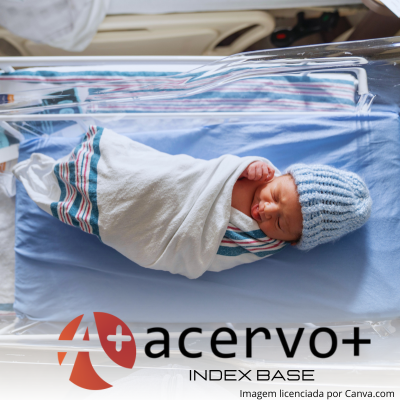
Objective: To analyze the factors associated with hypothermia in newborns in a public maternity hospital in Salvador, describe the obstetric, neonatal and environmental profile of births and verify the association of maternal factors, the newborn and the birth environment with neonatal hypothermia. Methods: Retrospective cross-sectional study carried out in a high-risk reference maternity hospital. Through the labor and birth care monitoring form, obstetric and neonatal information, the birth environment and good care practices were obtained for births occurring between January and June 2023. Bivariate analysis was used to evaluate differences between groups (hypothermic vs. normothermic). This project was approved by the Research Ethics Committee. Results: Of the 863 births analyzed, 370 (42.9%) were classified as hypothermic and 493 (57.1%) as normothermic. There was a statistically significant difference for maternal hypothermia, full-term newborn, APGAR score at the 5th minute, inadequate temperature in the delivery room and failure to turn off the air conditioning before birth. Conclusion: The findings demonstrated that hypothermia is still a problem and that in addition to neonatal factors, it is also associated with obstetric and environmental factors.
References
ALMEIDA MFB e GUINSBURG R. Reanimação do recém-nascido <34 semanas em sala de parto: dire-trizes 2022 da Sociedade Brasileira de Pediatria. Rio de Janeiro: 2022.
ALMEIDA MFB e GUINSBURG R. Reanimação do recém-nascido ≥34 semanas em sala de parto: dire-trizes 2022 da Sociedade Brasileira de Pediatria. Rio de Janeiro: 2022.
BEIRANVAND S, et al. The effects of skin-to-skin contact on temperature and breastfeeding successfulness in full-term newborns after cesarean delivery. International Journal of Pediatrics, 2014; 846486.
BELETEW B, et al. Prevalence of neonatal hypothermia and its associated factors in East Africa: a systematic review and meta-analysis. BMC Pediatrics, 2020; 20: 148.
BRASIL. Ministério da Saúde. Secretaria de Atenção à Saúde. Departamento de Ações Programáticas e Estratégicas. Atenção à saúde do recém-nascido: guia para os profissionais de saúde. Brasília: Ministério da saúde, 2011; 194. Disponível em: https ://bvsms.saude.gov.br/bvs/publicacoes/atencao_saude_recem_nascido_v1.pdf. Acessado em: 20 de março de 2023.
BRASIL. Ministério da Saúde. Secretaria de Atenção a Saúde. Departamento de Ações Programáticas e Estratégicas. Atenção humanizada à saúde do recém-nascido: Método Canguru. Brasília: Ministério da Saúde, 2017; 340. Disponível em: https ://bvsms.saude.gov.br/bvs/publicacoes/atencao_humanizada_metodo_canguru_manual_3ed.pdf. Acessado em: 20 de março de 2023.
COBB B, et al. Active Warming Utilizing Combined IV Fluid and Forced-Air Warming Decreases Hypothermia and Improves Maternal Comfort During Cesarean Delivery: A Randomized Control Trial. Anesthesia and analgesia, 2016; 122(5): 1490–1497.
CORDEIRO RCO, et al. Hypothermia and neonatal morbimortality in very low birth weight preterm infants. Revista Paulista de Pediatria, 2022; 40: 2020349.
DANG R, et al. Incidence of Neonatal Hypothermia in the Newborn Nursery and Associated Factors. JAMA Network Open, 2023; 6(8): 2331011.
DE LIMA ACMM, et al. Fatores de risco e morbimortalidade associada à hipotermia à admissão na unidade de terapia intensiva neonatal. Residência Pediátrica, 2022; 12(3): 1-6.
DESGRANGES FP, et al. Predictive factors of maternal hypothermia during Cesarean delivery: a prospective cohort study. Canadian Journal of Anesthesia, 2017; 64: 919-27.
DURYEA EL, et al. The impact of ambient operating room temperature on neonatal and maternal hypothermia and associated morbidities: a randomized controlled trial. American Journal of Obstetrics & Gynecology, 2016; 214(4): 505-1-5057.
ELBAUM C, et al. Antecedents and outcomes of hypothermia at admission to the neonatal intensive care unit. The Journal of Maternal-Fetal & Neonatal Medicine, 2021; 34(1): 66-71.
HARKOUK H, et al. Hypothermie profonde après rachianesthésie et morphine intrathécale après césarienne: un nouveau cas clinique [Hypothermia after intrathecal morphine for caesarean delivery: another case report]. Annales Françaises d'Anesthésie et de Réanimation, 2013; 32: 53-55.
HORN EP, et al. Active warming during cesarean delivery. Anesthesia and analgesia, 2002; 94(2): 409-414.
LAPTOOK AR, et al. Admission Temperature of Low-Birth-Weight Infants: Predictors and Associated Morbidities. Pediatrics, 2007; 119(3): 643–649.
LAPTOOK AR, et al. Admission Temperature and Associated Mortality and Morbidity among Moderately and Extremely Preterm Infants.The Journal of Pediatrics, 2018; 192: 53-592.
LIU J, et al. Advances in the Prevention and Treatment of Neonatal Hypothermia in Early Birth. Therapeutic hypothermia and temperature management, 2022; 12(2): 51-56.
MERAZZI D, et al. Body temperature at nursery admission in a cohort of healthy newborn infants: results from an observational cross-sectional study. Italian Journal of Pediatrics, 2020; 46(46).
MILLER S, et al. Hypothermia in very low birth weight infants: distribution, risk factors and outcomes. Journal of perinatology: official journal of the California Perinatal Association, 2011; 31(1): 49-56.
MUKUNYA D, et al. Neonatal hypothermia in Northern Uganda: a community-based cross-sectional study. BMJ Open, 2021; 11: 041723.
NEMETH M, et al. Perioperative Hypothermia in Children. International Journal of Environmental Research and Public Health, 2021; 18: 7541.
NGUYEN L, et al. Factors associated with hypothermia within the first 6 hours of life in infants born at ≥340 weeks' gestation: a multivariable analysis. BMC Pediatrics, 2022; 22(1): 447.
PERLMAN J e KJAER K. Neonatal and maternal temperature regulation during and after delivery. Anesthesia Analgesia, 2016; 123(1): 168-172.
PHOYA F, et al. Association of Neonatal Hypothermia with Morbidity and Mortality in a Tertiary Hospital in Malawi. Journal of Tropical Pediatrics, 2020; 66(5): 470-478.
SHARMA D. Golden hour of neonatal life: need of the hour. Maternal health, neonatology and perinatology, 2017; 3: 16.
SHIBESH BF, et al. Determinants of neonatal hypothermia among neonates admitted to neonatal intensive care unit northwest, Ethiopia, case-control study. The Journal of Maternal-Fetal & Neonatal Medicine. 2022; 35(20): 3903-3908.
SINGER D. Pediatric Hypothermia: An Ambiguous Issue. International Journal of Environmental Research and Public Health, 2021; 18: 11484.
SOARES T, et al. Prevalência da hipotermia na primeira hora de vida de prematuros com peso ≤ 1500g. Revista Gaúcha de Enfermagem, 2020; 41: 20190094.
SOBEL HL, et al. Immediate newborn care practices delay thermoregulation and breastfeeding initiation. Acta paediatrica. 2011; 100(8): 1127–1133.
WHO. WORLD HEALTH ORGANIZATION. Thermal protection of the newborn: a practical guide. In: Maternal and Newborn Health/Safe Motherhood Unit. Geneva: 1997. Disponível em: https ://apps.who.int/iris/bitstream/handle/10665/63986/WHO_RHT_MSM_97.2.pdf;jsessionid
=D26E524A0D9CBDDA2A090034178E83FB?sequence=1. Acessado em: 25 de junho de 2023.