
Keywords
Diagnosis
Technological innovation
Public health
How to Cite
Copyright © | All rights reserved.
The journal holds the exclusive copyright for the publication of this article under the terms of Brazilian law 9610/98.
Partial reproduction
The use of parts of the texts, figures and questionnaire of the article is free, being mandatory the citation of the authors and journal.
Total reproduction
It is expressly prohibited and must be authorized by the journal.
Abstract
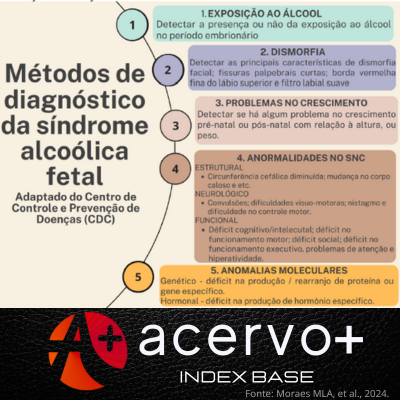
Objective: To conduct a technological prospecting of diagnostic methods for fetal alcohol syndrome (FAS) in affected individuals. Methods: This descriptive research analyzed technological innovations in articles and patents available in databases from 2002 to 2024, including documents whose diagnostic methods for FAS were directed at humans. The data were expressed in graphs and tables. Results: A total of 51 articles and 9 patents were included. The United States stood out in inventive activity and was the second in the number of article publications on the topic. The increase in articles since 2011 reflected the growth of alcohol consumption during childbearing age. The most frequent diagnostic method focused on detecting anomalies in the central nervous system, mainly in the postnatal period, probably due to the safety and detail offered by these methods. The most addressed age group was children, prioritizing early detection to improve patients' quality of life. Conclusion: Despite significant investment in research, a relatively low number of patents were observed compared to articles. Greater investment in inventive activities related to FAS diagnostic methods is suggested, as this is a public health problem affecting various countries.
References
ALMEIDA L, et al. Murine models for the study of fetal alcohol spectrum disorders: an overview. Frontiers in pediatrics, 2020; 8: 359-386.
BALTAZAR L, et al. Capacitação em propriedade intelectual e prospecção tecnológica por meio de patentes: análise da elaboração de método inovador. Brazilian Journal of Development, 2021; 7(7): 67577-67590.
BERRIGAN P, et al. Budget impact analysis of an epigenetic test used for diagnosing fetal alcohol spectrum disorder from the perspective of a laboratory budget holder in manitoba, Canada. Pharmaco Economics, 2022; 6(2): 253-263.
BROWN J, et al. The standardization of diagnostic criteria for fetal alcohol spectrum disorder (FASD): implications for research, clinical practice and population health. The Canadian Journal of Psychiatry, 2019; 64(3): 169-176.
CASTRO K, et al. Métodos diagnósticos e repercussões clínicas da Síndrome Alcoólica Fetal. Research, Society and Development, 2023; 12(8): 1-9.
DEJONG K, et al. Alcohol use in pregnancy. Clinical Obstetrics and Gynecology, 2019; 62(1): 142-155.
ERGUN G, et al. Fetal alcohol spectrum disorder—Issues of misdiagnosis and missed diagnosis in black youth: a case report. Innovations in Clinical Neuroscience, 2021; 18(4-6): 20-23.
FRANCESCHETTO L, et al. Phosphatidylethanol in maternal or neonatal blood to detect alcohol exposure during pregnancy: a systematic review. Life, 2022; 12: 1528-1549.
GLASS L, et al. Current considerations for fetal alcohol spectrum disorders: identification to intervention. Current Opinion In Psychriatry, 2023; 36(3): 249-256.
GOMES M. Saúde da mulher na gestação, parto e puerpério. Ministério da saúde. 2019.
GOMEZ D, et al. Fetal alcohol spectrum disorders: current state of diagnosis and treatment. Current Opinion In Pediatrics, 2021; 33(6): 570-575.
INPI. Guia Básico: Instituto Nacional de Propriedade Intelectual. GOV, 2020.
LIM Y. Fetal alcohol spectrum disorders screening tools: A systematic review. Research in Developmental Disabilities, 2022; 122: 1-14.
MANIKANDAN P, et al. Ethanol effects on early developmental stages studied using the zebrafish. Biomedicines, 2022; 10: 2055-2066.
MARQUES H, et al. Monitoramento tecnológico: estudo de uma propriedade intelectual da Universidade Federal de Viçosa. Cereus, 2014; 6: 1-20.
MATTSON S. Fetal alcohol spectrum disorders: a review of the neurobehavioral deficits associated with prenatal alcohol exposure. Alcohol, Clinical and Experimental Research, 2019; 43(6): 1046–1062.
MELO M, et al. Prospecção tecnológica em bases de patentes de técnicas e produtos aplicados à obtenção de monosexo em peixes. Veterinária e Zootecnia, 2022; 29: 1-16.
MUKHERJEE R, et al. Diagnosis and management of foetal alcohol specturm disorder. Current Opinion In Psychiatry, 2019; 32(2): 92-96.
NANOS. COVID-19 and increased alcohol consumption: NANOS poll summary report; canadian centre on substance. Use and addiction. NANOS Research, 2020.
NAUGHTON F, et al. Health behaviour change during the UK COVID-19 lockdown: Findings from the first wave of the C-19 health behaviour andwell-being daily tracker study. British Journal of Health Psychology, 2021; 26: 624–643.
POPOVA S, et al. Alcohol's impact on the fetus. Nutrients, 2021; 13: 2-16.
POPOVA S, et al. Fetal alcohol spectrum disorders. Nature Reviews Disease Primers, 2023; 9(11): 1-21.
REID N, et al. International survey of specialist fetal alcohol spectrum disorder diagnostic clinics: comparison of diagnostic approach and considerations regarding the potential for unificatio. International Journal of Environmental Research and Public Health, 2022; 19(23): 1-13.
ROOMANEY I, et al. Facial imaging to screen for fetal alcohol spectrum disorder: A scoping review. Alcohol, Clinical and Experimental Research, 2022; 46: 1166-1180.
SALTREUIL C, et al. Alcoolisation faetale. Médicine/Sciences, 2019; 35: 859-865.
SILVA W, et al. Aspectos gerais do sistema de propriedade intelectual no Brasil. Capacite, 2018; 1: 93-107.
SILVA W, et al. Monitoramento tecnológico da aplicação de enzimas celulolíticas: panorama mundial e brasileiro. Geama, 2021; 7: 48-58.
WHO. Global status report on alcohol and health 2018. World Health Organization. World Health Organization, 2018.
WIPO. Perguntas e respostas sobre PCT, 2004.
WIPO. Publicação IPC. IPCPUB, 2023; 8: 5.
WOZNIAK J, et al. Clinical presentation, diagnosis, and management of fetal alcohol spectrum disorder. The Lancet Neurology, 2019; 18(8): 760-770.