
Keywords
Malocclusion
Orthodontics
How to Cite
Copyright © | All rights reserved.
The journal holds the exclusive copyright for the publication of this article under the terms of Brazilian law 9610/98.
Partial reproduction
The use of parts of the texts, figures and questionnaire of the article is free, being mandatory the citation of the authors and journal.
Total reproduction
It is expressly prohibited and must be authorized by the journal.
Abstract
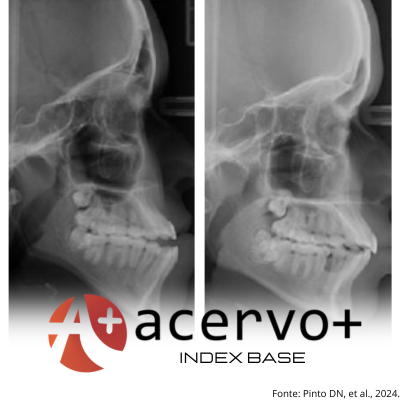
Objective: To report two cases of monozygotic twins with different types of malocclusions, one with Class I, Pattern I malocclusion and the other with Class III, Pattern III malocclusion, evaluating the influence of genetic and environmental components within the skull-dent complex facial. Case details: Monozygotic twins with different types of malocclusions, who sought treatment at a private clinic in Fortaleza, CE. The patients are 1 and 2., both 16 years old and female. The patients underwent initial exams for orthodontic evaluation, as they had malocclusions. The diagnosis of malocclusions was carried out with the aid of imaging exams, intraoral and extraoral photos, panoramic radiography, lateral teleradiography and cephalometric analyses. Final considerations: Through this report with monozygotic twins, we observed that the etiology of Class III malocclusions does not depend solely on genetic factors to express themselves, their etiology is multifactorial and genetic, epigenetic and environmental factors contribute significantly to the expression and severity of the malocclusion.
References
AIKINS E.A. e ONYEASO C.O. Prevalência de maloclusão e traços oclusais entre adolescentes e jovens adultos no Estado de Rivers, Nigéria. Odontostomatol Trop, 2014; 37: 5-12.
ANGLE E.H. Classification of malocclusion. Dental Cosmos, 1899; 41(3): 248-264.
BRAGA CP, et al. Comparação do diâmetro mésiodistal de incisivos e primeiros molares permanentes entre gêmeos monozigóticos. J Bras Ortodon Ortop Facial, 2003; 8: 30-39.
CARVALHO IF, et al. Aspectos genéticos e epigenéticos relacionados com maloclusão: relato de casos de gêmeos monozigóticos. Brazilian Journal of Health Review, 2019; 2(5): 4719–4730.
CHHIBBER A. et al. Correção cirúrgica versus funcional de Classe II a longo prazo: uma comparação entre gêmeos idênticos. Angle Orthodontist, 2015; 85(1): 142-156.
CHUNG KR, et al. Correção de Classe III usando terapia biocriativa (C-Therapy). Semin Orthod, 2011; 17: 108-123.
CONSOLARO A. O gene e a epigenética: as características dentárias e maxilares estão relacionadas com fatores ambientais ou os genes não comandam tudo? Insight Ortodôntico. R Dental Press Ortodon Ortop Facial, 2009; 14(6): 14-18.
DELABARY RM e LIMA EMS. de. Comparação cefalométrica do complexo craniofacial entre gêmeos monozigóticos. Jornal Brasileiro de Ortodontia e Ortopedia Facial, 2003; 8: 376-387.
DJORDJEVIC J, et al. Genetic and environmental contributions to facial morphological variation: a 3D population-based twin study. Plos One, 2016; 11(9): 162250.
JENA A, et al. Class-III malocclusion: Genetics or environment? A twins study. J Indian Soc Pedod Prev Dent, 2005; 23(1): 27-30.
KRAUS BS, et al. Hereditariedade e o complexo craniofacial. Am J Orthod , 1959; 45: 172-217.
LAUWERYNS I, et al. The use of twins in dentofacial genetic research. Am J Orthod Dentofacial Orthop, 1993; 103(1).
LUNDSTRFM A. The significance of genetic and non-genetic factors in the profile of the facial skeleton. Revista Eletrônica Acervo Saúde, 1955; 41(12): 910-916.
MANFREDI C, et al. Heritability of orthodontic cephalometric parameters and MN-paired singletons. Revista Eletrônica Acervo Saúde, 1997; 111(1): 44-51.
MAS C e FRAPIER LA genetic heritage; the same yet different: A comparative study in twins. Revista Eletrônica Acervo Saúde, 2017; 15: 483-497.
NARAYANAN RK, et al. Prevalence of malocclusion among 10-12-year-old schoolchildren in Kozhikode District, Kerala: an epidemiological study. Revista Eletrônica Acervo Saúde, 2016; 9(1): 50-55.
NETO JRS, et al. Protocolo de diagnóstico clínico e radiográfico de classe e padrão de pacientes compensatórios, limítrofes ou ortocirúrgicos. Revista de Fisioterapia, 2024; 28.
PINTO EM, et al. Análise crítica dos diversos métodos de avaliação e registro das más oclusões. Revista Eletrônica Acervo Saúde, 2008; 13(1): 82-91.
PRESTES MCS, et al. Tratamento da má oclusão de Classe III com o uso de miniplacas como dispositivo de ancoragem. Revista Eletrônica Acervo Saúde, 2018; 11(42): 75-84.
SAHU M e PRASUNA J. Twin studies: a unique epidemiological tool. Revista Eletrônica Acervo Saúde, 2016; 41(3): 177-182.
SAKUDA M, et al. Monozygotic twins showing differences in occlusion. Revista Eletrônica Acervo Saúde, 1973; 43(1): 41-52.
ŠIDLAUSKAS M, et al. Heritability of mandibular cephalometric variables in twins with completed craniofacial growth. Revista Eletrônica Acervo Saúde, 2016; 38(5): 493–502.
SUGAWARA J, et al. One-phase vs 2-phase treatment for developing Class III malocclusion: a comparison of identical twins. Revista Eletrônica Acervo Saúde, 2012; 141(1): 1122.
TOWNSEND GC, et al. Genetic aspects of dental disorders. Revista Eletrônica Acervo Saúde, 1998; 43(4): 269-286.
TOWNSEND GC e RICHARDS LC. Twin and twinning, dentists and dentistry. Revista Eletrônica Acervo Saúde, 1990; 35(4): 317-327.
XUE F, et al. Genes, genetics, and Class III malocclusion. Revista Eletrônica Acervo Saúde, 2010; 13: 69–74.