
Keywords
Denture Partial Removable
Prosthetic Rehabilitation
Palatal obliterator
How to Cite
Copyright © | All rights reserved.
The journal holds the exclusive copyright for the publication of this article under the terms of Brazilian law 9610/98.
Partial reproduction
The use of parts of the texts, figures and questionnaire of the article is free, being mandatory the citation of the authors and journal.
Total reproduction
It is expressly prohibited and must be authorized by the journal.
Abstract
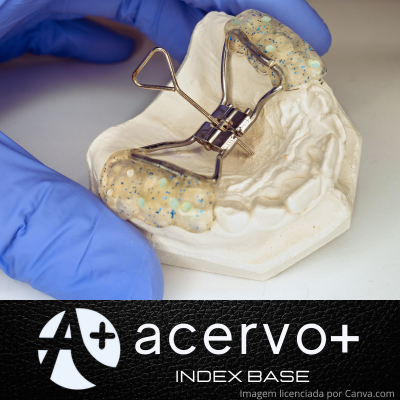
Objective: To report the case of a 48-year-old patient with congenital cleft palate who sought prosthetic rehabilitation using a clasp-assisted removable partial denture with palatal obturator (PPRGOP). Case details: The patient specifically used a temporary acrylic removable partial denture retained by orthodontic wires (PPRP) for a period of 1 year. The patient complained of difficulties in chewing and speaking; in addition to aesthetic dissatisfaction, which compromised his quality of life in the functional and social spheres. In order to make him suitable for prosthetic rehabilitation, the patient underwent complete oral adaptation, which was previously attended to in the Oral Surgery, Periodontics, Endodontics and Dentistry clinics. Final considerations: After adaptation to the oral environment, the patient returned to the Removable Partial Denture Clinic for rehabilitation using a PPRGOP. This prosthetic rehabilitation, by presenting a metal infrastructure, provided greater prevention, stability, aesthetics and, consequently, significantly recovered chewing and phonetics by specifically obliterating the cleft palate. In this way, it was possible to improve the patient's quality of life.
References
CHEN J, et al. Obturator Manufacturing for Oronasal Fistula after Cleft Palate Repair: a review from handicraft to the application of digital techniques. Journal Of Functional Biomaterials, 2022; 13(4):251–1.
JESUS R, et al. Oral rehabilitation in patients with cleft lip and palate: literature review. Facit Business and Technology Journal, 2022.
AZEVEDO K, et al. Tratamento com Prótese Removível em Paciente com Fenda Lábio-Palatina. Instituto Universitário de Ciências da Saúde, Pernambuco, 2020; 3(1):41.
LIMA VC, et al. Análise cognitiva e qualidade de vida em crianças portadoras de fissura orofacial não sindrômica: estudo caso controle. Revista Eletrônica Acervo Saúde, 2020; 12(3): 271-2.
SILVA LD, et al. Vedamento Parcial de Fissura Labiopalatina Utilizando Placa Obturadora em Resina Acrílica: Relato de Caso. Revista Eletrônica Acervo Saúde, 2019; 18(1).
SAMPAIO L, et al. Prosthetic rehabilitation in patients with cleft palate: case report. Rev. Uningá, Maringá, 2018.
WORLEY M. et al. Cleft Lip and Palate. Clinics In Perinatology, 2018, 45(4):661-678.
CHAVES SCL, et al. Política de atenção à fissura labiopalatina: a emergência do Centrinho de Salvador, Bahia. Physis Revista de Saúde Coletiva, 2016; 26(2): 591-610.
TREZZA PM, et al.. Custo do tratamento complementar da fissura labiopalatina. Revista UNINGÁ, 2016; 47(1):38-44.
GUPTA L, et al. Functional and Aesthetic Rehabilitation of a Geriatric Patient with Cleft Palate: a case report. The Cleft Palate-Craniofacial Journal, 2015, 52(3):363-368.
SILVA MAM. Próteses obturadoras na reabilitação oral de pacientes com fendas palatinas. Dissertação (Mestrado Integrado em Medicina Dentária) –FMDUP. Universidade do Porto, Porto, 2015.
TAIB B, et al. Cleft lip and palate: diagnosis and management. British Journal Of Hospital Medicine, 2015, 76(10):584-591.
GOYAL M, et al. Role of obturators and other feeding interventions in patients with cleft lip and palate: a review. European Archives Of Paediatric Dentistry, 2014, 15(1):1-9.
MARTELLI, DBR. Non sindromic cleft lip and palate: relationship between sex and clinical extension. Braz J Otorhinolaryngol, 2012; 78 (5): 116-120.
GÜMÜŞ HO e TUNA SH. An alternative method for constructing an obturator prosthesis for a patient with a bilateral cleft lip and palate: a clinical report. Journal of Esthetic and Restorative Dentistry, 2009, 21(2),89-94.
TUNA SH, et al. Rehabilitation of an Edentulous Cleft Lip and Palate Patient with a Soft Palate Defect Using a Bar-Retained, Implant-Supported Speech-Aid Prosthesis: a clinical report. The Cleft Palate-Craniofacial Journal, 2009, 46 (1), 97-102.
SPINA V, et al. Classificação das fissuras lábio-palatinas: sugestão de modificação. Rev Hosp Clin Fac, 2008.
DUSKOVA M. et al. Bone reconstruction of the maxillary alveolus for subsequent insertion of a dental implant in patients with cleft lip and palate. J Craniofac Surg, 2007, 18, 630-638.
REISBERG DJ. Prosthetic habilitation of patients with clefts. Clinics In Plastic Surgery, 2004, 31, (2), 353-360.
SILVA O, et al. Classificação das fissuras labiopalatinas: breve histórico, considerações clínicas e sugestão de modificação. Rev Bras Cir, 1992, 82 (2), 59-65.