
Keywords
Dental pulp capping
Endodontics
How to Cite
Copyright © | All rights reserved.
The journal holds the exclusive copyright for the publication of this article under the terms of Brazilian law 9610/98.
Partial reproduction
The use of parts of the texts, figures and questionnaire of the article is free, being mandatory the citation of the authors and journal.
Total reproduction
It is expressly prohibited and must be authorized by the journal.
Abstract
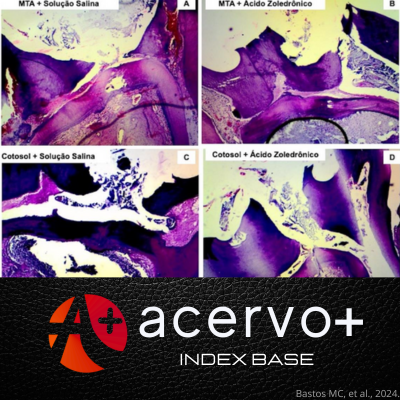
Objective: Given the widespread use of bisphosphonates (BF) for treating conditions like osteoporosis and bone metastases, and the need to prevent bisphosphonate-induced osteonecrosis of the jaws (BON), understanding their impact on vital pulp therapy (VPT) is essential. Methods: This study evaluated the pulp and periapical response, as well as the repair capacity of direct pulp capping (DPC) in an animal model pretreated with bisphosphonates. Using 36 lower molars from 18 Wistar rats, the animals were divided based on restorative material (MTA or Cotosol) and pharmacological treatment (Zoledronic Acid or saline). Results: The ZA + MTA group demonstrated superior outcomes, with 44.5% mild inflammation (p=0.033), 88.9% absence of periapical pathology (p=0.034), and 55.6% slight dentin bridge formation (p=0.01). Additionally, 33.3% of the group maintained normal tissue morphology (p=0.024) with the lowest dystrophic calcification occurrence (37.5%) (p=0.032). Conclusion: The findings suggest that MTA reduces inflammatory infiltrates, promotes dentin formation, and supports periapical health, even in the presence of bisphosphonates. These results highlight MTA's potential to mitigate the adverse effects of bisphosphonates on pulp and periapical healing.
References
ALRAHABI MK e GHABBANI HM. Clinical impact of bisphosphonates in root canal therapy. Saudi Med J, 2018; 39(3): 232.
BRIZUELA C, et al. Direct pulp capping with calcium hydroxide, mineral trioxide aggregate, and biodentine in permanent young teeth with caries: a randomized clinical trial. J Endod, 2017; 43(11): 1776-80.
CUNHA D, et al. 3D-printed microgels supplemented with dentin matrix molecules as a novel biomaterial for direct pulp capping. Clin Oral Investig, 2023; 27(3): 1215-25.
CVIKL B, et al. The response of dental pulp‐derived cells to zoledronate depends on the experimental model. Int Endod J, 2011; 44(1): 33-40.
DE BARROS SILVA PG, et al. Chronic treatment with zoledronic acid alters the expression levels of inflammatory, bone, and apoptotic markers and Toll-like receptors 2 and 4 in rat dental pulp. Oral Surg Oral Med Oral Pathol Oral Radiol, 2019; 128(2): 139-45.
DE BARROS SILVA PG, et al. Immune cell profile of dental pulp tissue treated with zoledronic acid. Int Endod J, 2017; 50(11): 1067-76.
DE-FREITAS NR, et al. Bisphosphonate treatment and dental implants: A systematic review. Med Oral Patol Oral Cir Bucal, 2016; 21(5).
FILLEUL O, et al. Bisphosphonate-induced osteonecrosis of the jaw: a review of 2,400 patient cases. J Cancer Res Clin Oncol, 2010; 136(8): 1117-24.
FLIEFEL R, et al. Treatment strategies and outcomes of bisphosphonate-related osteonecrosis of the jaw (BRONJ) with characterization of patients: a systematic review. Int J Oral Maxillofac Surg, 2015; 44(5): 568-85.
HORSOPHONPHONG S, et al. Equivalence of human and bovine dentin matrix molecules for dental pulp regeneration: proteomic analysis and biological function. Arch Oral Biol, 2020.
KILKENNY C, et al. Animal research: reporting in vivo experiments: the ARRIVE guidelines. Br J Pharmacol., 2010; 160(7): 1577.
KIM M, et al. Effect of ProRoot MTA® and Biodentine® on osteoclastic differentiation and activity of mouse bone marrow macrophages. J Appl Oral Sci, 2019; 27.
KLEIN‐JÚNIOR CA, et al. Development and evaluation of calcium hydroxide‐coated, pericardium‐based biomembranes for direct pulp capping. J Investig Clin Dent, 2019; 10(1).
KUROSHIMA S, et al. Medication-related osteonecrosis of the jaw: A literature review. J Oral Biosci, 2019; 61(2): 99-104.
LIN HP, et al. Controlled release of lovastatin from poly (lactic-co-glycolic acid) nanoparticles for direct pulp capping in rat teeth. Int J Nanomedicine, 2017; 12: 5473.
LIU L, et al. The expression of MCP-1 and CCR2 in induced rats periapical lesions. Arch Oral Biol., 2014; 59(5): 492-9.
MANASPON C, et al. Human dental pulp stem cell responses to different dental pulp capping materials. BMC Oral Health, 2021; 21(1): 209.
PAPIC M, et al. Effects of direct pulp capping with recombinant human erythropoietin and/or mineral trioxide aggregate on inflamed rat dental pulp. Mol Cell Biochem, 2023.
PAULA A, et al. Direct pulp capping: which is the most effective biomaterial? A retrospective clinical study. Materials, 2019; 12(20): 3382.
PEZELJ-RIBARIC S, et al. Detection of tumor necrosis factor α in normal and inflamed human dental pulps. Arch Med Res, 2002; 33(5): 482-4.
QIU Y, et al. Activation of the Wnt/β-catenin signaling pathway is required for FGF-2-induced proliferation and odontogenic differentiation of human periodontal ligament stem cells. J Cell Mol Med, 2018; 22(1): 582-92.
TOMSON PL, et al. Growth factor release from dentine matrix by pulp-capping agents promotes pulp tissue repair-associated events. Int Endod J, 2017; 50: 281-292.
TRONGKIJ V, et al. The effect of mineral trioxide aggregate (MTA) and zinc oxide (ZA) on inflammatory response and dentin formation after pulpotomy in dog teeth. J Clin Dent, 2018; 29(2): 131-8.
TZIAFA C, et al. Dentinogenic responses after direct pulp capping of miniature swine teeth with Biodentine. J Endod, 2014; 40(12): 1967-71.
WANG Y, et al. Mineral trioxide aggregate enhances the odonto/osteogenic capacity of stem cells from inflammatory dental pulps via NF‐κB pathway. Oral Dis, 2014; 20(7): 650-8.
WATERHOUSE PJ e Teixeira RM. Pulp revascularization: a review of the clinical techniques and therapeutic outcomes. Int Endod J, 2002; 35(6): 441-51.
WELLS C, et al. Vital pulp therapy for endodontic treatment of mature teeth: a review of clinical effectiveness, cost-effectiveness, and guidelines. Vital Pulp Therapy, 2019.
ZHAO X, et al. Mineral trioxide aggregate promotes odontoblastic differentiation via mitogen-activated protein kinase pathway in human dental pulp stem cells. Mol Biol Rep, 2012; 39: 215-20.
ZHU C, et al. Clinical outcome of direct pulp capping with MTA or calcium hydroxide: a systematic review and meta-analysis. Int J ClinExp Med, 2015; 8(10): 17055.