
Keywords
TNF Antagonist
Sarcoidosis
How to Cite
Copyright © | All rights reserved.
The journal holds the exclusive copyright for the publication of this article under the terms of Brazilian law 9610/98.
Partial reproduction
The use of parts of the texts, figures and questionnaire of the article is free, being mandatory the citation of the authors and journal.
Total reproduction
It is expressly prohibited and must be authorized by the journal.
Abstract
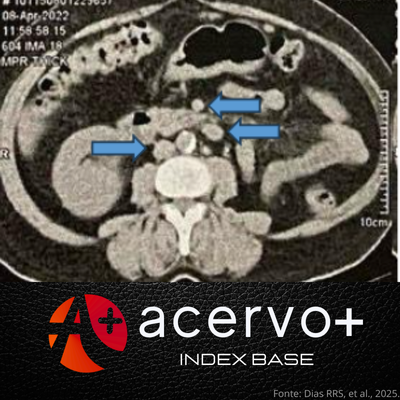
Objective: To report a case of psoriatic arthritis that evolved into sarcoidosis after seven years of use of tumor necrosis factor antagonist (anti-TNF) drugs, adalimumab and, later, etanercept. Case details: Female patient, 64 years old, diagnosed with psoriatic arthritis, used adalimumab for two years and, after therapeutic failure, was switched to etanercept, which had been used for five years. He had recurrent polyarthralgia and persistent fatigue. On physical examination, left ankle arthritis, nail dystrophy and pitting. No palpable lymph node enlargement and active psoriasis lesions. Abdominal tomography showed retroperitoneal lymph node enlargement, and it was decided to perform a biopsy via laparotomy. The histopathological findings were non-caseating epithelioid granulomas and immunohistochemistry showed findings consistent with chronic granulomatous lymphadenitis, suggesting sarcoidosis. Considerations: Anti-TNFs are used to treat sarcoidosis, however it is believed that these drugs do not inhibit all signaling pathways, thus resulting in "escape" routes and, in some cases, causing sarcoidosis secondary to these drugs. If the patient does not present respiratory symptoms and granulomatous skin lesions, we must be aware of the possibility of antiTNF-induced sarcoidosis.
References
ALBERNAZ MS, et al. Reação sarcoidose-like induzida por adalimumabe em paciente com artrite reumatoide. Revista Brasília Médica, 2022; 1-6: 59.
ARKEMA EV, et al. Epidemiology of Sarcoidosis: Current Findings and Future Directions. Ther. Adv. Chronic Dis, 2018; 9: 227–240.
CHOPRA A, et al. Drug-Induced Sarcoidosis-Like Reactions. Chest, 2018; 154: 664–77.
COHEN AUBART F, et al. Cohen Aubart, Fleur et al. Drug‐induced sarcoidosis: an overview of the WHO pharmacovigilance database. Journal of Internal Medicine, 2020; 288: 356-362.
CROMMELIN HA, et al. Anti-TNF therapeutics for the treatment of sarcoidosis. Immunotherapy, 2014; 6(10): 1127-1143.
CROUSER ED, et al. Diagnosis and Detection of Sarcoidosis. An Official American Thoracic Society Clinical Practice Guideline. Am. J. Respir. Crit. Care Med, 2020; 201: 26-51.
DAIEN CI, et al. Sarcoid-like granulomatosis in patients treated with tumor necrosis factor blockers: 10 cases. Rheumatology, 2009; 48(8): 883-886.
DONZELLA D, et al. New onset sarcoidosis following biologic treatment in patients with seronegative inflammatory arthritis: A case series and systematic literature review. Autoimmunity Reviews, 2024; 23(3): 103481.
DOTY JD, et al. Treatment of sarcoidosis with infliximab. Chest, 2005; 1064-71.
ELLERIN T, et al. Infections and anti-tumor necrosis factor α therapy. Arthritis Rheum, 2003; 48: 3013-22.
GERKE AK, et al. Treatment of Sarcoidosis: A Multidisciplinary Approach. Frontiers in Immunology, 2020; 11(545413): 19.
GONÇALVES P, et al. Sarcoidosis-like reaction secondary to adalimumab treatment in a patient with axial spondylarthritis. Monaldi Arch Chest Dis, 2022; 4: 93(1).
HUNNINGHAKE G, et al. Statement on Sarcoidosis. Am. J. Respir. Crit. Care Med, 1999; 160: 20.
IANNUZZI MC, et al. Sarcoidosis. N Engl J Med, 2007; 357: 2153-65.
JUDSON MA, et al. The diagnosis of sarcoidosis. Clin. Chest Med, 2008; 29: 415-425.
JUDSON MA, et al. The WASOG Sarcoidosis Organ Assessment Instrument: An Update of a Previous Clinical Tool. Sarcoidosis Vasc. Diffus. Lung Dis, 2014; 31: 19–27.
MASSARA A, et al. Sarcoidosis appearing during anti-tumor necrosis factor alpha therapy: a new "class effect" paradoxical phenomenon. Two case reports and literature review. Semin Arthritis Rheum, 2010; 39(4): 313-9.
METYAS SK, et al. Adalimumab-induced noncaseating granuloma in the bone marrow of a patient being treated for rheumatoid arthritis. Rheumatol Int, 2009; 29(4): 437-9.
NEWMAN LS, et al. Sarcoidosis. The New England journal of medicine, 1997; 336(17): 1224-34.
REZAEE M, et al. Role of anti-tumor necrosis factor-alpha agents in treatment of sarcoidosis: A meta-analysis. European Journal of Internal Medicine, 2023; 109: 42-49.
SWEISS N, et al. Rheumatologic. Manifestations of Sarcoidosis. Semin. Respir. Crit. Care Med, 2010; 31: 463–473.
UNTERSTELL N, et al. Systemic sarcoidosis induced by etanercept: first Brazilian case report. An Bras Dermatol, 2013; 88(6-1): 197-199.
VALEYRE D, et al. ERS clinical practice guidelines on treatment of sarcoidosis. Eur Respir J, 2021; 58(6): 2004079.
VALEYRE D, et al. Sarcoidosis. Lancet, 2014; 383: 1155–1167.
WANG A, et al. Interleukin-17 blockade downregulates NOD2 in skin and may promote paradoxical sarcoidosis. J Eur Acad Dermatol Venereol., 2020; 34(9): e497-e499.