
Keywords
Immunohistochemistry
PTEN phosphohydrolase
Phosphatidylinositol 3-kinase
Ribosomal protein S6 kinase
How to Cite
Copyright © | All rights reserved.
The journal holds the exclusive copyright for the publication of this article under the terms of Brazilian law 9610/98.
Partial reproduction
The use of parts of the texts, figures and questionnaire of the article is free, being mandatory the citation of the authors and journal.
Total reproduction
It is expressly prohibited and must be authorized by the journal.
Abstract
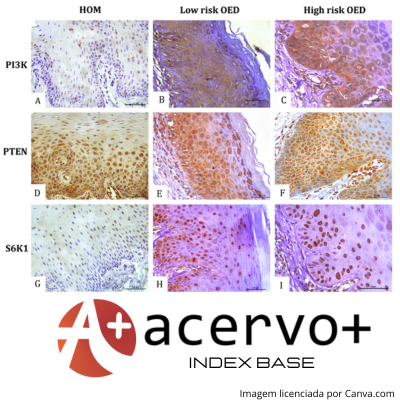
Objective: To evaluate the immunoexpression of PI3K, PTEN, and S6K1 proteins in oral epithelial dysplasias (OED). Methods: Twenty cases of OED with different histological grades and twenty cases of healthy oral mucosa (HOM) were subjected to immunohistochemical reaction using anti-PI3K, anti-PTEN, and anti-S6K1 antibodies, which were analyzed semiquantitatively. Statistical analysis was carried out using Fisher's exact test or Pearson's chi-squared test for categorical variables, and the Mann-Whitney test or the Kruskal-Wallis test for quantitative variables. Results: A higher frequency of positive immunostaining for PI3K and S6K1 was observed in OED, together with decreased nuclear and cytoplasmic PTEN in OED compared to HOM. Furthermore, a higher mean cytoplasmic number of cells expressing PTEN was observed in low-risk OED compared to high-risk ones. Conclusion: Increased expression of PI3K and S6K1, along with reduced PTEN expression, may be linked to the development and progression of OED. Consequently, these markers may have potential diagnostic value, aiding in risk stratification and potentially contributing to prognosis assessment.
References
BADWELAN M, et al. Oral Squamous Cell Carcinoma and Concomitant Primary Tumors, What Do We Know? A Review of the Literature. Current Oncology, 2023; 30(4): 3721–34.
CHAVES FN, et al. Loss of heterozygosity and immunoexpression of PTEN in oral epithelial dysplasia and squamous cell carcinoma. Exp Mol Pathol, 2020; 112: 104341.
DELGADO L, et al. p-S6 as a Prognostic Biomarker in Canine Oral Squamous Cell Carcinoma. Biomolecules, 2022; 12(7): 935.
ESTEVA FJ, et al. PTEN, PIK3CA, p-AKT, and p-p70S6K Status. The American Journal of Pathology, 2010; 177(4): 1647–56.
GIUDICE FS, SQUARIZE CH. The determinants of head and neck cancer: Unmasking the PI3K pathway mutations. J Carcinog Mutagen, 2013; Suppl 5: 003.
GUIMARÃES LM, et al. The genetic basis of oral leukoplakia and its key role in understanding oral carcinogenesis. J Oral Pathology Medicine, 2021; 50(7): 632–8.
HAN EJ, et al. Piperine Induces Apoptosis and Autophagy in HSC-3 Human Oral Cancer Cells by Regulating PI3K Signaling Pathway. IJMS, 2023; 24(18): 13949.
IDRIS A, et al. Relative Frequency of Oral Malignancies and Oral Precancer in the Biopsy Service of Jazan Province, 2009-2014. Asian Pacific Journal of Cancer Prevention, 2016; 17(2): 519–25.
KAUR J, et al. Clinical significance of Phosphatidyl Inositol Synthase overexpression in oral cancer. BMC Cancer, 2010; 10(1): 168.
KUJAN O, et al. Evaluation of a new binary system of grading oral epithelial dysplasia for prediction of malignant transformation. Oral Oncology, 2006; 42(10): 987–93.
LEONEL ACLS, et al. Knowledge and Attitudes of Primary Health Care Dentists Regarding Oral Cancer in Brazil. Acta Stomatol Croat, 2019; 53(1): 55–63.
MARTINS F, et al. PI 3K– AKT – MTOR pathway proteins are differently expressed in oral carcinogenesis. J Oral Pathology Medicine, 2016; 45(10): 746–52.
MIYAHARA LAN, et al. PTEN allelic loss is an important mechanism in the late stage of development of oral leucoplakia into oral squamous cell carcinoma. Histopathology, 2018; 72(2): 330–8.
MOURA ACD, et al. Worldwide prevalence of PI3K-AKT-mTOR pathway mutations in head and neck cancer: A systematic review and meta-analysis. Critical Reviews in Oncology/Hematology, 2021; 160: 103284.
PAGIN O, et al. The importance of a proper selection area to be biopsied in nodular leukoplakia: a case report. Acta Stomatol Croat, 2014; 48(1): 42–7.
RADMAN M, et al. Knowledge of Oral Cancer among the Fourth and Fifth Year Dental Students. Acta Stomatol Croat, 2018; 52(4): 340–7.
VERED M, WRIGHT JM. Update from the 5th Edition of the World Health Organization Classification of Head and Neck Tumors: Odontogenic and Maxillofacial Bone Tumours. Head and Neck Pathol, 2022; 16(1): 63–75.
WANG H, et al. Elevated Expression of Zinc Finger Protein 703 Promotes Cell Proliferation and Metastasis through PI3K/AKT/GSK-3β Signalling in Oral Squamous Cell Carcinoma. Cell Physiol Biochem, 2017; 44(3): 920–34.
WARNAKULASURIYA S, et al. Oral potentially malignant disorders: A consensus report from an international seminar on nomenclature and classification, convened by the WHO Collaborating Centre for Oral Cancer. Oral Diseases, 2021; 27(8): 1862–80.
WILS LJ, et al. The role of differentiated dysplasia in the prediction of malignant transformation of oral leukoplakia. J Oral Pathology Medicine, 2023; 52(10): 930–8.
WU J, et al. PLAC8 inhibits oral squamous cell carcinogenesis and epithelial-mesenchymal transition via the Wnt/β-catenin and PI3K/Akt/GSK3β signaling pathways. Oncol Lett, 2020; 20(5): 1–1.