
Keywords
Education
Dental
Pediatric dentistry
How to Cite
Copyright © | All rights reserved.
The journal holds the exclusive copyright for the publication of this article under the terms of Brazilian law 9610/98.
Partial reproduction
The use of parts of the texts, figures and questionnaire of the article is free, being mandatory the citation of the authors and journal.
Total reproduction
It is expressly prohibited and must be authorized by the journal.
Abstract
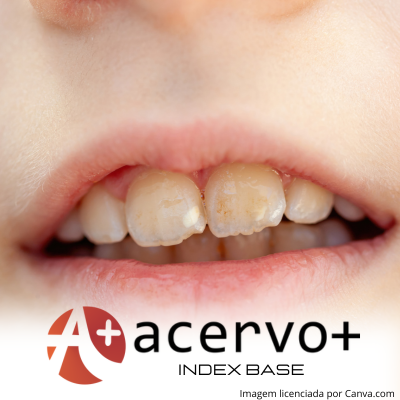
Objective: Evaluate the knowledge of Dentistry students regarding Molar Incisor Hypomineralization (MIH). Methods: This is a cross-sectional analytical observational study with a qualitative and quantitative approach. A total of 122 students from the 6th to the 10th semester participated in the research by answering an online questionnaire via Google Forms. Results: The results showed that 74.6% of participants reported knowing what MIH is, with most of them (81.5%) acquiring this knowledge during their undergraduate studies, mainly in the theoretical Pediatric Dentistry course (66.7%). However, 61.5% of participants stated that they had not encountered clinical cases of MIH. It was also observed that, although the students demonstrated basic knowledge about the condition, significant gaps remain in aspects such as etiology, differential diagnosis, and materials indicated for definitive restoration. Conclusion: It is concluded that there is a need to improve courses related to Pediatric Dentistry and to encourage further studies on the topic, aiming to enhance future professionals' knowledge for early diagnosis and proper treatment, preserving dental tissue and providing a better quality of life for patients.
References
ALMUALLEN SA, BUSUTTIL-NAUDI A. Molar incisor hypomineralization (MIH) - an overview. British Dental Journal, 2018; 225(7): 601-606.
ASSUNÇÃO CM, et al. Hypersensitivity and esthetic concerns in patients affected by molar incisor hypomineralization: a case series. The Journal of Contemporary Dental Practice, 2014; 15(6): 787-790.
BEZAMAT M, et al. Association between genetic polymorphisms in enamel formation genes and molar-incisor hypomineralization in a southern Brazilian population. Caries Research, 2021; 55(1): 48-55.
CABRAL RN, et al. Impact of molar-incisor hypomineralization on oral health-related quality of life in schoolchildren. Brazilian Oral Research, 2019; 33: e076.
COSTA-SILVA CM, et al. Molar incisor hypomineralization: prevalence, severity and clinical consequences in Brazilian children. International Journal of Paediatric Dentistry, 2010; 20(6): 426-434.
CROMBIE F, et al. Aetiology of molar-incisor hypomineralization: a critical review. International Journal of Paediatric Dentistry, 2009; 19(2): 73-83.
DAVENPORT M, et al. Prevalence of molar-incisor hypomineralization in the southeastern region of Brazil. Brazilian Dental Journal, 2019; 30(4): 324-328.
ELHENNAWY K, et al. Management of molar-incisor hypomineralization: a systematic review. JournalofDentistry, 2017; 55: 16-24.
FARIAS L, et al. Hipomineralização molar-incisivo: etiologia, características clínicas e tratamento. Revista de Ciências Médicas e Biológicas, 2018; 17(2): 211-219.
FATTURI AL, et al. A systematic review and meta-analysis of the association between molar incisor hypomineralization and dental caries. InternationalJournalofPaediatricDentistry, 2019; 29(3): 273-284.
FERNANDES AS, et al. Hipomineralização incisivo-molar: uma revisão da literatura. Revista Portuguesa de Estomatologia, Medicina Dentária e Cirurgia Maxilofacial, 2012; 53(4): 258-262.
FERNANDES LHF, et al. Severity of molar-incisor hypomineralization and its relation to dental caries in a group of Brazilian children. Journal of Oral Diagnosis, 2021; 6: e14.
FRAGELLI CMB, et al. Molar incisor hypomineralization (MIH): conservative treatment management to restore affected teeth. Brazilian Oral Research, 2021; 29: 1-7.
GAMBOA GCS, et al. Knowledge, attitudes and clinical experience of general dental practitioners towards molar-incisor hypomineralisation in Latin American countries. European Archives of Paediatric Dentistry, 2019; 20(5): 435-442.
GHANIM A, et al. Molar-incisor hypomineralisation: prevalence and defect characteristics in Iraqi children. International Journal of Paediatric Dentistry, 2011; 21(6): 413-421.
GHANIM A, et al. Prevalence of demarcated hypomineralisation defects in second primary molars in Iraqi children. International Journal of Paediatric Dentistry, 2013; 23(1): 48-55.
GHANIM A, et al. A practical method for use in epidemiological studies on enamel hypomineralisation. European Archives of Paediatric Dentistry, 2015; 16(3): 235-246.
GHANIM A, et al. Molar incisor hypomineralisation: a prevalence study in seven-year-old children living in Damascus, Syria. European Archives of Paediatric Dentistry, 2017; 18(2): 85-93.
HUBBARD MJ, et al. The molar incisor hypomineralization (MIH) hypothesis: a paradigm shift for the developmental defect. In: TranslationalResearch in Oral Biology. KargerPublishers, 2017; p. 60-72.
JALEVIK B. Prevalence and diagnosis of molar-incisor-hypomineralisation (MIH): a systematic review. European Archives of Paediatric Dentistry, 2010; 11(2): 59-64.
JEREMIAS F, et al. Genes expressed in dental enamel development are associated with molar-incisor hypomineralization. Archives of Oral Biology, 2016; 64: 72-80.
LIRA ALS, et al. Molar incisor hypomineralization: diagnostic challenges. RevistaGaúcha de Odontologia, 2021; 69: e20210022.
LYGIDAKIS NA, et al. Best clinical practice guidance for clinicians dealing with children presenting with molar-incisor-hypomineralisation (MIH): an EAPD policy document. European Archives of Paediatric Dentistry, 2010; 11(2): 75-81.
RAPOSO F, et al. Prevalence of hypersensitivity in teeth affected by molar-incisor hypomineralization (MIH). Caries Research, 2019; 53(4): 424-430.
RESENDE PF, FAVRETTO CO. Hipomineralização molar-incisivo (HMI): relato de caso clínico. FOL - Faculdade de Odontologia de Lins, 2019; 29(1): 63-70.
RIBEIRO APD, et al. Brazilian dentists' knowledge and clinical experience regarding molar-incisor hypomineralization. Revista Odontológica do Brasil Central, 2021; 30(89): 22-39.
SILVA MJ, et al. Etiology of molar incisor hypomineralization – a systematic review. Community Dentistry and Oral Epidemiology, 2016; 44(4): 342-353.
SILVA-JÚNIOR IF, et al. Knowledge and attitudes of Brazilian dentists and dental students regarding molar-incisor hypomineralization. European Archives of Paediatric Dentistry, 2018; 19(4): 243-250.
TOURINO LFP, et al. Association between molar incisor hypomineralization in schoolchildren and both prenatal and postnatal factors: a population-based study. PLoS One, 2016; 11(6): e0156332.
WEERHEIJM KL, et al. Judgement criteria for molar incisor hypomineralisation (MIH) in epidemiologic studies: a summary of the European meeting on MIH held in Athens, 2003. European Journal of Paediatric Dentistry, 2003; 4(3): 110-113.
WEERHEIJM KL. Molar incisor hypomineralization (MIH): clinical presentation, aetiology and management. Dental Update, 2004; 31(1): 9-12.
WEERHEIJM KL, et al. Molar-incisor hypomineralisation. Caries Research, 2001; 35(5): 390-391.
ZHAO D, et al. The prevalence of molar incisor hypomineralization: evidence from 70 studies. International Journal of Paediatric Dentistry, 2018; 28(2): 170-179.