
Keywords
Orthopantomography
Age determination by teeth
How to Cite
Copyright © | All rights reserved.
The journal holds the exclusive copyright for the publication of this article under the terms of Brazilian law 9610/98.
Partial reproduction
The use of parts of the texts, figures and questionnaire of the article is free, being mandatory the citation of the authors and journal.
Total reproduction
It is expressly prohibited and must be authorized by the journal.
Abstract
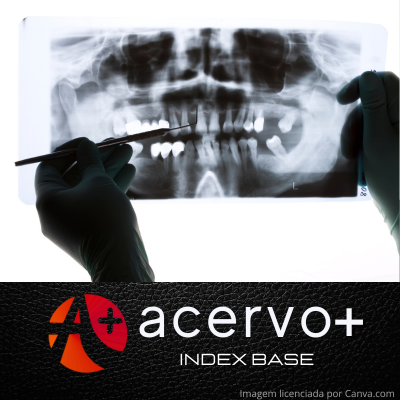
Objective: To review dental age estimation methods using panoramic radiographs in children and young adults. Methods: A search was conducted in the SciELO, LILACS, and PubMed databases using the keywords "Dental Age Determination", "Panoramic Radiographs", combined with "AND" in both Portuguese and English. Only full-text articles published between 2020 and 2025 were included. Results: Forty-three studies were analyzed, evaluating 14 distinct dental age estimation methods in populations aged 2 to 30 years. The most frequently tested methods were Demirjian, which overestimated age in most studies, particularly in males; Willems, which showed overestimation in younger ages and males, but underestimation in older age groups; AlQahtani, which overestimated age in younger cohorts; Cameriere, which exhibited a tendency to overestimate in females, though some studies reported underestimation; and Nolla, which underestimated age in females. The Nicodemo method demonstrated low accuracy across all age groups, with regional variations (e.g., India, Brazil, China), suggesting population-specific influences. Final considerations: Accuracy varies significantly by region, highlighting the need for method adaptations to specific populations.
References
AL-OBAIDLI N, et al. Dental age estimation: development and testing of a reference data set for Qatari children, adolescents, and young adults aged between 5 and 25 years. Forensic Sci Med Pathol, 2024; 20(1): 59-72.
ALOTAIBI NN, ALQAHTANI SJ. Performance of different dental age estimation methods on Saudi children. J Forensic Odontostomatol, 2023; 41(1):27-46. JPMID: 37149752; PMCID: PMC10319098.
ALQERBAN A, et al. Age estimation based on Willems method versus country specific model in Saudi Arabia children and adolescents. BMC Oral Health, 2021; 21(1):341.
BEDEK I, et al. Applicability of the Demirjian, Willems and Haavikko methods in Croatian children. J Forensic Odontostomato, 2022; 40(2):21-30.
CAGGIANO M, et al. Estimating the 18-Year Threshold with Third Molars Radiographs in the Southern Italy Population: Accuracy and Reproducibility of Demirjian Method. Int J Environ Res Public Health, 2022; 19(16):10454.
CHANDAIL K, et al. Estimation of dental age using Willems method and comparing it with Demirjian's method in 7-14-year-old children of Uttarakhand. J Indian Soc Pedod Prev Dent., 2022; 40(1):43-47.
CHINNI SS, et al. Evaluating legal age of 18 years through observation of third molars using Gambier et al. method in an orthopantomographic sample of subadults from South India. Leg Med (Tokyo), 2024; 68:102435.
CORTÉS MMP, et al. Accuracy assessment of dental age estimation with the Willems, Demirjian and Nolla methods in Spanish children: Comparative cross-sectional study. BMC Pediatr, 2020; 20(1):361.
DARICI A, et al. Comparison of accuracy of different dental age estimation methods in Finnish and Turkish populations. Acta Odontol Scand, 2024; 83:643-652.
EL-DESOUKY SS, KABBASH IA. Age estimation of children based on open apex measurement in the developing permanent dentition: an Egyptian formula. Clin Oral Investig, 2023; 27(4):1529-1539.
GÜMÜŞBOĞA ZŞ, et al. An investigation of the validity of the Bedek models and Cameriere-European formula used in dental age prediction in Turkish children. BMC Oral Health, 2024; 24(1):1396.
GUO YX, et al. Dental Age Estimation in Northern Chinese Han Children and Adolescents Using Demirjian's Method Combined with Machine Learning Algorithms. Fa Yi Xue Za Zhi, 2024; 40(2):135-142. English, Chinese.
ISMAIL AF, et al. Accuracy of different dental age assessment methods to determine chronological age among children with special needs. J Indian Soc Pedod Prev Dent, 2024; 42(1):64-70.
JIA SX, et al. Accuracy of Nolla Method for Age Estimation of Northern Chinese Han Children. Fa Yi Xue Za Zhi, 2021; 37(2):181-186. English, Chinese.
KUHNEN B, et al. Chronology of permanent teeth mineralization in Brazilian individuals: age estimation tables. BMC Oral Health, 2023; 23(1):165.
KWON K, et al. Demirjian method and Willems method to study the dental age of adolescents in Shanghai before and after 10 years. Folia Morphol (Warsz), 2023; 82(2):346-358.
LIN Y, et al. Performance of the London Atlas, Willems, and a new quick method for dental age estimation in Chinese Uyghur children. BMC Oral Health, 2022; 22(1):624.
MACHADO ALR, et al. Evaluation of Cameriere and Willems age estimation methods in panoramic radiographs of Brazilian children. J Forensic Odontostomatol, 2020; 38(3):8-15.
MELO M, et al. Demirjian and Cameriere methods for age estimation in a Spanish sample of 1386 living subjects. Sci Rep, 2022; 12(1):2838.
MEMORANDO JR. Evaluation of mandibular third molar for age estimation of Filipino population age 9 - 23 years. J Forensic Odontostomatol, 2020; 38(1):26-33.
MOHAMMED F, et al. Assessment to determine the accuracy of Chaillet and Demirjian method of dental age estimation using Orthopantomographs, Eastern Province, Saudi Arabia. F1000Res, 2025; 13:1554.
MÓNICO LS, et al. Adapting Demirjian Standards for Portuguese and Spanish Children and Adolescents. Int J Environ Res Public Health, 2022; 19(19):12706.
MOVAHHEDIAN N, et al. Third molar maturity index for discriminating between adults and minors: validation in an Iranian sample. J Forensic Odontostomatol, 2024; 42(3):9-19.
NASCIMENTO LG, et al. Age estimation in north east Brazilians by measurement of open apices. J Forensic Odontostomatol, 2020; 38(2):2-11.
NOAMAN BR, ABDULLAH AO. Validity of nolla's method for age estimation for children in Kurdish Iraqi population - A retrospective study. Indian J Dent Res, 2022; 33(4):393-396.
ONG SH, et al. Secular changes in dental development of Korean children aged 4 to 16 years over a 10-year period. J Clin Pediatr Dent, 2024; 48(4):68-73.
PADDENBERG E, et al. Individual dental and skeletal age assessment according to Demirjian and Baccetti: Updated norm values for Central-European patients. J Orofac Orthop, 2024; 85(3):199-212.
PAN J, et al. A modified dental age assessment method for 5- to 16-year-old eastern Chinese children. Clin JOral Investig, 2021; 25(6):3463-3474.
PLISKA B, et al. Radiological Evaluation of the Accuracy of Demirjian, Nolla, and Willems Methods for Dental Age Estimation in 3-17-Year-Old Iranian Children. Biomed Res Int, 2024; 2024:8783660.
PRAKOESWA BFWR, et al. Children and Adolescent Dental Age Estimation by the Willems and Al Qahtani Methods in Surabaya, Indonesia. Biomed Res Int, 2022; 2022:9692214.
RAMOS MDM, et al. Estimation of the age of majority through radiographic evaluation of the third molar maturation degree. Med Oral Patol Oral Cir Bucal, 2020; 25(3):e359-e363.
ŞAHIN TN, GÜLEÇ M. Evaluation of the Accuracy of Cameriere, Modified Cameriere and Willems and Blenkin-Evans Methods for Turkish Children. Int Dent J, 2025; 75(1):295-304.
SCENDONI R, et al. Forensic Validity of the Third Molar Maturity Index (I3M) for Age Estimation in a Russian Population. Biomed Res Int, 2020; 2020:6670590.
SHAN W, et al. Boosting algorithm improves the accuracy of juvenile forensic dental age estimation in southern China population. Sci Rep, 2022; 12(1):15649.
SHARMA P, WADHWAN V. Comparison of accuracy of age estimation in Indian children by measurement of open apices in teeth with the London Atlas of tooth development. J Forensic Odontostomatol, 2020; 38(1):39-47.
SHEN S, et al. Evaluation of a machine learning algorithms for predicting the dental age of adolescent based on different preprocessing methods. Front Public Health, 2022; 10:1068253.
SHEN S, et al. Machine learning assisted Cameriere method for dental age estimation. BMC Oral Health, 2021; 21(1):641.
SHEN S, et al. Predicting chronological age of 14 or 18 in adolescents: integrating dental assessments with machine learning. BMC Pediatr, 2024; 24(1):248.
SHERIFF SO, et al. Testing the accuracy of Bedek et al's new models based on 1-to-7 mandibular teeth for age estimation in 7-15 year old south Indian children. J Forensic Odontostomatol, 2020 Sep; 38(2):22-39.
STAMM ADB, et al. Use of the Demirjian method to estimate dental age in panoramic radiographs of patients treated at the Buenos Aires University School of Dentistry. Acta Odontol Latinoam, 2022; 35(1):25-30.
UPALANANDA W, et al. Age estimation at 18-year threshold: comparing Demirjian and Cameriere's methods for Thais. J Forensic Odontostomatol, 2024; 42(3):28-38.
VALENTE RPA, et al. Nicodemo's method on dental development: a cross-sectional study with 3,271 children and adolescents. Braz Oral Res, 2024; 38:e109.
WANG J, et al. Comparative assessment of the Willems dental age estimation methods: a Chinese population-based radiographic study. BMC Oral Health, 2022; 22(1):373.