
Keywords
Mycosis fungoides
HIV
How to Cite
Copyright © | All rights reserved.
The journal holds the exclusive copyright for the publication of this article under the terms of Brazilian law 9610/98.
Partial reproduction
The use of parts of the texts, figures and questionnaire of the article is free, being mandatory the citation of the authors and journal.
Total reproduction
It is expressly prohibited and must be authorized by the journal.
Abstract
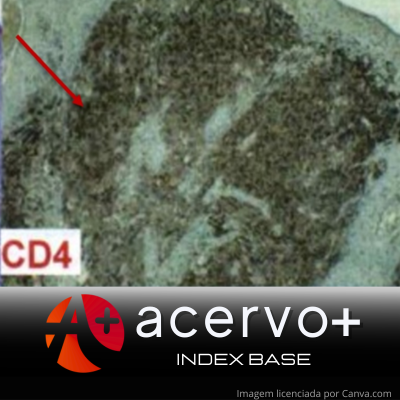
Objective: To describe a case of Sézary Syndrome (SS) in a patient diagnosed with human immunodeficiency virus (HIV) infection and using antiretroviral therapy (ART). Case details: Female patient, 41 years old, with pruritic erythroderma for five months, associated with supraclavicular lymph node enlargement and facial infiltration. He had a history of HIV with an undetectable viral load after seven months of ART. Laboratory tests revealed an elevated CD4 cell count and immunophenotyping compatible with SS. The diagnosis was confirmed by histopathology and immunohistochemistry, with findings of clonal proliferation of CD4+ T lymphocytes and the presence of Sézary cells in peripheral blood. Treatment included UVB-narrow band phototherapy and systemic chemotherapy, with progressive clinical improvement. Final considerations: SS is a rare disease and, when associated with HIV, may present changes in its presentation and clinical evolution, which makes diagnosis difficult. The case presents a diagnosis of SS, confirmed by histopathology and immunophenotyping, during the use of ART, reporting significant clinical improvement of the patient after combined management with UVB-narrow band phototherapy and chemotherapy. However, it is highlighted that stem cell transplantation is the only curative option.
References
AMORIM GM, et al. Validacão de algoritmo baseado em dados clínicos, histopatológicos e imuno-histoquímicos para diagnóstico de micose fungoide em estágio inicial. Anais Brasileiro de Dermatologia, 2020; 95: 326-331.
ARAUJO MDGM, et al. Avaliação imunofenotípica por citometria de fluxo no diagnóstico da Síndrome de Sézary no Rio Grande do Norte. Hematol Transfusion and Cell Therapy, 2022; 44: 560.
BLANCO G, et al. Infección por virus linfotrópico de células T humanas: Síndrome de Sezary asociado a paraparesia espástica tropical a propósito de un caso. Revista Digital de Postgrado, 2023; 12: 355.
CARITI C, et al. Infecções na síndrome de Sézary: um estudo de coorte retrospectivo de 113 pacientes. J Am Acad Dermatol, 2022; 86: 943-946.
DADOO AS e STEENKAMP I. Rapid progression of immune dysregulation in na HIV-infected patient with Sézary syndrome. Dermatology Online Journal, 2029; 25: 13030/6-7-44.
DOBOS G, et al. Mycosis Fungoides and Sézary Syndrome: Microenvironment and Cancer Progression. Cancers, 2023; 15: 746.
FLORES NAG, et al. Respiratory failure in a patient with Sézary syndrome. Revista científica Del Instituto Nacional De Salud, 2023; 6: 93-98.
KONDO RN, et al. Eritrodermia esfoliativa: estudo clínico e etiológico de 88 casos atendidos em hospital terciário durante 25 anos. Anais Brasileiro de Dermatologia, 2024; 99: 584-587.
LEHLOENYA RJ, et al. Aggressive worsening of Sézary syndrome during early antiretroviral therapy. AIDS, 2013; 27: 1035-1036.
LOBATO BAL, et al. Diagnóstico tardio de micose fungoide: um relato de caso. Revista Pan-Amazônica de Saúde, 2021; 12: 202100820.
MANFRERE KCG. Avaliação dos receptores de inflamassoma na Síndrome de Sézary. Tese (Doutorado em Dermatologia) – Programa de Dermatologia. Faculdade de Medicina da Universidade de São Paulo, São Paulo, 2022; 63.
MIYASHIRO DR. Micose fungóide e síndrome de Sézary: caracterização demográfica, clínica, histopatológica, imunopatológica, molecular, laboratorial e evolutiva de coorte observada no ambulatório de linfomas. Tese (Doutorado em Dermatologia) – Programa de Dermatologia. Faculdade de Medicina da Universidade de São Paulo, São Paulo, 2021; 228.
MONTEZZO DE. Macrófagos M2 no microambiente cutâneo da micose fungoide e da síndrome de Sézary e seu impacto no comprometimento linfonodal. Tese (Doutorado em Patologia) – Programa de Patologia. Faculdade de Medicina da Unidade de São Paulo, São Paulo, 2023; 138.
RAMOS LG, et al. Diagnóstico de Síndrome de Sézary em paciente internado em um hospital no interior do Espírito Santo: um relato de caso. Brazilian Journal of Health Review, 2023; 6: 8789-8793.
ROCHA DI, et al. Síndrome de Sézary: Uma causa crucial de coceira incontrolável. SPMI Case Reports, 2024; 2: 58-61.
SANCHES JA, et al. Micose fungoide e síndrome de Sézary: foco no cenário atual de tratamento. Anais Brasileiro de Dermatologia, 2021; 96: 458-471.
VAIDYA T e BADRI T. Micose fungoide. Treasure Island (FL): StatPearls Publishing, 2023.
VAKITI A, et al. Sezary Syndrome. Ilha do Tesouro (FL): StatPearls Publishing, 2025.
VIANNA CFB, et al. Linfoma cutâneo de Células T - Diagnóstico e prognóstico. Revista Científica da Faculdade de Medicina de Campos, 2023; 18: 49-52.
YAMASHITA T, et al. Mycosis fungoides and Sézary syndrome: clinical, histopathological and immunohistochemical review and update. Anais Brasileiro de Dermatologia, 2012; 87: 817-830.