
Keywords
Habits
Orthodontics
How to Cite
Copyright © | All rights reserved.
The journal holds the exclusive copyright for the publication of this article under the terms of Brazilian law 9610/98.
Partial reproduction
The use of parts of the texts, figures and questionnaire of the article is free, being mandatory the citation of the authors and journal.
Total reproduction
It is expressly prohibited and must be authorized by the journal.
Abstract
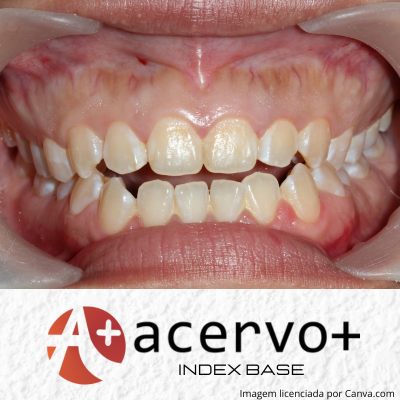
Objective: To verify the effectiveness of orthodontic appliances in correcting anterior open bite due to anterior tongue positioning at rest on the palatal surface of the upper incisors or between the incisors of both arches, or on the lingual surface of the lower incisors. Methods: Cross-sectional study with 410 children between 3 and 8 years of age, divided into G1 (preschoolers) and G2 (elementary schoolers). Those with anterior open bite (AOB) were compared before (T1) and after treatment (T2), observing whether there was tongue repositioning and the necessary treatment time, when using palatal cribs (GP) or active tips (AP). Results: The prevalence of AOB in the sample of 410 children was 4.63% (n=19), more frequent in females (3.33:1). In G1, the prevalence was 1.98% in females. In G2, the prevalence of children with AOB was 5.5%, with a female ratio of 3.88:1. Conclusion: Anterior open bite was significantly prevalent in the study sample, diagnosed exclusively during mixed dentition, and associated with non-nutritive sucking habits and tongue thrusting. The use of a fixed palatal crib and active tips is effective in the early correction of this malocclusion.
References
ALENCAR LBB, et al. Hábitos associados à Mordida Aberta Anterior em Crianças: uma revisão integrativa. Arquivos em Odontologia, 2021; 57(26): 244-252.
ANTOUN TRA, et al. Mordida Aberta Anterior- uma revisão da literatura. Revista Odontologia, 2018; 30(2): 190-199.
ARTESE A, et al. Critérios para o diagnóstico e tratamento estável da mordida aberta anterior. Dental Press Journal of Orthodontics, 2011; 16(3): 136–161.
BATISTA CLC, et al. Nutritive and non-nutritive sucking patterns associated with pacifier use and bottle-feeding in full-term infants. Early Human Development, 2019; 132: 18-23.
CARVALHO AA, et al. Prevalência de mordida aberta e fatores associados em pré-escolares de Salvador-BA em 2019. Revista de Odontologia da UNESP, 2020; 49: 20200068.
DA SILVA VP, et al. Mordida aberta anterior: etiologia e tratamento revisão de literatura. Revista CPAQV-Centro de Pesquisas Avançadas em Qualidade de Vida, 2024; 16(1): 1-11.
DE ARAÚJO KC, et al. Interceptação precoce de mordida cruzada anterior: relato de caso. Observatório de la Economía Latinoamericana, 2023; 21(11): 22930–22943.
FONTELLES MJ, et al. Metodologia da pesquisa: diretrizes para o cálculo do tamanho da amostra. Scientific research methodology: guidelines for size sample calculation. Revista. Paramédica, 2010; 24(2): 57-64.
FRANCO FCM, et al. Pontas ativas: um recurso para o tratamento da mordida anterior. Ortodontia. Gaúcha, 2001; 5(1): 6-12.
GOMES GV, et al. Ortodontia Preventiva e Interceptativa e suas contribuições para um bom desenvolvimento da oclusão do paciente em fase de dentição decídua e/ou mista: um estudo teórico. Facit Business and Technology Journal, 2020; 14(2): 74-86.
LARA TS, et al. Mordida aberta anterior dentoalveolar: diagnóstico morfológico e abordagens terapêuticas. Ortodontia, 2009; 42(2): 123-132.
LEITE JS, et al. Effects of palatal crib and bonded spurs in early treatment of anterior open bite: A prospective randomized clinical study. The Angle Orthodontist, 2016; 86(5): 734–739.
LING HTB, et al. The association between nutritive, non-nutritive sucking habits and primary dental occlusion. BMC Oral Health, 2018; 18(1): 145-151.
LIRA ALS e SOUSA C. Aparelho ortodôntico fixo com grade palatina para correção da mordida aberta anterior – relato de casos. Orthodontic Science and Practice, 2018; 11(42): 94–100.
MALTAROLLO TH, et al. Hábito deletério não nutritivo: sucção digital e a consequência mordida aberta. E-Acadêmica, 2021; 2(1): 42122.
MATOS BS, et al. Etiologia, diagnóstico e tratamento da mordida aberta anterior na dentadura mista. Revista Rede de Cuidado em Saúde, 2019; 13(1): 21-31.
MATSUMOTO MAN. Má oclusão Classe I de Angle, com mordida aberta anterior, tratada com extração de dentes permanentes. Dental Press Journal of Orthodontics, 2011; 16(1): 126–138.
NOGUEIRA FF, et al. Esporão lingual colado Nogueira®: tratamento coadjuvante da deglutição atípica por pressionamento lingual. Revista Dental Press de Ortodontia e Ortopedia Facial, 2005; 10(2): 129–156.
PEDRIN RRA, et al. Etiologia das más oclusöes: causas hereditárias e congênitas, adquiridas gerais, locais e proximais (hábitos bucais). Dental Press Journal of Ortodontics, 2000; 5(6): 107-129.
PISANI L, et al. Systematic review for orthodontic and orthopedic treatments for anterior open bite in the mixed dentition. Progress in Orthodontics, 2016; 17(1): 1-14.
RAMOS-JORGE J, et al. Association between anterior open bite and impact on quality of life of preschool children. Brazilian Oral Research, 2015; 29(1): 1-7.
REIS MT, et al. Tratamento da mordida aberta anterior: relato de caso clínico. Revista Clínica Ortodôntica Dental Press, 2007; 6(4): 88-96.
ROSA M, et al. Paediatric orthodontics part 1: anterior open bite in the mixed dentition. European Journal of Paediatric Dentistry, 2019; 20(1): 80-82.
ROSA M, et al. Rapid Palatal Expansion in the absence of posterior cross-bite to intercept maxillary incisor crowding in the mixed dentition: a CBCT evaluation of spontaneous changes of untouched permanent molars. European Journal of Paediatric Dentistry, 2016; 17(4): 286–294.
TORK MRS, et al. Mordida aberta anterior e habitos bucais deletérios: chupeta e sucção digital. Brazilian Journal of Implantology and Health Sciences, 2022; 4(5): 2–13.