
Keywords
Medicine Chinese Traditional
Complementary Therapies
How to Cite
Copyright © | All rights reserved.
The journal holds the exclusive copyright for the publication of this article under the terms of Brazilian law 9610/98.
Partial reproduction
The use of parts of the texts, figures and questionnaire of the article is free, being mandatory the citation of the authors and journal.
Total reproduction
It is expressly prohibited and must be authorized by the journal.
Abstract
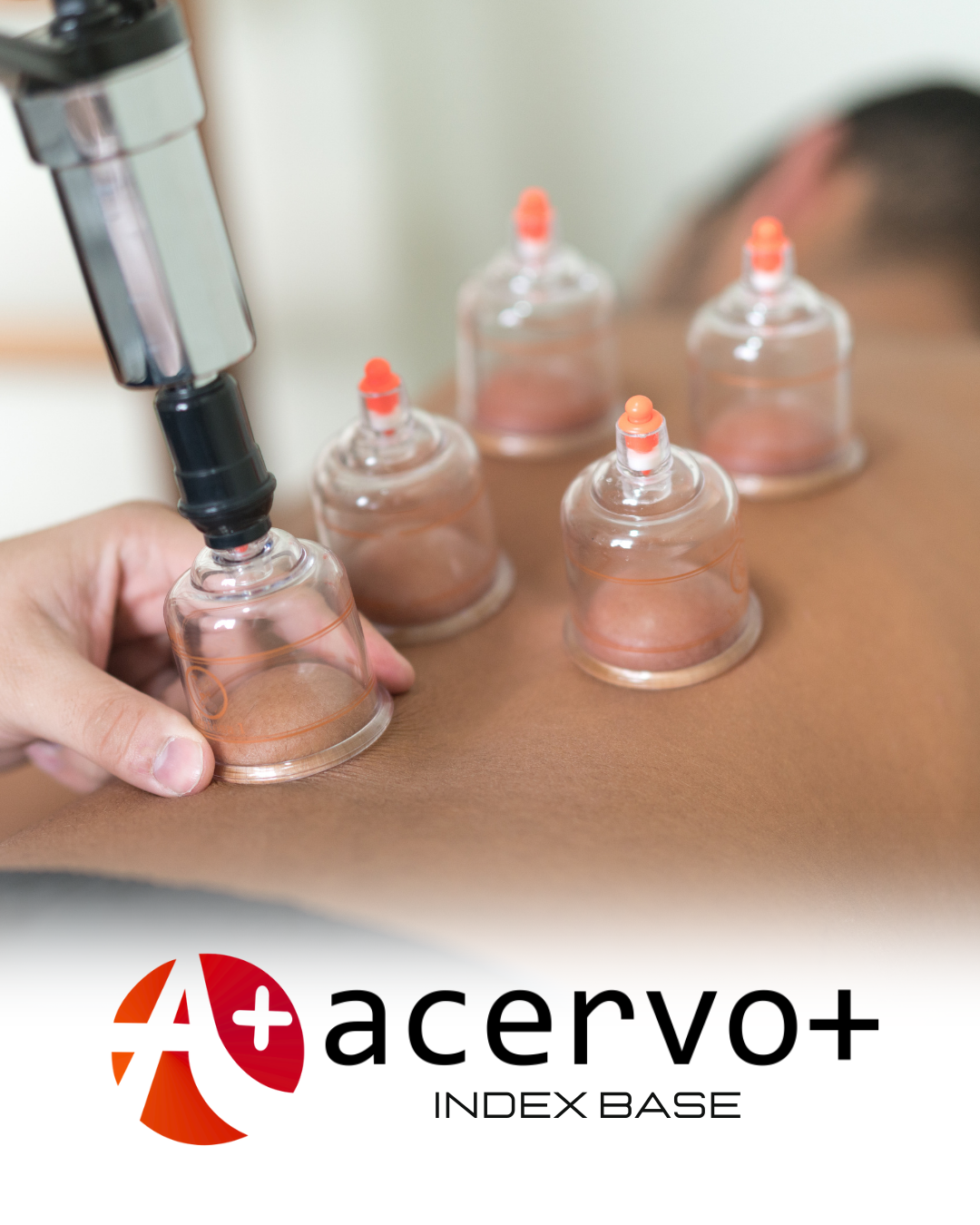
Objective: To describe the main application modalities of cupping therapy, including techniques, suction intensities, vacuum-generation methods, therapeutic combinations, and indications according to the target population. Literature review: Cupping therapy, originating from Traditional Chinese Medicine, has evolved over time, incorporating different materials, methodological adjustments, and therapeutic purposes. The identified modalities include dry cupping (static and sliding) and wet cupping; light, moderate, and strong suction intensities; vacuum-generation methods using fire, manual pumps, or electric devices; as well as combinations with acupuncture, moxibustion, heated water, and magnetotherapy. Specific applications were also described, such as facial, pedicure, and abdominal cupping. The analysis demonstrates that the different application modalities directly influence the therapeutic effects and the safety of the intervention. Final considerations: Cupping therapy comprises several application modalities that differ in suction methods, techniques employed, intensities, and therapeutic purposes. Structuring these modalities supports clinical practice by providing guidance for selecting the most appropriate and safe technique according to patient needs.
References
ABOUSHANAB TS, ALSANAD S. Cupping therapy: an overview from a modern medicine perspective. Journal of Acupuncture and Meridian Studies, 2018; 11(3): 83-87.
AGÊNCIA NACIONAL DE VIGILÂNCIA SANITÁRIA (ANVISA). Manual de limpeza e desinfecção de superfícies. Brasília: ANVISA; 2020. Disponível em: https://www.gov.br/anvisa/pt-br/centraisdeconteudo/publicacoes/servicosdesaude/publicacoes/manual-de-limpeza-e-desinfeccao-de-superficies.pdf/view. Acessado em: 04 out. 2025.
AL-BEDAH AM, et al. Classification of cupping therapy: a tool for modernization and standardization. Journal of Complementary Medicine Research, 2016; 1(1): 1-10.
AL-BEDAH AM, et al. The medical perspective of cupping therapy: Effects and mechanisms of action. Journal of Traditional and Complementary Medicine, 2018; 9(2): 90-97.
BOCCOLINI PMM, et al. Prevalence of complementary and alternative medicine use in Brazil: results of the National Health Survey, 2019. BMC Complementary Medicine and Therapy, 2022; 22(1): 205.
BRASIL. Ministério da Saúde. Manual de implantação de serviços de práticas integrativas e complementares no SUS. 2018. Disponível em: https://www.gov.br/saude/pt-
br/composicao/saps/pics/publicacoes/manual_implantacao_servicos_pics.pdf/view. Acessado em: 04 out. 2025.
BRASIL. Ministério da Saúde. Política Nacional de Práticas Integrativas e Complementares no SUS – PNPIC-SUS. 2006. Disponível em: https://bibliotecadigital.economia.gov.br/bitstream/123456789/958/3/PNPIC.pdf. Acessado em: 04 out. 2025.
BRASIL. Ministério da Saúde. Resolução de Diretoria Colegiada – RDC nº 63, de 25 de novembro de 2011: dispõe sobre os requisitos de boas práticas de funcionamento para os serviços de saúde. Brasília: Ministério da Saúde; 2011. Disponível em: https://bvsms.saude.gov.br/bvs/saudelegis/anvisa/2011/rdc0063_25_11_2011.html. Acessado em: 04 out. 2025.
CHI LM, et al. The effectiveness of cupping therapy on relieving chronic neck and shoulder pain: a randomized controlled trial. Evidence-Based Complementary and Alternative Medicine, 2016; 2016: 1-7.
CHOI T, et al. Evidence map of cupping therapy. Journal of Clinical Medicine, 2021; 10(8): 1750.
FILHO R. Ventosaterapia chinesa. 1ª ed. São Paulo: EBMC; 2015; 131 p.
KIM DS. Suma de diagnósticos secretos para tratamento com ventosaterapia. 2ª ed. Dong Yang; 2002. 327 p.
LOWE DT. Cupping therapy: an analysis of the effects of suction on skin and the possible influence on human health. Complementary Therapies in Clinical Practice, 2017; 29: 162-168.
MOURA CC, et al. Cupping therapy and chronic back pain: systematic review and meta-analysis. Revista Latino-Americana de Enfermagem, 2018; 26(e3094): 1-9.
MOURA CC, et al. Effects of ear acupuncture combined with cupping therapy on severity and threshold of chronic back pain and physical disability: a randomized clinical trial. Journal of Traditional and Complementary Medicine, 2022; 12(2): 152-161.
NAHIN RL, et al. Use of complementary health approaches overall and for pain management by US adults. JAMA, 2024.
ROZENFELD E, KALICHMAN L. New is the well-forgotten old: the use of dry cupping in musculoskeletal medicine. Journal of Bodywork and Movement Therapies, 2016; 20(1): 173-178.
SANTOS FM. Ventosaterapia clínica. 1ª ed. São Paulo: Editora Inserir; 2020.
SHABAN T. Enciclopédia de ventosaterapia. 2ª ed. Arábia Saudita: Tamer Shaban, 2018; 161 p.
THAM LM, LEE HP, LU C. Cupping: from a biomechanical perspective. Journal of Biomechanics, 2006; 39(12): 2183-2193.
WANG L, et al. Efficacy of cupping therapy on pain outcomes: an evidence mapping study. Frontiers in Neurology, 2023; 14: 1266712.
WANG XL, et al. Effect of cupping therapy pressures and durations on skin blood flow responses. Frontiers in Bioengineering and Biotechnology, 2020; 8: 608509.
WANG Y, et al. Update evidence of effectiveness on pain relieving of cupping therapy: a systematic review and meta-analysis of randomized controlled trials. Journal of Traditional Chinese Medicine, 2025; 45(2): 234-253.
YAMAMURA Y. Acupuntura tradicional: a arte de inserir. 2ª ed. rev. e ampl. São Paulo: Roca, 2010; 919 p.