
Keywords
Neoplasm
Sunburn
How to Cite
Copyright © | All rights reserved.
The journal holds the exclusive copyright for the publication of this article under the terms of Brazilian law 9610/98.
Partial reproduction
The use of parts of the texts, figures and questionnaire of the article is free, being mandatory the citation of the authors and journal.
Total reproduction
It is expressly prohibited and must be authorized by the journal.
Abstract
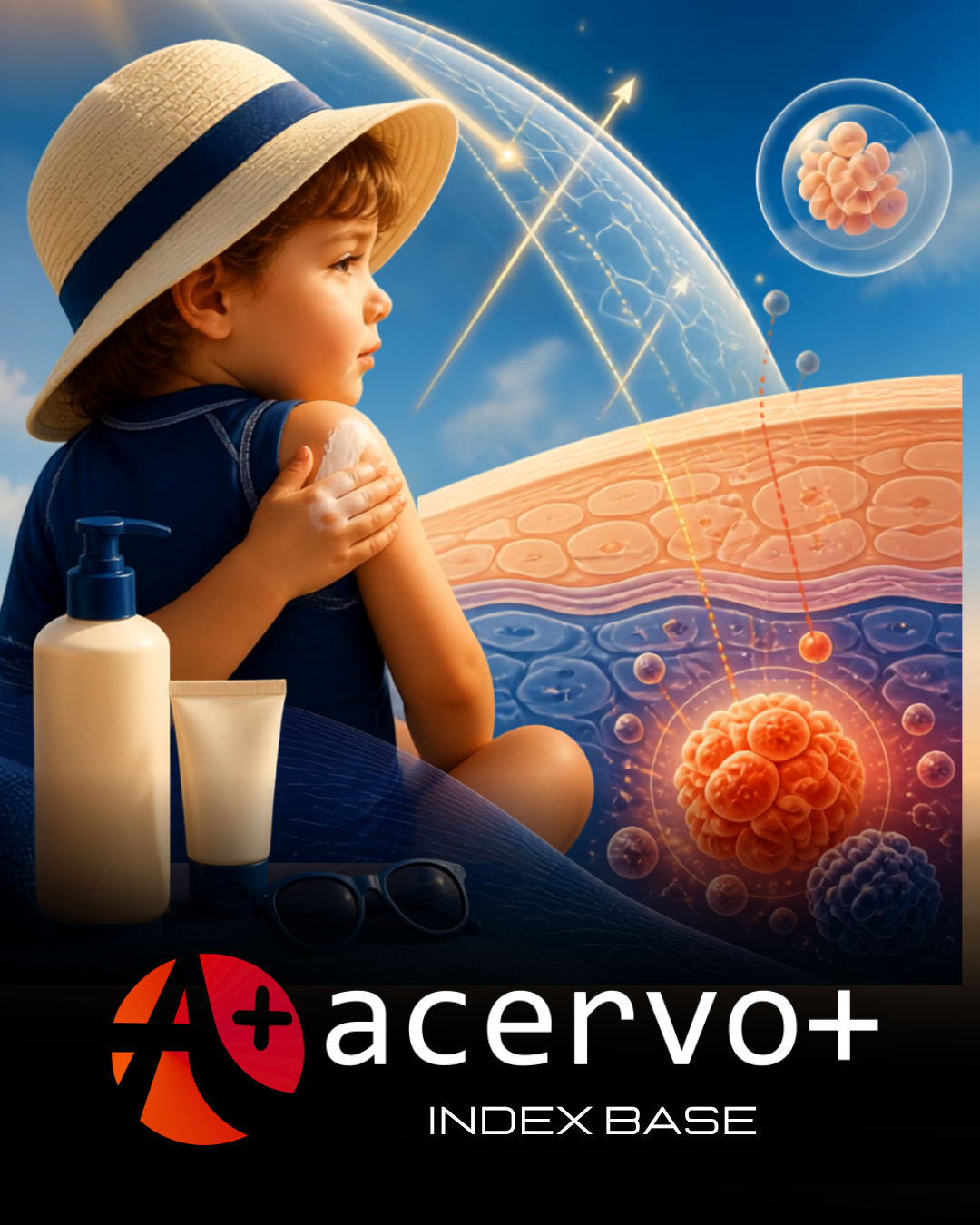
Objective: To evaluate whether exposure to sunburns during childhood is associated with an increased risk of developing skin neoplasms compared with individuals with low or no sun exposure during this period. Methods: This is a systematic literature review conducted according to the PRISMA protocol. The research question was structured using the PICO strategy, with children as the population, sunburn as the exposure, and skin neoplasms as the outcome. Searches were performed in the PubMed/MEDLINE, CAPES, ScienceDirect, EBSCOhost, and BVS databases using the descriptors “Skin neoplasm”, “Sunburn”, and “Child”, including studies published between 2021 and 2026 in English and Portuguese. Study selection occurred in three stages (title, abstract, and full text), with independent duplicate review and use of Rayyan software. Methodological quality was assessed using the Jadad scale and the Newcastle-Ottawa Scale. Results: Eight studies were included. A consistent association was observed between childhood sunburn and increased risk of melanoma and other skin neoplasms, as well as a relationship with a higher number of melanocytic nevi. Educational interventions were also found to be effective in improving photoprotection behaviors among children and adolescents. Final considerations: There is a consistent association between childhood sunburn and an increased risk of skin neoplasms, although methodological limitations and heterogeneity among studies restrict causal inferences.
References
BARSOUM R, HARRISON SL. Clinical characteristics in early childhood associated with a nevus-prone phenotype in adults from tropical Australia: two decades of follow-up of the Townsville Preschool Cohort Study. International Journal of Environmental Research and Public Health, 2020; 17(22): 8680.
BRASIL. Ministério da Saúde. Instituto Nacional do Câncer José Alencar Gomes da Silva. Estimativa 2020: incidência de câncer no Brasil. Rio de Janeiro: INCA, 2020.
CHANG MS, et al. Cutaneous squamous cell carcinoma: the frontier of cancer immunoprevention. Annual Review of Pathology, 2022; 17(1): 101-119.
CHANG YM, et al. Análise conjunta do fenótipo do nevo melanocítico e o risco de melanoma cutâneo em diferentes latitudes. International Journal of Cancer, 2009; 124(2): 420–428.
CHENG J, et al. Mensagens de proteção solar baseadas na aparência versus mensagens baseadas na saúde: um estudo randomizado, duplo-cego e controlado. Journal of Cosmetic Dermatology, 2019; 18(4): 1030–1036.
COELHO KM, et al. Melanoma pediátrico no Brasil: análise da mortalidade. Anais Brasileiros de Dermatologia, 2025; 100(6): 25-36
CORRENTI CM, et al. Racial disparities in fifth-grade sun protection: evidence from the Healthy Passages study. Pediatric Dermatology, 2018; 35(5): 588-596.
CUNHA AL, et al. Atualização do estadiamento de carcinomas cutâneos: revisão bibliográfica. Revista Brasileira de Cirurgia Plástica, 2019; 34(S1): 107-111.
DURAND C, et al. Influência de fatores sociais e psicossociais nos comportamentos de proteção solar de turistas de verão: o estudo PRISME. International Journal of Public Health, 2022; 67(16): 47-56.
DURAND C, et al. Efficacy of an appearance-based and a health-based sun protection intervention on summer vacationers’ behaviours. British Journal of Health Psychology, 2023; 28(3): 724–739.
GHIASVAND R, et al. Association of phenotypic characteristics and UV radiation exposure with risk of melanoma. JAMA Dermatology, 2019; 155(1): 39–49.
GLENN BA, et al. Sun protection practices and sun exposure among children with a parental history of melanoma. Cancer Epidemiology Biomarkers & Prevention, 2015; 24(1): 169–177.
GRUBER CR, et al. Câncer de pele não melanoma: revisão integrativa. SciELO Preprints, 2024; 23:1-14.
GUSENBAUER M, HADDAWAY NR. Which academic search systems are suitable for systematic reviews? Research Synthesis Methods, 2020; 11(2): 181-217.
HENRIKSON NB, et al. Aconselhamento comportamental para prevenção do câncer de pele: revisão sistemática. Rockville: Agency for Healthcare Research and Quality, 2018, 319(11):1143-1157.
HIGGINS J. Cochrane handbook for systematic reviews of interventions. 2. ed. Chichester: Cochrane, 2019.
JADAD AR, et al. Assessing the quality of reports of randomized clinical trials. Controlled Clinical Trials, 1996; 17(1): 1-12.
KENNEDY C, et al. The influence of painful sunburns and lifetime sun exposure. Journal of Investigative Dermatology, 2003; 120(6): 1087–1093.
LERGENMULLER S, et al. Lifetime sunburn trajectories and melanoma risk. JAMA Dermatology, 2022; 158(12): 1367-1377.
LI Y, et al. Childhood sunburn and risk of melanoma. Environmental Science and Pollution Research, 2023; 30(58): 122011-122023.
LIU Q, et al. Analysing causal relationship and melanoma. Journal of the European Academy of Dermatology and Venereology, 2024; 38: 102-111.
MILLER KA, et al. Sun protection changes among schoolchildren. Preventive Medicine, 2021; 149: 106601.
NAIK PP, DESAI MB. Basal cell carcinoma: a narrative review. Oncology and Therapy, 2022; 10: 317–335.
OLIVEIRA SP, BRANDÃO BJF. Análise de melanoma em crianças. BWS Journal, 2021; 4(7) 1–12.
OLSEN CM, et al. Does polygenic risk influence melanoma? British Journal of Dermatology, 2020; 183(2): 303–310.
OUZZANI M, et al. Rayyan—a web and mobile app for systematic reviews. Systematic Reviews, 2016; 5(1): 1-10.
SAVOYE I, et al. Patterns of UV exposure and skin cancer risk. Journal of Epidemiology, 2018; 28(1): 27–33.
SHARMIN S, et al. Parental supply of alcohol. International Journal of Environmental Research and Public Health, 2017; 14(3): 287.
SIMON GR, et al. Recommendations for pediatric preventive health care. Pediatrics, 2014; 133: 568-570.
SÜMEN A, ÖNCEL S. O efeito do programa de proteção solar. Journal of Advanced Nursing, 2021; 77: 387–
SWETTER SM, et al. Diretrizes para melanoma cutâneo. Journal of the American Academy of Dermatology, 2019; 80: 208–250.
THOONEN K, et al. Environmental interventions for skin cancer prevention. International Journal of Environmental Research and Public Health, 2020; 17(2): 529.
TRIPP MK, et al. Correlates of sun protection in children. American Journal of Preventive Medicine, 2016; 51(3): 77-85.
UMBELINO CC. As Condições de Saúde Ocular no Brasil, 2023; p. 104. Link da publicação: https://www.cbo.com.br/novo/publicacoes/condicoes_saude_ocular_brasil2019.pdf
URBAN K, et al. A carga global do câncer de pele. JAAD International, 2021; 2: 98-108.
ZHOU G, et al. Facilitating sunscreen use among Chinese young adults. International Journal of Behavioral Medicine, 2015; 22: 443–451.