
Keywords
Glucose transport proteins
Hyperglycemia
Insulin resistance
Diabetes mellitus
How to Cite
Copyright © | All rights reserved.
The journal holds the exclusive copyright for the publication of this article under the terms of Brazilian law 9610/98.
Partial reproduction
The use of parts of the texts, figures and questionnaire of the article is free, being mandatory the citation of the authors and journal.
Total reproduction
It is expressly prohibited and must be authorized by the journal.
Abstract
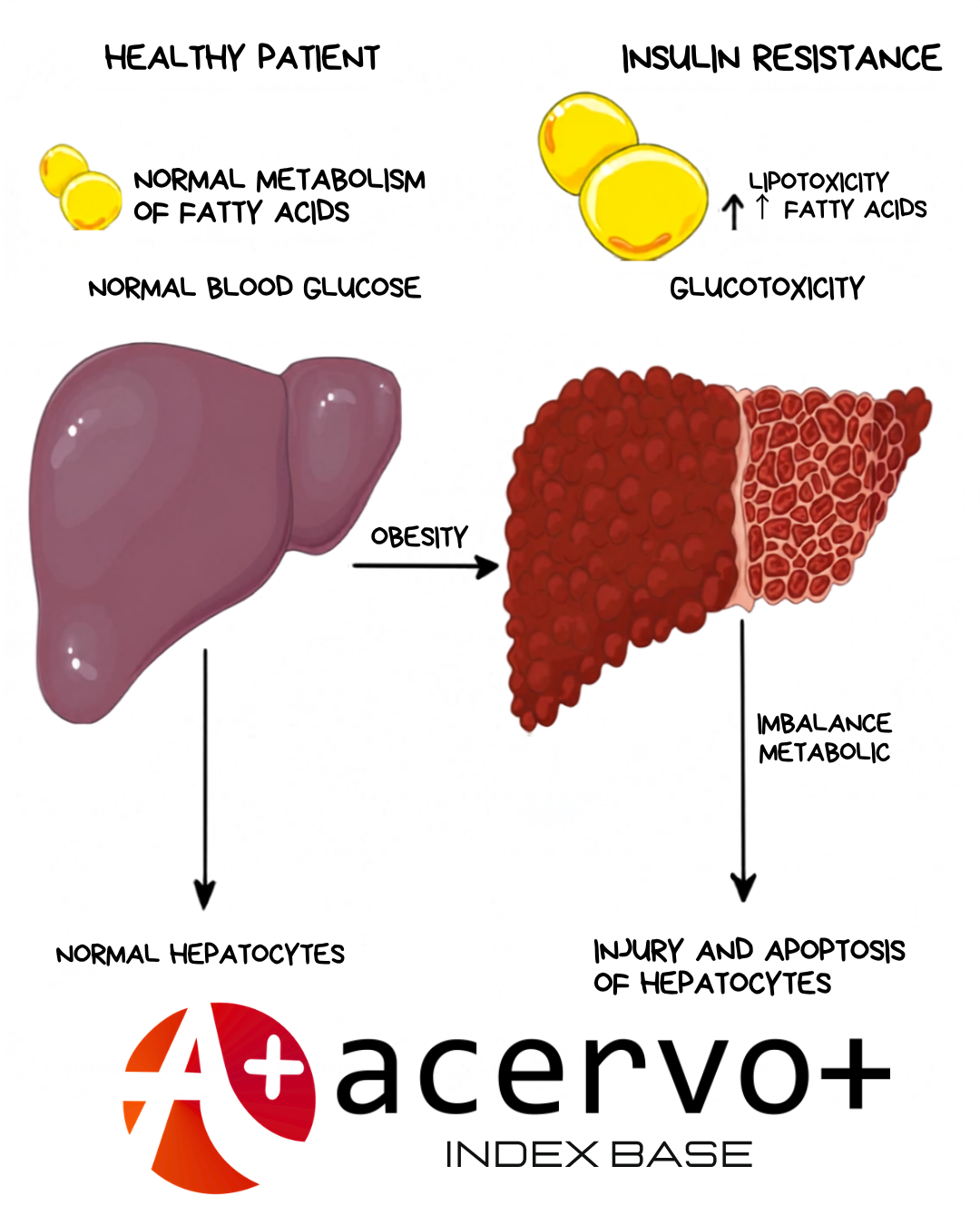
Objective: To describe the main molecular mechanisms involved in the regulation of glucose transporters during metabolic syndrome. Literature review: Metabolic syndrome is a multifactorial metabolic disorder associated with environmental, behavioral, and genetic factors. Understanding the molecular mechanisms that lead to this pathology contributes to understanding the systemic changes observed and aids in the search for new treatments. The expression of glucose transporters (GLUTs) is closely linked to the regulation of glucose homeostasis in tissues. In metabolic syndrome, the regulation of GLUT expression undergoes alterations, leading to changes in glucose fluxes in tissues. Regarding GLUT4, its concentration in the membranes of adipocytes and myocytes decreases as a consequence of obesity and insulin resistance. Regarding GLUT2, its expression occurs differently in hepatocytes and pancreatic cells during metabolic syndrome, with an increase in the former and a decrease in the latter. Regarding GLUT1, its endocytosis occurs in epithelial cells in response to the hyperglycemia generated by metabolic syndrome. Final considerations: In metabolic syndrome, the regulation of GLUT expression undergoes alterations, leading to changes in glucose fluxes in tissues. These changes contribute to disturbances in glucose homeostasis and intracellular substrate metabolism, ultimately responsible for the observed functional alterations.
References
ALGHANNAM AF, et al. Regulation of Energy Substrate Metabolism in Endurance Exercise. Int J Environ Res Public Health, 2021; 18(9):4963.
ANADERSSON DP, et al. Relationship Between a Sedentary Lifestyle and Adipose Insulin Resistance. Diabetes, 2023; 1;72(3):316-325.
BAUMEL-ALTERZON S, SCOTT DK. Regulation of Pdx1 by oxidative stress and Nrf2 in pancreatic beta-cells. Front Endocrinol (Lausanne), 2022;13:1011187.
BURHANS MS, et al. Contribution of Adipose Tissue Inflammation to the Development of Type 2 Diabetes Mellitus. Compr Physiol. 2018; 9(1):1-58.
CHOO YN, et al. Insulin resistance induced by obesity: Mechanisms, metabolic implications and therapeutic approaches. Mol Biol Rep, 2026; Feb 4;53(1):357.
CLEMENTE-SUÁREZ VJ, et al. The Role of Adipokines in Health and Disease. Biomedicines, 2023; 11(5):1290.
DRAGOO JL, et al. The essential roles of human adipose tissue: Metabolic, thermoregulatory, cellular, and paracrine effects. Journal of Cartilage & Joint Preservation, 2021; v. 1, n. 3, p. 100023.
DROBIOVA H, et al. GLUT4 Trafficking and Storage Vesicles: Molecular Architecture, Regulatory Networks, and Their Disruption in Insulin Resistance. Int J Mol Sci, 2025; 26(15):7568.
DYKSTRA H, et al. TXNIP interaction with GLUT1 depends on PI(4,5)P2. Biochim Biophys Acta Biomembr, 2021; 1863(12):183757.
FAHED G, et al. Metabolic Syndrome: Updates on Pathophysiology and Management in 2021. International Journal of Molecular Sciences, 2022; 23(2):786.
GARCIA D, SHANW RJ. AMPK: Mechanisms of Cellular Energy Sensing and Restoration of Metabolic Balance. Mol Cell, 2017; 66(6):789-800.
HATAKEYAMA H, et al. Cooperative actions of Tbc1d1 and AS160/Tbc1d4 in GLUT4-trafficking activities. Journal of Biological Chemistry, 2019; 294(4):1161-1172.
JIANG H, et al. Omega-3 polyunsaturated fatty acid biomarkers and risk of type 2 diabetes, cardiovascular disease, cancer, and mortality. Clinical Nutrition, 2022; 41(8):1798-1807.
KOEPSEL H. Glucose transporters in the small intestine in health and disease. Pflugers Arch. 2020; 472(9):1207-1248.
KOLB H. Obese visceral fat tissue inflammation: from protective to detrimental? BMC Med, 2022; 27;20(1):494.
LAIR B, et al. Novel Insights and Mechanisms of Lipotoxicity-Driven Insulin Resistance. Int J Mol Sci, 2020; 21(17):6358.
LEE JH, LEE J. Endoplasmic Reticulum (ER) Stress and Its Role in Pancreatic β-Cell Dysfunction and Senescence in Type 2 Diabetes. Int J Mol Sci, 2022; 23(9):4843.
LI M, et al. Trends in insulin resistance: insights into mechanisms and therapeutic strategy. Signal Transduct Target Ther, 2022; 7(1):216.
MARTÍNEZ BÁEZ A, et al. Phosphorylation Codes in IRS-1 and IRS-2 Are Associated with the Activation/Inhibition of Insulin Canonical Signaling Pathways. Curr Issues Mol Biol, 2024; 46(1):634-649.
MIAO L, et al. Metabolic reprogramming of pancreatic beta cells in type 2 diabetes and its therapeutic strategy. Ageing Res Rev, 2026; 113:102938
MIAO R, et al. Akt: A Potential Drug Target for Metabolic Syndrome. Front Physiol, 2022; 13:822333.
NAVALE, A. Glucose transporters and their cellular form, role and function. Molecular Nutrition: Carbohydrates, 2019; 21–34.
PEREIRA S, et al. Tissue-Specific Effects of Leptin on Glucose and Lipid Metabolism. Endocrine Reviews, 2021; 42(1):1-28.
POLLAK N, et al. Crosstalk Between Skeletal Muscle and Proximal Connective Tissues in Lipid Dysregulation in Obesity and Type 2 Diabetes. Metabolites, 2025; 15(9):581.
PRAGALLAPATI S, MANYAM R. Glucose transporter 1 in health and disease. J Oral Maxillofac Pathol, 2019; 23(3):443-449.
SHEN Z, et al. Physiological functions of glucose transporter-2: From cell physiology to links with diabetes mellitus. Heliyon, 2024; 10(3): e25459.
SUN B, et al. The role of GLUT2 in glucose metabolism in multiple organs and tissues. Mol Biol Rep, 2023;50(8):6963-6974.
VAN GERWEN J, et al. Insulin Signalling and GLUT4 Trafficking in Insulin Resistance. Biochemical Society Transactions, 2023; 51(3):1057-1069.
WALDHART AN, et al. Phosphorylation of TXNIP by AKT Mediates Acute Influx of Glucose in Response to Insulin. Cell Rep, 2017; 19(10):2005-2013.
WANG T, et al. Current understanding of glucose transporter 4 expression and functional mechanisms. World J Biol Chem, 2020; 11(3):76-98.
WANG X, et al. A high-cholesterol diet promotes steatohepatitis and liver tumorigenesis in HCV core gene transgenic mice. Arch Toxicol, 2019; 93(6):1713-1725.
WU N, et al. AMPK-dependent degradation of TXNIP upon energy stress leads to enhanced glucose uptake via GLUT1. Mol Cell, 2013; 49(6):1167-75.
ZAMOLODCHIKOVA TS, et al. Insulin in the regulation of the renin-angiotensin system: a new perspective on the mechanism of insulin resistance and diabetic complications. Front Endocrinol (Lausanne), 2024; 15:1293221.
ZHANG M, et al. Saturated fatty acids entrap PDX1 in stress granules and impede islet beta cell function. Diabetologia, 2021;64(5):1144-1157.
ZHANG Y, et al. PDX-1: A Promising Therapeutic Target to Reverse Diabetes. Biomolecules, 2022;12(12):1785.