
Keywords
Medical education
Motivation
How to Cite
Copyright © | All rights reserved.
The journal holds the exclusive copyright for the publication of this article under the terms of Brazilian law 9610/98.
Partial reproduction
The use of parts of the texts, figures and questionnaire of the article is free, being mandatory the citation of the authors and journal.
Total reproduction
It is expressly prohibited and must be authorized by the journal.
Abstract
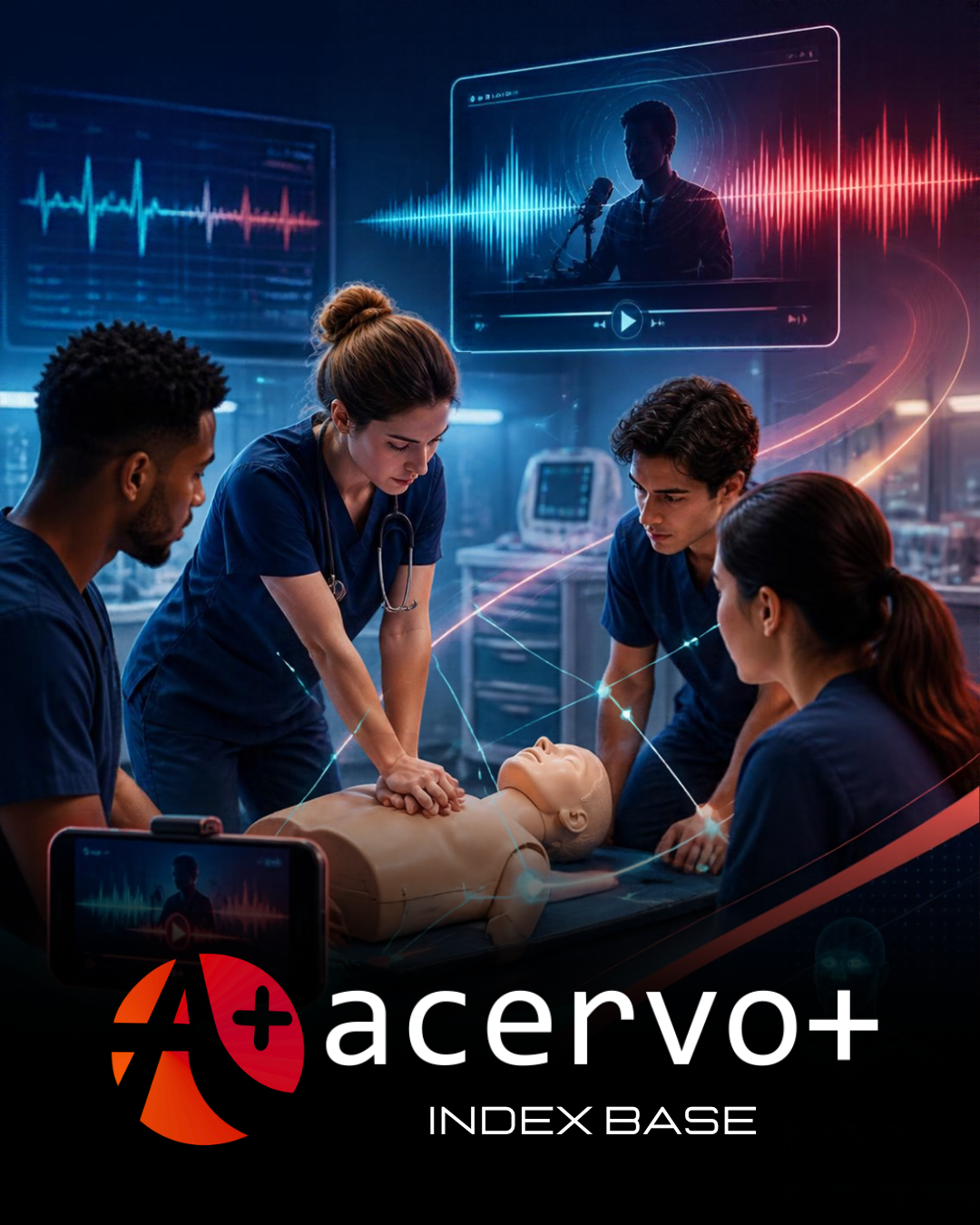
Objective: To evaluate the immediate effect of vodcasts (video-on-demand) on medical students' cognitive performance in cardiopulmonary resuscitation (CPR) and on their motivation, using a quasi-experimental pre-test and post-test design. Methods: A quasi-experimental pre-test and post-test study was conducted with 14 third-year medical students. Students watched a vodcast on CPR divided into three chapters, and cognitive performance was assessed using multiple-choice questions before and after the intervention. Motivation was measured using the validated Brazilian version of the Instructional Materials Motivation Survey (IMMS-BRV), which assesses four dimensions: interest, confidence, attention, and expectation. The study was approved by the Research Ethics Committee. Results: A significant improvement in performance was observed after the intervention, with a large effect size. Students who reported one to two hours of daily digital media use for medical studies improved more, and scored higher on the post-test, than those reporting more than three hours. Motivation was high and homogeneous across the four dimensions, with no significant differences among them, and was not associated with performance. Conclusion: In the sample assessed, the use of vodcasts was associated with an immediate improvement in cognitive performance in CPR; the findings should be interpreted with caution given the small sample size and the single-institution setting.
References
ALTMAN DG, BLAND JM. Statistics notes: Absence of evidence is not evidence of absence. BMJ, 1995; 311(7003): 485.
BHANJI F, et al. Part 14: Education: 2015 American Heart Association Guidelines Update for Cardiopulmonary Resuscitation and Emergency Cardiovascular Care. Circulation, 2015; 132(18 suppl 2): S561-S573.
BLAUTH C, et al. Age-based stereotypes: silent killer of collaboration. AchieveGlobal, 2011.
BONK CJ, WISHER RA. Applying collaborative and e-learning tools to military distance learning: A research framework. US Army Research Institute for the Behavioral and Social Sciences, 2000; 1107.
BRASIL. Conselho Nacional de Saúde. Resolução nº 466, de 12 de dezembro de 2012. Brasília: Ministério da Saúde, 2012.
BRASIL. Conselho Nacional de Saúde. Resolução nº 251, de 07 de agosto de 1997. Brasília: Ministério da Saúde, 1997.
BROWN A, GREEN TD. Video podcasting in perspective: The history, technology, aesthetics, and instructional uses of a new medium. Journal of Educational Technology Systems, 2007; 36(1): 3-17.
BUCKLIN BA, et al. Making it stick: use of active learning strategies in continuing medical education. BMC Medical Education, 2021; 21(1): 44.
CARDOSO-JÚNIOR A, FARIA RMD. Avaliação psicométrica do instrumento Instructional Materials Motivation Survey (IMMS) em ambiente remoto de aprendizagem. Revista Brasileira de Educação Médica, 2021; 45(4): e197.
CARDOSO-JÚNIOR A, et al. Translation and transcultural adaptation of the Instructional Materials Motivation Survey (IMMS) to brazilian portuguese. Revista Brasileira de Educação Médica, 2020; 44(4): e133.
CHENG A, et al. Resuscitation Education Science: Educational Strategies to Improve Outcomes From Cardiac Arrest: A Scientific Statement From the American Heart Association. Circulation, 2018; 138(6): e82-e122.
CILLIERS EJ. The challenge of teaching generation Z. People: International Journal of Social Sciences, 2017; 3(1): 188-198.
COHEN J. Statistical Power Analysis for the Behavioral Sciences. 2 ed. New York: Routledge, 2013; 567p.
CONOVER WJ. Practical nonparametric statistics. 3 ed. New York: John Wiley & Sons, 1999; 584p.
COSTLEY J, et al. The effects of instructional design on student engagement with video lectures at cyber
universities. Journal of Information Technology Education: Research, 2017; 16(1): 189-207.
DANGMEI J, SINGH A. Understanding the generation Z: the future workforce. South-Asian Journal of Multidisciplinary Studies, 2016; 3(3): 1-5.
DECI EL, RYAN RM. The “What” and “Why” of Goal Pursuits: Human Needs and the Self-Determination of Behavior. Psychological Inquiry, 2000; 11(4): 227-268.
FALAHINIA G, et al. Comparing the effects of CPR teaching using two methods, practical with model and film, on the knowledge and performance of aid groups in Hamadan, Iran. Avicenna Journal of Nursing and Midwifery Care, 2016; 24(1): 9-15.
GLENN M. The future of higher education: How technology will shape learning. Austin: The New Media Consortium, 2008; 28p.
HERNÁNDEZ-NIETO R. Contributions to statistical analysis: The coefficients of proportional variance, content validity and Kappa. Mérida: Universidad de Los Andes, 2002; 119p.
JENSEN SA. In-Class Versus Online Video Lectures: Similar Learning Outcomes, but a Preference for In-Class. Teaching of Psychology, 2011; 38(4): 298-302.
KELLER JM. Motivational design for learning and performance: The ARCS model approach. New York: Springer Science & Business Media, 2009; 345p.
LANGE C, COSTLEY J. Improving online video lectures: learning challenges created by media. International Journal of Educational Technology in Higher Education, 2020; 17(1): 16.
LITTLEWOOD KE, et al. High-fidelity simulation is superior to case-based discussion in teaching the management of shock. Medical Teacher, 2013; 35(3): e1003-e1010.
MASTERS K, et al. Online learning in health professions education. Part 2: Tools and practical application: AMEE Guide No. 163. Medical Teacher, 2024; 46(1): 18-33.
MEANEY PA, et al. Cardiopulmonary Resuscitation Quality: Improving Cardiac Resuscitation Outcomes Both Inside and Outside the Hospital: A Consensus Statement From the American Heart Association. Circulation, 2013; 128(4): 417-435.
MENG P. Podcasting and vodcasting: A white paper. Columbia: IAT Services, University of Missouri, 2005; 10p.
NEMENYI PB. Distribution-free multiple comparisons. Princeton: Princeton University, 1963; 127p.
R CORE TEAM. R: A Language and Environment for Statistical Computing. Vienna: R Foundation for Statistical Computing, 2022.
RAE MG, O’MALLEY D. Do prerecorded lecture VODcasts affect lecture attendance of first-year pre-clinical Graduate Entry to Medicine students? Medical Teacher, 2017; 39(3): 250-254.
RAZALI NM, WAH YB. Power comparisons of Shapiro-Wilk, Kolmogorov-Smirnov, Lilliefors and Anderson-Darling tests. Journal of Statistical Modeling and Analytics, 2011; 2(1): 21-33.
SAIDKHANI V, et al. The effect of scenario-based training versus video training on nurse anesthesia students’ basic life support knowledge and skill of cardiopulmonary resuscitation: a quasi-experimental comparative study. BMC Medical Education, 2024; 24(1): 488.
SANDARS J. Twelve tips for using podcasts in medical education. Medical Teacher, 2009; 31(5): 387-389.
THOMPSON P. The digital natives as learners: Technology use patterns and approaches to learning. Computers & Education, 2013; 65: 12-33.
TODD KH, et al. Simple CPR: A Randomized, Controlled Trial of Video Self-Instructional Cardiopulmonary Resuscitation Training in an African American Church Congregation. Annals of Emergency Medicine, 1999; 34(6): 730-737.
TOLONEN M, et al. Comparison of remote learning methods to on-site teaching - randomized, controlled trial. BMC Medical Education, 2023; 23(1): 778.
TULGAN B. Meet Generation Z: The second generation within the giant Millennial cohort. New Haven: Rainmaker Thinking, 2013; 13p.
WOLFF M, et al. Not Another Boring Lecture: Engaging Learners with Active Learning Techniques. The Journal of Emergency Medicine, 2015; 48(1): 85-93.
WORLD MEDICAL ASSOCIATION. World Medical Association Declaration of Helsinki: Ethical Principles for Medical Research Involving Human Subjects. JAMA, 2013; 310(20): 2191-2194.