
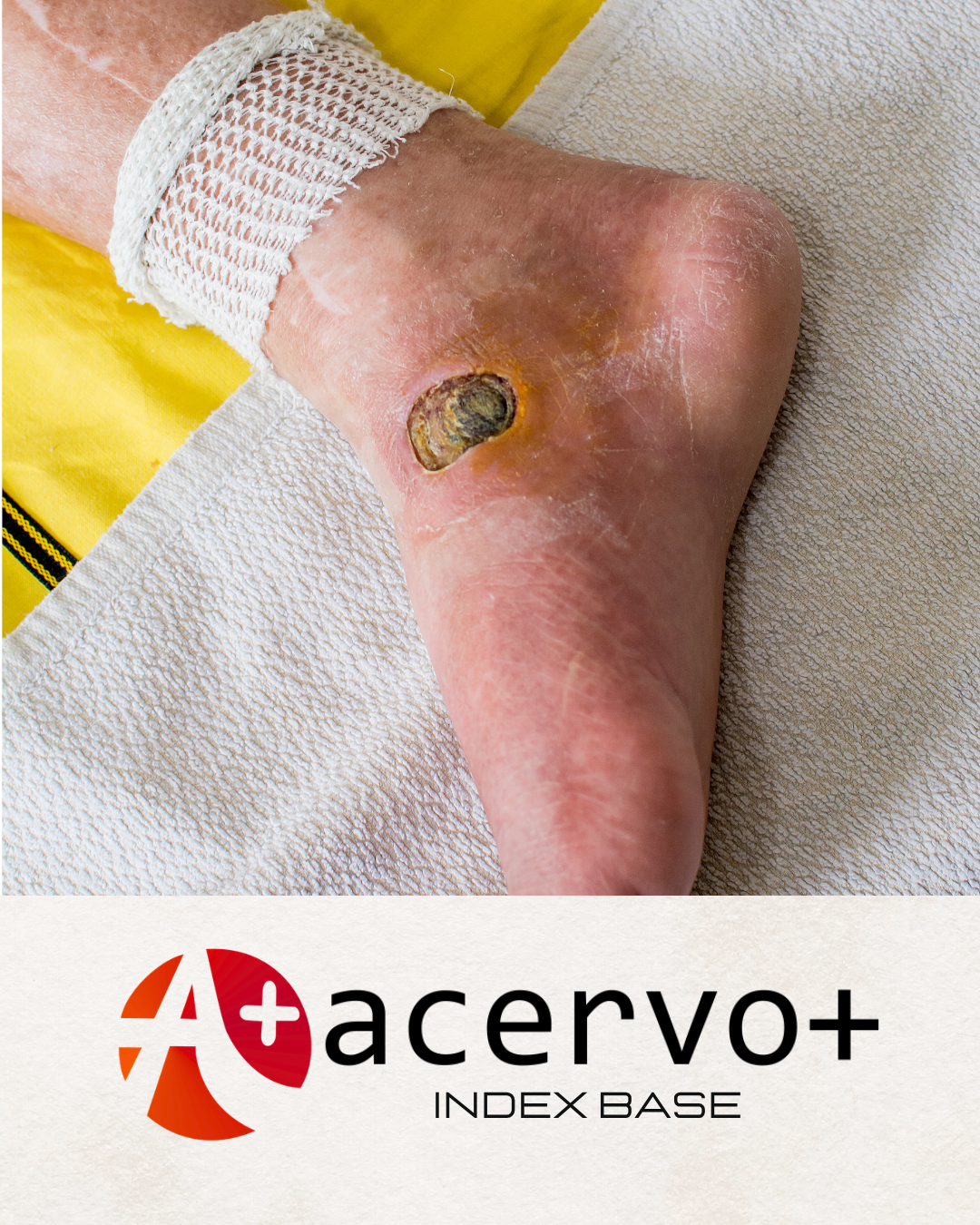
Keywords
Biomaterials
Diabect foot
Wound healing
Efficacy
How to Cite
Copyright © | All rights reserved.
The journal holds the exclusive copyright for the publication of this article under the terms of Brazilian law 9610/98.
Partial reproduction
The use of parts of the texts, figures and questionnaire of the article is free, being mandatory the citation of the authors and journal.
Total reproduction
It is expressly prohibited and must be authorized by the journal.
Abstract
Objective: To analyze the available evidence on the effectiveness of smart dressings, combined with biomaterials in the treatments of diabetic foot ulcers, compared to conventional dressings. Method: This is an integrative review, using the PICO methodology as a guiding question and the PRISMA guidelines to select the studies in this review; 7 articles were selected. Results: Biomaterials and smart dressings show promising results in the treatment of diabetic foot ulcers. Bioactive dressings, dermal matrices, smart biomaterials, hydrogels containing epidermal growth factor (EGF), and chitosan gel have demonstrated greater efficacy in wound cicatrization, reduction of lesion area, and biofilm control. However, Triticum vulgare hydrogel showed limited benefits, with improvements observed only in inflammatory signs. Despite these positive results, some technologies still require more robust clinical studies to confirm their effectiveness. Final Considerations: The evidence suggests that these resources are improving the treatment of diabetic foot ulcers. However, there are still gaps to be explored by more robust studies, as well as challenges related to cost and strategies for implementation in clinical nursing practices.
References
ARMSTRONG DG, et al. Use of a purified reconstituted bilayer matrix in the management of chronic diabetic foot ulcers improves patient outcomes vs standard of care: Results of a prospective randomised controlled multi-centre clinical trial. Int Wound J., 2022; 19(5): 1197-1209.
CONSELHO FEDERAL DE ENFERMAGEM. Manual de revisão bibliográfica sistematizada integrativa. Brasília, DF; 2016.
CONSELHO FEDERAL DE MEDICINA (CFM). Parecer nº 12/2021. Brasília: CFM; 2021.
COSTA CMS, et al. A estratégia PICO para a construção da pergunta de pesquisa e busca de evidências. Rev Latino-Am Enfermagem, 2007; 15: 508-511.
DELLA PEPA G, et al. Triticum vulgare Extract and Polyhexanide versus Saline Gauze Dressing in Patients with Diabetic Foot Ulcers: Results of a Randomized Controlled Trial. J Clin Med., 2023; 12(10): 3596.
DIAS RJS, CARNEIRO AP. Neuropatia diabética: fisiopatologia, clínica e eletroneuromiografia. Acta Fisiátrica, 2000; 7(1): 35-44.
DÖRR S, et al. Diversidade bacteriana e resposta inflamatória na primeira consulta em indivíduos jovens e idosos com infecção do pé diabético. Acta Diabetol., 2021; 58: 181-189.
EUROPEAN WOUND MANAGEMENT ASSOCIATION. Introducing the "Living with Skin Frailty & Skin Tears" Project. Frederiksberg; 2026.
GALIANO RD, et al. A Prospective Multicenter Study of a Weekly Application Regimen of Viable Human Amnion Membrane Allograft in the Management of Nonhealing Diabetic Foot Ulcers. Plast Reconstr Surg Glob Open, 2023; 11(10): e5291.
GONG X, et al. Polymer hydrogel-based multifunctional theranostics for managing diabetic wounds. Adv Funct Mater., 2024; 34(26): 2315564.
HE X, et al. Hydrogel-Based Treatment of Diabetic Wounds: From Smart Responsive to Smart Monitoring. Gels, 2025; 11(8): 647.
HUANG C, et al. Construction of Smart Biomaterials for Promoting Diabetic Wound Healing. Molecules, 2023; 28(3): 1110.
LIU Y, GE L. Smart Biomaterials in Wound Healing: Advances, Challenges, and Future Directions in Intelligent Dressing Design. Bioengineering (Basel), 2025; 12(11): 1178.
MAFALDO CF, et al. Fibras eletrofiadas como curativos inteligentes para o tratamento de feridas: revisão sistemática. Disciplinarum Scientia: Ciências Naturais e Tecnológicas, 2025; 25(3): 131-144.
MENDES KDS, et al. Revisão integrativa: método de pesquisa para a incorporação de evidências na saúde e na enfermagem. Texto Contexto Enferm. 2008;17:758-764.
MINISTÉRIO DA SAÚDE (BR). Ministério da Saúde incorpora transplante da membrana amniótica para tratamento da diabetes e alterações oculares. Brasília, DF; 2026.
MINISTÉRIO DA SAÚDE. Protocolo clínico e diretrizes terapêuticas (PCDT) para diabetes mellitus tipo II. Brasília, DF; 2026.
NETTO LE, JACON JC. Efetividade da biocelulose na cicatrização de úlceras venosas. Cuidarte Enfermagem. 2022;16(1):51-58.
PESSANHA FS, et al. Eficácia do hidrogel de carboximetilcelulose carregado com fator de crescimento epidérmico na formação de biofilme em feridas de pacientes diabéticos: um ensaio clínico randomizado. Gels, 2023; 9(2): 117.
SALAHI P, et al. Short-term effect of dressing with Dermaheal ointment in the treatment of diabetic foot ulcer: A double-blinded randomized controlled clinical trial. Health Sci Rep., 2024; 7(2): e1868.
SANGALETI CT, FARIAS CW. Feridas crônicas. In: Guia prático: feridas crônicas. Guarapuava: Editora Unicentro; 2025; 19.
SANTOS FAAS, et al. Qualidade de vida e cuidados de enfermagem direcionados à pessoa com ferida crônica: revisão integrativa. Rev Enferm Atual In Derme, 2025; 99(3): e025066.
SILVA J, et al. Innovative Functional Biomaterials as Therapeutic Wound Dressings for Chronic Diabetic Foot Ulcers. Int J Mol Sci., 2023; 24(12): 9900.
SLIVNIK M, et al. A randomized, placebo-controlled study of chitosan gel for the treatment of chronic diabetic foot ulcers (the CHITOWOUND study). BMJ Open Diabetes Res Care, 2024; 12(3): e004195.
SOARES CB, et al. Revisão integrativa: conceitos e métodos utilizados na enfermagem. Rev Esc Enferm USP, 2014; 48(2): 335-345.
SRISAWAT S, et al. Eficácia de curativos bioativos comparados a curativos passivos na promoção da cicatrização de úlceras do pé diabético: um ensaio clínico randomizado controlado. J Wound Res Technol., 2025; 2(1): 19-27.
VLADULESCU D, et al. Platelet-Rich Plasma (PRP) in Dermatology: Cellular and Molecular Mechanisms of Action. Biomedicines, 2023; 12(1): 7.
WANG G, et al. Efeito do poli(L-lactídeo-co-caprolactona) eletrofiado e do fibrinogênio suíno formulado no tratamento de úlceras do pé diabético. Eur J Pharm Sci., 2024.
ZHANG J, et al. Efficacy and Safety of Biomaterials and Antimicrobial Dressings in the Treatment of Diabetic Foot Ulcers: A Systematic Review and Network Meta-Analysis. J Diabetes Res., 2025; 1548984.
ZHAO X, et al. Innovative therapies for diabetic foot ulcers: application and prospects of smart dressings. Biomed Pharmacother., 2025; 191: 118498.