
Palabras clave
Cefalea
Neurofeedback
Adolescentes
Cómo citar
Copyright © | Todos los derechos reservados.
La revista posee los derechos de autor exclusivos para la publicación de este artículo en los términos de la ley brasileña 9610/98.
Reproducción parcial
El uso de partes de los textos, figuras y cuestionario del artículo es libre, siendo obligatoria la citación de los autores y revista.
Reproducción total
Está expresamente prohibido y debe ser autorizado por la revista.
Resumen
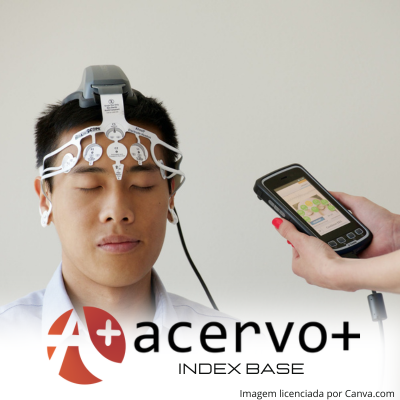
Objetivo: Evaluar los resultados obtenidos mediante entrenamiento cerebral con Neurofeedback en adolescentes y adultos jóvenes con diagnóstico de migraña como alternativa terapéutica no farmacológica. Métodos: En un ensayo clínico abierto, veintiún participantes con migraña, con y sin aura, fueron evaluados para entrenamiento cerebral con neurofeedback tras electroencefalografía cuantitativa + hemoencefalografía. Se describió todo el proceso de investigación, incluyendo el uso de neurofeedback y las dificultades encontradas para la adherencia al tratamiento. Resultados: De los 21 participantes, 10 eran hombres y 11 mujeres. Tras 20 sesiones, los participantes entrenados presentaron estabilización de la nueva crisis y una reducción significativa de las quejas sobre frecuencia, intensidad y duración del dolor. Conclusión: El presente estudio reporta una mejoría clínica en la población estudiada, relacionada con la modalidad terapéutica aplicada. Los resultados muestran el potencial del neurofeedback para el tratamiento de la migraña en jóvenes, lo que evidencia la importancia de realizar estudios a gran escala, controlados y aleatorizados sobre neuroterapia no invasiva para el tratamiento de la migraña y otras enfermedades crónicas o trastornos progresivos.
Referencias
AMERICAN HEADACHE SOCIETY. The 2012 AHS/AAN guidelines for prevention of episodic migraine: A summary and comparison with other recent clinical practice guidelines. Headaches. 2012;52:930-45.
ARAGÃO MS, MASCARENHAS TS, COSTA, JPL, CORRÊA RGCF, BRITO LMO. Anxiety, depression and stress in women with chronic pelvic pain. Rev Pesq Saúde.2015;2:85-9.
AZARPAIKAN A, TORBATI HT, SOHRABI M. Neurofeedback and physical balance in Parkinson’s patients. 2014;40:177-81.
AKYOL A, KIYLIOGLU N, AYDIN I, ERTURK A, KAYA E, TELLI E, et al. Epidemiology and clinical characteristics of migraine among school children in the Menderes region. Cephalalgia. 2007;67:2005-14.
BIGAL ME, LIPTON RB, WINNER P, REED ML, DIAMOND S, et al. Migraine in adolescents: Association with socioeconomic status and family history. Neurology.2007;69:16-25.
COLLURA TF. Neuronal Dynamics in Relation to Normative Electroencephalography assessment and Training. Biofeedback. 2008;36:134-39.
DIAS ÁM. Tendências do neurofeedback em psicologia: Revisão sistemática. Psicologia em estudo. 2010;15:811–20.
GUNKELMAN JD, JOHNSTONE J. Neurofeedback and the brain. Journal of Adult Development. 2005;12:93-8.
HAMMOND DC. What is neurofeedback? Journal of Neurotherapy. 2006;10:25-36.
HEADACHE CLASSIFICATION SUBCOMMITTEE OF THE INTERNACIONAL HEADACHE SOCIETY. Internacional classification of headache disorders. Cephalalgia. 2013;33:629-808.
JENSEN R, STOVNER LJ. Epidemiology and comorbidity of headache. Lancet Neurol. 2008;7:354-61.
LARSEN S, SHERLIN L. Neurofeedback: An Emerging Technology for Treating Central Nervous System Dysregulation. Psychiatr Clin N Am. 2013;13:163-68.
LE H, TFELT-HANSEN P, SKYTTHE A, KYVIK KO, OLESEN, J. Association between migraine, lifestyle and socioeconomic factors: A population-based cross-sectional study. J Headache Pain. 2011;12:157-72.
LIPTON RB, BIGAL ME, STEINER TJ, SILBERSTEIN SD, OLESEN J. Classification of primary headaches. Neurology. 2004;63:427-35.
MORIYAMA TS, POLANCZYK G, CAYE A, BANASCHEWSKI T, BRANDEIS, D, ROHDE LA. Evidence-based information on the clinical use of neurofeedback for ADHD. Neurotherapeutics. 2012;9:588-98.
NEY BL, THADANI VM. Migraine and Epilepsy: Review of the Literature. Headache. 2015;55:359-80.
NESTORIUC Y, MARTIN A, RIEF W, ANDRASIK F. Biofeedback treatment for headaches disorders: A comprehensive efficacy review. Appl Psychophysiol Biofeedback.2008;33:125-40.
NIV S. Clinical efficacy and potential mechanisms of neurofeedback. Personality and Individual Differences. 2013;54:676-86.
RIBAS VR, RIBAS, RMG, MATINS HA. The learning curve in neurofeedback of Peter Van Deusen: Review Article. Dementia Neuropsychol. 2016;10:98-103.
ROCHA TPO, NETO JAF, FERNANDES DR, SANTANA EEC, ABREU JER, CARDOSO RLS, et al. A comparative study among different treatment adherence methods in hypertensive patients. Internacional Journal of Cardiovascular Sciences.2015;28:122-29.
SAVI R, ULBRICHT VR. Digital educational games: benefits and challenges. Novas tecnologias na educação. 2008;6.
SIMKIN DRS, THATCHER RW, LUBAR J. Quantitative EEG and neurofeedback in children and adolescents. Child Adolesc Psychiatric Clin N Am. 2014;23:427-64.
STOKES DA, LAPPIN MS. Neurofeedback and biofeedback with 37 migraineurs: a clinical outcome study. Behavioral and brain functions : BBF. 2010;6:1-10.
TEGELER CH, KUMAR SR, CONKLIN D, LEE SW, GERDES L, TURNER DP, TEGELER CL, FIDALI BC, HOULE TT. Open label, randomized, crossover pilot trial of high-resolution, relational, resonance-based, electroencephalic mirroring to realive insomnia. Brain and Behavior. 2012;2:814-24.
VECCHIA D, PIETROBON D. Migraine: a disorder of brain excitatory-inhibitory balance? Trends in Neurosciences. 2012;8:507-520.
VERNON D, EGNER T, COOPER N, COMPTON T, NEILANDS C, SHERI A, GRUZELIER J. The effect of training distinct neurofeedback protocols on aspects of cognitive performance. Internacional Journal of Psychophysiology, 2003;47:75-85.
WIENECKE T, OLESEN J, OTURAI PS, ASHINA M. Prostacyclin (epopostrenol) induces headache in healthy subjects. Pain. 2008.
GOMES RP, MICHAELSEN SM, RODRIGUES LC, FARIAS NC, SILVA R. Scientific research with individuals post stroke: difficulties in recruitment, allocation and adherence on two different protocols of physiotherapy intervention. Fisiot Pesq. 2015;22:34-40.
YEAW J, BANNER JS, WALT JG, SIAN S, SMITH DB. Comparing adherence and persistence across 6 chronic medication classes. J Manag Care Pharm. 2009;15:728-40.
WORLD HEALTH ORGANIZATION [Internet]. R: Adherence to long-term therapies: evidence for action. Switzerland; 2003 [cited 2003]. Avaliable from: http://whqlibdoc.who.intpublications/2003/9241545992.pdf2003