
Palabras clave
Periodoncia
Tejido conectivo
Implante dental
Cómo citar
Copyright © | Todos los derechos reservados.
La revista posee los derechos de autor exclusivos para la publicación de este artículo en los términos de la ley brasileña 9610/98.
Reproducción parcial
El uso de partes de los textos, figuras y cuestionario del artículo es libre, siendo obligatoria la citación de los autores y revista.
Reproducción total
Está expresamente prohibido y debe ser autorizado por la revista.
Resumen
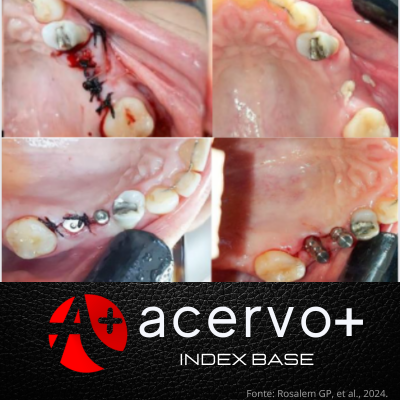
Objetivo: Pesentar un caso clínico de rehabilitación oral en una región de defecto estético con colocación de implantes y uso de injerto conectivo subepitelial para ganar volumen vestibular y tejido queratinizado. Detalle del caso: Paciente femenina de sesenta años se presentó el 11 de octubre de 2019 para su primera consulta clínica en el curso de especialización en implantología, en la Facultad de Odontología, buscando tratamiento de rehabilitación con implantes. Se realizó la extracción de tejido gingival libre de la tuberosidad maxilar, desepitelización y adaptación del injerto de tejido conectivo subepitelial en la región vestibular posterior del maxilar superior, junto con la colocación de dos implantes endoóseos. Después del período de osteointegración, se fabricaron provisionales implanto soportados para la adaptación y formación del perfil de emergencia periimplantario. Después de la formación de la papila interimplantaria, se instalaron las coronas de porcelana. Consideraciones finales: Se condidera que la técnica combinada de colocación de implantes e inserción de tejido conectivo es efectiva para la rehabilitación del paciente, tanto en el aspecto funcional como estético.
Referencias
BÄUMER D, et al. Socket Shield Technique for immediate implant placement– clinical, radiographic and volumetric data after 5 years. Clinical Oral Implants Research, 2017; 28(11):1450-1458.
BENNANI V, et al. The periodontal restorative interface: esthetic considerations. Periodontology 2000, 2017; 74(1):74-101.
BOYNUEĞRI D, et al. Yeliz A. Significance of keratinized mucosa around dental implants: a prospective comparative study. Clinical oral implants research, 2013; 24(8): 928-933.
CHUNG D, et al. Significance of keratinized mucosa in maintenance of dental implants with different surfaces. Journal of periodontology, 2006;77(8):1410- 1420.
EDEL A. The use of a free connective tissue graft to increase the width of attached gingiva. Oral Surgery, Oral Medicine, Oral Pathology, 1975;39(3):341-346.
FUNATO A, et al. Timing, positioning, and sequential staging in esthetic implant therapy: a four-dimensional perspective. International Journal of Periodontics & Restorative Dentistry, 2007;27(4): 313-323.
GARBER D, et al. Restoration-driven implant placement with restoration-generated site development. Compendium of continuing education in dentistry (Jamesburg, NJ: 1995), 1995;16(8):798-802.
JUNG U, et al. Histologic observation of soft tissue acquired from maxillary tuberosity area for root coverage. Journal of periodontology, 2008; 79(5):934-940.
LANGER B, CALAGNA L. The subepithelial connective tissue graft. The Journal of prosthetic dentistry, 1980;44(4):363-367.
LANGER B, Burton L. Subepithelial connective tissue graft technique for root coverage. Journal of periodontology, 1985;56(12):715-720.
MISCH C. Divisions of available bone in dentistry. Int J Oral Implantol, 1990;7: 9-17.
PAPADOPOULOS I, et al. Transferring the emergence profile from the provisional to the final restoration. Journal of esthetic and restorative dentistry, 2014;26(3): 154-161.
PEREIRA JR, et al. Transferring conditioned partially edentulous ridge form to a master cast. Journal of Prosthodontics, 2016;25(7):595-598.
PUISYS A, LINKEVICIUS T. The influence of mucosal tissue thickening on crestal bone stability around bone‐level implants. A prospective controlled clinical trial. Clinical oral implants research, 2015;26(2):123-129.
REISER G, et al. The subepithelial connective tissue graft palatal donor site: anatomic considerations for surgeons. International Journal of Periodontics & Restorative Dentistry, 1996;16(2):130-137.
SCHUPBACH P, GLAUSER R. The defense architecture of the human periimplant mucosa: a histological study. The Journal of prosthetic dentistry, 2007;97(6): S15-S25.
SON M, JANG H. Gingival recontouring by provisional implant restoration for optimal emergence profile: report of two cases. Journal of periodontal & implant science, 2011;41(6):302-308.
SONICK M. The dependability of connective Tissue Graft-ing for the Resolution of Full-mouth Recession. Compendium, 2011;32(1):48-53.
STEIGMANN M, et al. Emergence profile design based on implant position in the esthetic zone. International Journal of Periodontics & Restorative Dentistry, 2014; 34(4):559-563.
TAN W, et al. A systematic review of post‐extractional alveolar hard and soft tissue dimensional changes in humans. Clinical oral implants research, 2012;23:1- 21.