
Palabras clave
Síndrome de Sézary
Linfoma no Hodgkin
Cómo citar
Copyright © | Todos los derechos reservados.
La revista posee los derechos de autor exclusivos para la publicación de este artículo en los términos de la ley brasileña 9610/98.
Reproducción parcial
El uso de partes de los textos, figuras y cuestionario del artículo es libre, siendo obligatoria la citación de los autores y revista.
Reproducción total
Está expresamente prohibido y debe ser autorizado por la revista.
Resumen
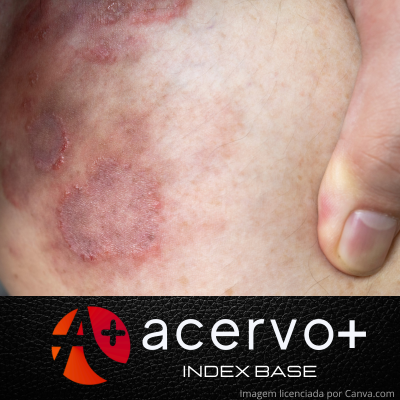
Objetivo: Analizar las características de la Micosis Fungoide (MF). Revisión bibliográfica: La MF es el tipo más común de linfoma cutáneo, aunque tenga rara incidencia en la población general. Es más prevalente en hombres, negro, adultos y ancianos, y se presenta de manera heterogénea, en tres fases clínicas: mancha, placa y etapa tumoral. La MF es sospechosa en lesiones cutáneas refractarias a las terapias dirigidas o cuando hay compromiso polimórfico en distribución típica (áreas protegidas del sol). Esta patología conlleva diversos diagnósticos diferenciales, como enfermedades cutáneas infecciosas, oncológicas y autoinmunes, requiriendo una anamnesis minuciosa y análisis histopatológico para confirmación. Los hallazgos histopatológicos, dependen de la fase de la enfermedad en la que se realiza la biopsia, siendo el epidermotropismo un marcador característico de la enfermedad. El tratamiento se guía por su estadificación, que tiene en cuenta la extensión de la enfermedad, el compromiso ganglionar, la metástasis y las alteraciones sanguíneas. Consideraciones finales: A pesar de representar una enfermedad de baja incidencia poblacional, la MF debe ser reconocida por la comunidad científica, dado el impacto en la calidad de vida de las personas, ya que comparte diagnóstico diferencial con dermatosis más comunes y requiere una investigación clínica e histopatológica más precisa.
Referencias
BELTRAMINELLI H. Cutaneous T‐cell lymphoma—Focus on some problems, and some solutions. Hematological Oncology, 2023; 41: 20-24.
CERRONI LMD. Mycosis fungoides—clinical and histopathologic features, differential diagnosis, and treatment. Seminars in Cutaneous Medicine and Surgery, 2018; 37(1): 2-10.
ELSAYAD K, et al. Total skin electron beam for primary cutaneous T-cell lymphoma. International Journal of Radiation Oncology* Biology* Physics, 2015; 93(5): 1077-1086.
HEALD P, et al. Topical bexarotene therapy for patients with refractory or persistent early-stage cutaneous T-cell lymphoma: results of the phase III clinical trial. Journal of the American Academy of Dermatology, 2003; 49(5): 801-815.
HODAK E and AMITAY-LAISH I. Mycosis fungoides: A great imitator. Clinics in Dermatology, 2019; 37(3): 255-267.
HORWITZ SM, et al. Review of the treatment of mycosis fungoides and Sézary syndrome: a stage-based approach. Journal of the National Comprehensive Cancer Network, 2008; 6(4): 436-442.
LAROCCA C and KUPPER T. Mycosis fungoides and Sézary syndrome: an update. Hematology/ Oncology Clinics, 2019; 33(1): 103-120.
MARTA GN, et al. Micose fungoide: relato de caso tratado com radioterapia. Anais Brasileiros de Dermatologia, 2011; 86: 561-564.
MITTELDORF C. Folliculotropic mycosis fungoides. Deutsche Dermatologische Gesellschaft, 2018; 16(5): 543-557.
MORRIS S, et al. The results of low-dose total skin electron beam radiation therapy (TSEB) in patients with mycosis fungoides from the UK Cutaneous Lymphoma Group. International Journal of Radiation Oncology Biology Physics, 2017; 99(3): 627-633.
MUÑOZ-GONZÁLEZ H, et al. Clinicopathologic variants of mycosis fungoides. Actas Dermo-Sifiliográficas (English Edition), 2017; 108(3): 192-208.
OLSEN E, et al. Revisions to the staging and classification of mycosis fungoides and Sezary syndrome: a proposal of the International Society for Cutaneous Lymphomas (ISCL) and the cutaneous lymphoma task force of the European Organization of Research and Treatment of Cancer (EORTC). Blood, The Journal of the American Society of Hematology, 2007; 110(6): 1713-1722.
SANCHES JA, et al. Mycosis fungoides and Sézary syndrome: focus on the current treatment scenario. Anais brasileiros de dermatologia, 2021; 96: 458-471.
SEGAL O, et al. Illness perception, coping, and quality of life in early-stage Mycosis fungoides. An Bras Dermatol. 2021; 96: 27-33.
SPACCARELLI N and ROOK AH. The use of interferons in the treatment of cutaneous T-cell lymphoma. Dermatologic clinics, 2015; 33(4): 731-745.
TRAUTINGER F, et al. European Organisation for Research and Treatment of Cancer consensus recommendations for the treatment of mycosis fungoides/Sézary syndrome – Update, 2017. European Journal of Cancer, 2017; 77: 57-74.
VAN SANTEN S, et al. Clinical staging and prognostic factors in folliculotropic mycosis fungoides. JAMA dermatology, 2016; 152(9): 992-1000.
WILLEMZE R. Mycosis fungoides variants-clinicopathologic features, differential diagnosis, and treatment. Seminars in Cutaneous Medicine and Surgery, 2018; 37(1): 11-17.
YAMASHITA T, et al. Mycosis fungoides and Sézary syndrome: clinical, histopathological and immunohistochemical review and update. Anais brasileiros de dermatologia, 2012; 87: 817-830.
ZACKHEIM HS, et al. Low-dose methotrexate to treat erythrodermic cutaneous T-cell lymphoma: results in twenty-nine patients. Journal of the American Academy of Dermatology, 1996; 34(4): 626-631.
ZHANG XY and WANG P. Mycosis Fungoides Exhibits the Features of Skin Tags: A Case Report. Clinical, Cosmetic and Investigational Dermatology, 2023; 16: 1765-1768.
ZINZANI PL, et al. Mycosis fungoides. Critical Reviews in Oncology/Hematology, 2008; 65(2): 172-182.