
Palabras clave
COVID-19
Salud pública
Notificación
Cómo citar
Copyright © | Todos los derechos reservados.
La revista posee los derechos de autor exclusivos para la publicación de este artículo en los términos de la ley brasileña 9610/98.
Reproducción parcial
El uso de partes de los textos, figuras y cuestionario del artículo es libre, siendo obligatoria la citación de los autores y revista.
Reproducción total
Está expresamente prohibido y debe ser autorizado por la revista.
Resumen
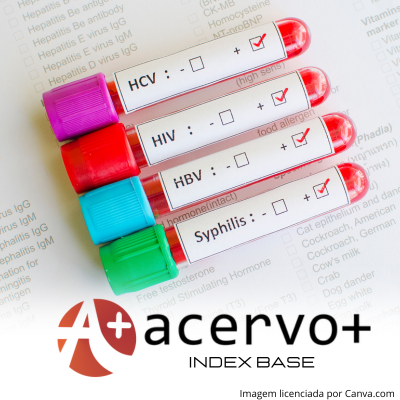
Objetivo: Analizar la tendencia y el impacto que tuvo la COVID-19 en las notificaciones de ITS (VIH/Sida, Sífilis, VHB y VHC) en Brasil. Métodos: Se trata de un estudio ecológico, con tendencia temporal de las notificaciones de ITS por la tasa de detección de infección no Brasil, de 2015 a 2021. El análisis de tendencia de 2015 a 2021 se realizó mediante el uso de una regresión lineal. Modelo para series históricas. Para evaluar el impacto de la pandemia se compararon los casos esperados con los casos observados para los años 2015 a 2021. Se estableció un nivel de significancia del 5%, además del programa versión R. Resultados: Los resultados demuestran que hubo una fuerte disminución en las tasas de notificación obligatoria de ITS en Brasil durante el período de la pandemia de Covid-19. La reducción gradual de las tasas de detección de ITS en todas las regiones brasileñas durante el período de pandemia. Conclusión: Durante la pandemia de COVID-19 hubo una reducción de las notificaciones de ITS. Estos resultados respaldan el establecimiento de estrategias de vigilancia y atención médica para minimizar los impactos del retraso en el diagnóstico y tratamiento de estas infecciones.
Referencias
BARBEE LA, et al. “Sex in the Time of COVID”: Clinical Guidelines for Sexually Transmitted Disease Management in an Era of Social Distancing. Sexually Transmitted Diseases, 2020; 47(7): 427–430.
BOTTURA BR, et al. Perfil epidemiológico da sífilis gestacional e congênita no Brasil – período de 2007 a 2016. Arquivos Médicos dos Hospitais e da Faculdade de Ciências Médicas da Santa Casa de São Paulo, 2019; 64(2): 69.
CAVALCANTE JR, et al. COVID-19 no Brasil: evolução da epidemia até a semana epidemiológica 20 de 2020. Epidemiologia e Serviços de Saúde, 2020; 29(4): 2020376.
CDC. Sexually Transmitted Disease Surveillance 2020. Centers for Disease Control and Prevention, 2023.
CRANE MA, et al. Reporting of sexually transmitted infections during the COVID-19 pandemic. Sexually Transmitted Infections, 2021; 97(2): 101–102.
DE BAETSELIER I, et al. The impact of physical restriction measures imposed during the two waves of COVID-19 on chlamydia and gonorrhea diagnoses in Belgium. Results of an sexually transmitted infection clinic. International Journal of STD and AIDS, 2021; 32(11): 998–1003.
DOMINGUES CSB, et al. Protocolo Brasileiro para Infecções Sexualmente Transmissíveis 2020: vigilância epidemiológica. Epidemiologia e Serviços de Saúde, 2021; 30(1).
EIBSCHUTZ LS, et al. Global Impact of COVID‐19 on Healthcare Systems. Coronavirus Disease 2019 (COVID‐19), 2023; 615–650.
FERNÀNDEZ-LÓPEZ L, et al. Impact of the COVID-19 pandemic on community-based testing for HIV, viral hepatitis and sexually transmitted infections in the WHO European Region, March to August 2020. European Journal of Public Health, 2023; 33(3): 528–535.
GATECHOMPOL S, et al. COVID-19 and HIV infection co-pandemics and their impact: a review of the literature. AIDS Research and Therapy, 2021; 18(1): 28.
GHAZNAVI C, et al. Recent changes in the reporting of STIs in Japan during the COVID-19 pandemic. Sexually Transmitted Infections, 2022; sextrans-2021-055378.
JOHNSON KA, et al. Measuring the Impact of the COVID-19 Pandemic on Sexually Transmitted Diseases Public Health Surveillance and Program Operations in the State of California. Sexually Transmitted Diseases, 2021; 48(8): 606–613.
KANDA N, et al. Indirect impact of the COVID-19 pandemic on the incidence of non–COVID-19 infectious diseases: a region-wide, patient-based database study in Japan. Public Health, 2023; 214: 20–24.
KIM H-J, et al. Permutation tests for joinpoint regression with applications to cancer rates. Statistics in Medicine, 2000; 19(3): 335–351.
LIU M, et al. A Neglected Narrative in the COVID-19 Pandemic: Epidemiological and Clinical Impacts of the COVID-19 Outbreak on Syphilis. Clinical, Cosmetic and Investigational Dermatology, 2023; 16: 2485–2496.
MAITHUFI R, et al. The Impact of the COVID-19 pandemic on STI services in the Eastern Cape Province of South Africa. COVID – epidemiology & health services impacts, 2021; A232-A24.
PAGAOA M, et al. Trends in Nationally Notifiable Sexually Transmitted Disease Case Reports During the US COVID-19 Pandemic, January to December 2020. Sexually Transmitted Diseases, 2021; 48(10): 798–804.
PEREIRA GFM, et al. HIV/AIDS, STIs and viral hepatitis in Brazil: Epidemiological trends. Revista Brasileira de Epidemiologia, 2019; 22: 1–2.
SARKAR S, et al. Impact of COVID-19 in patients with concurrent co-infections: A systematic review and meta-analyses. Journal of Medical Virology, 2021; 93(4): 2385–2395.
SENTÍS A, et al. The impact of the COVID-19 pandemic on Sexually Transmitted Infections surveillance data: incidence drop or artefact? BMC Public Health, 2021; 21(1): 1637.
SHIFERAW W, et al. A systematic review and meta-analysis of sexually transmitted infections and blood-borne viruses in travellers. Journal of Travel Medicine, 2024; 31(4): 038.
SILVA DL, et al. Estratégias de prevenção a IST realizadas por enfermeiros na atenção primaria a saúde: uma revisão integrativa. Brazilian Journal of Health Review, 2021; 4(2): 4028–4044.
SILVA EF de O, et al. Fatores associados ao aumento de infecções sexualmente transmissíveis no público idoso. Revista Eletrônica Acervo Saúde, 2023; 23(3): 11813.
SIMÕES D, et al. Impact of the COVID-19 pandemic on testing services for HIV, viral hepatitis and sexually transmitted infections in the WHO European Region, March to August 2020. Eurosurveillance, 2020; 25(47).
SINKA K. The global burden of sexually transmitted infections. Clinics in Dermatology, 2024; 42(2): 110–118.
SOE NN, et al. Clinical features-based machine learning models to separate sexually transmitted infections from other skin diagnoses. Journal of Infection, 2024; 88(4): 106128.
WAGENLEHNER FME, et al. Klinik, Diagnostik und Therapie sexuell übertragbarer Infektionen. Deutsches Arzteblatt International, 2016; 113(1–2): 11–22.
WHO. Global hepatitis report 2024: action for access in low-and middle-income countries. World Health Organization, 2024.
WHO. HIV statistics, globally and by WHO region, 2023. World Health Organization, 2023.
WHO. Timeline of WHO’s response to COVID-19. World Health Organization, 2020.
WIHLFAHRT K, et al. Sexually Transmitted Diseases-An Update and Overview of Current Research. Diagnostics, 2023; 13(9): 1656.
WU X, et al. The Impact of COVID-19 Lockdown on Cases of and Deaths From AIDS, Gonorrhea, Syphilis, Hepatitis B, and Hepatitis C: Interrupted Time Series Analysis. JMIR Public Health and Surveillance, 2023; 9: 40591.
ZHENG Y, et al. Global burden and trends of sexually transmitted infections from 1990 to 2019: an observational trend study. The Lancet Infectious Diseases, 2022; 22(4): 541–551.