
Palabras clave
Recubrimiento de la pulpa dental
Endodoncia
Cómo citar
Copyright © | Todos los derechos reservados.
La revista posee los derechos de autor exclusivos para la publicación de este artículo en los términos de la ley brasileña 9610/98.
Reproducción parcial
El uso de partes de los textos, figuras y cuestionario del artículo es libre, siendo obligatoria la citación de los autores y revista.
Reproducción total
Está expresamente prohibido y debe ser autorizado por la revista.
Resumen
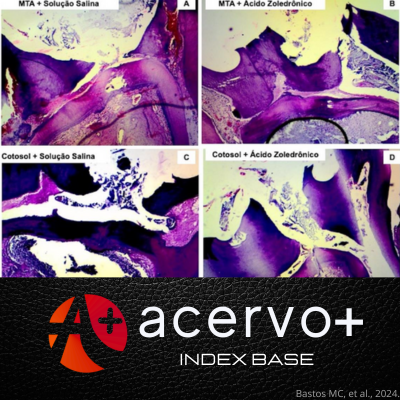
Objetivo: Dado el uso generalizado de losbisfosfonatos (BF) para eltratamiento de condiciones como laosteoporosis y lasmetástasisóseas, y lanecesidad de prevenir laosteonecrosis de los maxilares inducida por bisfosfonatos (ONM), es esencialcomprendersu impacto enla terapia pulpar vital (TPV). Métodos: Este estudioevaluólarespuesta pulpar y periapical, así como lacapacidad de reparacióndelrecubrimiento pulpar directo (RPD) enun modelo animal pretratadoconbisfosfonatos. Utilizando 36 molares inferiores de 18 ratas Wistar, losanimalesfueron divididos segúnel material restaurador (MTA o Cotosol) y eltratamiento farmacológico (Ácido Zoledrónico o solución salina). Resultados: El grupo ZA + MTA mostrólosmejores resultados, conun 44,5% de inflamación leve (p=0,033), un 88,9% de ausencia de patología periapical (p=0,034) y un 55,6% de formación leve de puentedentinario (p=0,01). Además, el 33,3% del grupo mantuvo una morfologíatisular normal (p=0,024), conla menor ocurrencia de calcificación distrófica (37,5%) (p=0,032). Conclusión: Los hallazgossugieren que el MTA reduceel infiltrado inflamatorio, promuevelaformación de dentina y favorecelasalud periapical, incluso en presencia de bisfosfonatos. Estos resultados destacanel potencial del MTA para mitigar losefectos adversos de losbisfosfonatosenlacicatrización pulpar y periapical.
Referencias
ALRAHABI MK e GHABBANI HM. Clinical impact of bisphosphonates in root canal therapy. Saudi Med J, 2018; 39(3): 232.
BRIZUELA C, et al. Direct pulp capping with calcium hydroxide, mineral trioxide aggregate, and biodentine in permanent young teeth with caries: a randomized clinical trial. J Endod, 2017; 43(11): 1776-80.
CUNHA D, et al. 3D-printed microgels supplemented with dentin matrix molecules as a novel biomaterial for direct pulp capping. Clin Oral Investig, 2023; 27(3): 1215-25.
CVIKL B, et al. The response of dental pulp‐derived cells to zoledronate depends on the experimental model. Int Endod J, 2011; 44(1): 33-40.
DE BARROS SILVA PG, et al. Chronic treatment with zoledronic acid alters the expression levels of inflammatory, bone, and apoptotic markers and Toll-like receptors 2 and 4 in rat dental pulp. Oral Surg Oral Med Oral Pathol Oral Radiol, 2019; 128(2): 139-45.
DE BARROS SILVA PG, et al. Immune cell profile of dental pulp tissue treated with zoledronic acid. Int Endod J, 2017; 50(11): 1067-76.
DE-FREITAS NR, et al. Bisphosphonate treatment and dental implants: A systematic review. Med Oral Patol Oral Cir Bucal, 2016; 21(5).
FILLEUL O, et al. Bisphosphonate-induced osteonecrosis of the jaw: a review of 2,400 patient cases. J Cancer Res Clin Oncol, 2010; 136(8): 1117-24.
FLIEFEL R, et al. Treatment strategies and outcomes of bisphosphonate-related osteonecrosis of the jaw (BRONJ) with characterization of patients: a systematic review. Int J Oral Maxillofac Surg, 2015; 44(5): 568-85.
HORSOPHONPHONG S, et al. Equivalence of human and bovine dentin matrix molecules for dental pulp regeneration: proteomic analysis and biological function. Arch Oral Biol, 2020.
KILKENNY C, et al. Animal research: reporting in vivo experiments: the ARRIVE guidelines. Br J Pharmacol., 2010; 160(7): 1577.
KIM M, et al. Effect of ProRoot MTA® and Biodentine® on osteoclastic differentiation and activity of mouse bone marrow macrophages. J Appl Oral Sci, 2019; 27.
KLEIN‐JÚNIOR CA, et al. Development and evaluation of calcium hydroxide‐coated, pericardium‐based biomembranes for direct pulp capping. J Investig Clin Dent, 2019; 10(1).
KUROSHIMA S, et al. Medication-related osteonecrosis of the jaw: A literature review. J Oral Biosci, 2019; 61(2): 99-104.
LIN HP, et al. Controlled release of lovastatin from poly (lactic-co-glycolic acid) nanoparticles for direct pulp capping in rat teeth. Int J Nanomedicine, 2017; 12: 5473.
LIU L, et al. The expression of MCP-1 and CCR2 in induced rats periapical lesions. Arch Oral Biol., 2014; 59(5): 492-9.
MANASPON C, et al. Human dental pulp stem cell responses to different dental pulp capping materials. BMC Oral Health, 2021; 21(1): 209.
PAPIC M, et al. Effects of direct pulp capping with recombinant human erythropoietin and/or mineral trioxide aggregate on inflamed rat dental pulp. Mol Cell Biochem, 2023.
PAULA A, et al. Direct pulp capping: which is the most effective biomaterial? A retrospective clinical study. Materials, 2019; 12(20): 3382.
PEZELJ-RIBARIC S, et al. Detection of tumor necrosis factor α in normal and inflamed human dental pulps. Arch Med Res, 2002; 33(5): 482-4.
QIU Y, et al. Activation of the Wnt/β-catenin signaling pathway is required for FGF-2-induced proliferation and odontogenic differentiation of human periodontal ligament stem cells. J Cell Mol Med, 2018; 22(1): 582-92.
TOMSON PL, et al. Growth factor release from dentine matrix by pulp-capping agents promotes pulp tissue repair-associated events. Int Endod J, 2017; 50: 281-292.
TRONGKIJ V, et al. The effect of mineral trioxide aggregate (MTA) and zinc oxide (ZA) on inflammatory response and dentin formation after pulpotomy in dog teeth. J Clin Dent, 2018; 29(2): 131-8.
TZIAFA C, et al. Dentinogenic responses after direct pulp capping of miniature swine teeth with Biodentine. J Endod, 2014; 40(12): 1967-71.
WANG Y, et al. Mineral trioxide aggregate enhances the odonto/osteogenic capacity of stem cells from inflammatory dental pulps via NF‐κB pathway. Oral Dis, 2014; 20(7): 650-8.
WATERHOUSE PJ e Teixeira RM. Pulp revascularization: a review of the clinical techniques and therapeutic outcomes. Int Endod J, 2002; 35(6): 441-51.
WELLS C, et al. Vital pulp therapy for endodontic treatment of mature teeth: a review of clinical effectiveness, cost-effectiveness, and guidelines. Vital Pulp Therapy, 2019.
ZHAO X, et al. Mineral trioxide aggregate promotes odontoblastic differentiation via mitogen-activated protein kinase pathway in human dental pulp stem cells. Mol Biol Rep, 2012; 39: 215-20.
ZHU C, et al. Clinical outcome of direct pulp capping with MTA or calcium hydroxide: a systematic review and meta-analysis. Int J ClinExp Med, 2015; 8(10): 17055.