
Palabras clave
Estrés oxidativo
Nanoemulsión
Cómo citar
Copyright © | Todos los derechos reservados.
La revista posee los derechos de autor exclusivos para la publicación de este artículo en los términos de la ley brasileña 9610/98.
Reproducción parcial
El uso de partes de los textos, figuras y cuestionario del artículo es libre, siendo obligatoria la citación de los autores y revista.
Reproducción total
Está expresamente prohibido y debe ser autorizado por la revista.
Resumen
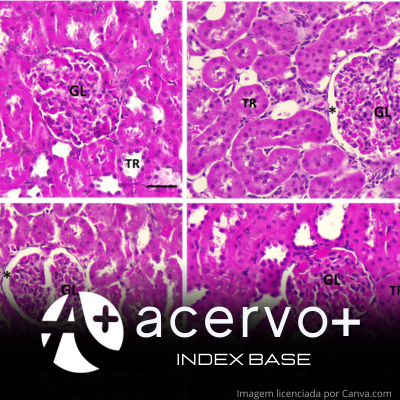
Objetivo: Evaluar los efectos terapéuticos de la nanoemulsión de aceite de Cannabis sativa (CBDON) sobre las alteraciones renales inducidas por el ácido valproico (VPA) en ratas. Métodos: Ratas Wistar hembras preñadas fueron expuestas a VPA y sus crías recibieron tratamiento con nanoemulsión de CBD en concentraciones de 1% y 2%. Después de 60 días, se realizaron evaluaciones mediante biometría corporal, morfometría renal y análisis de estrés oxidativo, con cuantificación de la actividad de malondialdehído (MDA) y enzima antioxidante. Los datos fueron analizados mediante estadística descriptiva e inferencial. Resultados: El VPA provocó una reducción del peso corporal y cambios en las estructuras renales, como una disminución del área y el diámetro glomerular. El tratamiento con nanoemulsión de CBD, especialmente a una concentración del 2%, mostró un efecto positivo en la recuperación de los parámetros morfométricos renales y la reducción del estrés oxidativo, revirtiendo parcialmente el daño causado por el VPA. Se observó un aumento de la actividad de las enzimas antioxidantes y una disminución de MDA en los grupos tratados con CBD. Conclusión: El estudio sugiere que la nanoemulsión de CBD puede tener un efecto nefroprotector, mitigando los cambios renales inducidos por VPA durante el período intrauterino.
Referencias
ADAMS HR. Physiologic, pathophysiologic, and therapeutic implications for endogenous nitric oxide. J Am Med Assoc ,1996; 209: 1297–1302.
ADEWOLE KE, et al. Exploring phytotherapeutic approach in the management of valproic acid-induced toxicity. Adv. Tradit. Med. 2021; 1–21.
AGUILAR S et al. Pregnancy and Epilepsy. Acta Obstet Ginecol Port, Coimbra, 2016; 10 (2):120-129.
ALSDORF, Rachel; WYSZYNSKI, Diego F. Teratogenicity of sodium valproate. Expert opinion on drug safety, v. 4, n. 2, p. 345-353, 2005.
ANGUISSOLA, Giulia et al. Kidney tubular injury induced by valproic acid: systematic literature review. Pediatric Nephrology, v. 38, n. 6, p. 1725-1731, 2023.
BARRETO LAAS. A maconha (Cannabis sativa) e seu valor terapêutico. 2002. Monografia [Trabalho de conclusão do curso de graduação em Ciências Biológicas] apresentada à Faculdade de Ciências da Saúde do Centro Universitário de Brasília. Brasília, 2002.
BENZIE IF, STRAIN JJ. The ferric reducing ability of plasma (FRAP) as a measure of “antioxidant power”: the FRAP assay. Analytical biochemistry, 1996; 239(1): 70-76.
BHATTACHARYYA A. et al., Oxidative stress: an essential factor in the pathogenesis of gastrointestinal mucosal diseases. Physiological reviews, 2014; 94(2): 329-354.
BITON V. Effect of antiepileptic drugs on bodyweight: overview and clinical implications for the treatment of epilepsy. CNS Drugs, 2003;17(11):781-91.
BRACONNIER, L et al. Encéphalopathie hyperammoniémique en Réanimation adulte: à propos de deux observations cliniques. Médecine Intensive Réanimation, 2018; 27: 558–562.
CHEN, O.; The early overgrowth theory of autism spectrum disorder: insight into convergent mechanisms from valproic acid exposure and translational models. Progress in Molecular Biology and Translational Science, 2020; 173: 275-300.
CHUA JT. Et al. Endocannabinoid system and the kidneys: from renal physiology to injury and disease. Cannabis and cannabinoid research, 2019; 4(1): 10-20.
CUPERTINO MC, et al. Long-lasting morphofunctional remodelling of liver parenchyma and stroma after a single exposure to low and moderate doses of cadmium in rats. Int. J. Exp. Pathol, 2013; 94, 343–351.
MELLO PA et al. Nefrotoxicidade e alterações de exames laboratoriais por fármacos: revisão da literatura. Revista de Medicina, 2021; 100 (2); 152-161.
FERREIRA ALA, MATSUBARA LS. Radicais livres: conceitos, doenças relacionadas, sistema de defesa e estresse oxidativo. RAMB, 1997; 43(1):61-8.
GAD AM. Study on the influence of caffeic acid against sodium valproate–induced nephrotoxicity in rats. Journal of biochemical and molecular toxicology, 2018; 32 (8); e22175.
GAYAM V. et al. Valproic acid induced acute liver injury resulting in hepatic encephalopathy-a case report and literature review. Journal of Community Hospital Internal Medicine Perspectives, 2018; 8 (5): 311-314.
GASTON TE, FRIEDMAN D. Pharmacology of cannabinoids in the treatment of epilepsy. Epilepsy Behav, 2017; May:313-318.
GILLHAM B. et al., Wills’: Biochemical basis of medicine, 3rd ed., Butterworth- Heinemann: Oxford, 1997.
GUTTERRIDGE JMC, HALLIWELL B. The measurement and mechanism of lipid peroxidation in biological systems. Trends Biochem. Sci, 1990; 15: 129–135.
HABIG WH, et al. Glutathione S-transferases: the first enzymatic step in mercapturic acid formation. Journal of biological Chemistry, 1974; 249 (22): 7130-7139.
HALL AM, et al. Síndrome de Fanconi renal induzida por drogas . QJM, 2014; 107: 261 – 269.
HAMED SA. The effect of antiepileptic drugs on the kidney function and structure. Expert Review of Clinical Pharmacology, 2017; 10 (9): 993-1006.
HEIDARI R, et al., Mechanism of valproic acid-induced Fanconi syndrome involves mitochondrial dysfunction and oxidative stress in rat kidney. Nephrology (Carlton), 2018 Apr;23(4):351-361.
HONÓRIO KM, et al. Aspectos terapêuticos de compostos da planta Cannabis sativa. Química nova, 2006; 29 (2): 318-325.
LOWRY OH, et al. Protein measurement with the folin phenol reagent. Anal. Biochem. 1951; 193, 265–275.
MATTOS BSm et al. Quercetin prevents alterations of behavioral parameters, delta-aminolevulinic dehydratase activity, and oxidative damage in brain of rats in a prenatal model of autism. International Journal of Developmental Neuroscience, 2020; 80: 287-302.
MCGARIGAL K. et al. Ordenação: análise de componentes principais. Estatística multivariada para pesquisa em ecologia e vida selvagem , p. 19-80, 2000.
MONCADA SMRJ, et al. Nitric oxide: pathophysiology, and pharmacology. Pharmacol Rev, 1991; 43: 109–142.
ORNOY A. et al. S-adenosyl methionine prevents ASD like behaviors triggered by early postnatal valproic acid exposure in very young mice. Neurotoxicology and Teratology. Amsterdã, 2019; 71: 64-74.
PECOITS-FILHO, R. Diagnóstico de doença renal crônica: avaliação da função renal. J Bras Nefrol,2004; 26 (3): 4-5.
PERUCCA E. Pharmacological and therapeutic properties of valproate: a summary after 35 years of clinical experience. CNS drugs, 2002; 16: 695-714.
POLZIN DJ. Chronic kidney disease in small animals. Vet Clin Small Anim, 2011; 41:15-30.
REMUZZI G, et al. Mechanisms of progression and regression of renal lesions of chronic nephropathies and diabetes. The Journal of clinical investigation, v. 116, n. 2, p. 288-296, 2006.
SAFDAR A, ISMAIL F. A comprehensive review on pharmacological applications and drug-induced toxicity of valproic acid. Saudi Pharmaceutical Journal, 2023; 31 (2): 265-278.
SCHNEIDER CD, OLIVEIRA AR. Radicais livres de oxigênio e exercício: mecanismos de formação e adaptação ao treinamento físico. RBME. 2004; 10(10):308-13.
SIDDIQUI IA, et al. Protective effects of black tea extract on testosterone induced oxidative damage in prostate. Cancer Lett. 2005; 227: 125–132.
TAN L, et al. The influence of cytochrome oxidase CYP2A6, CYP2B6, and CYP2C9 polymorphisms on the plasma concentrations of valproic acid in epileptic patients. Clin. Neurol. Neurosurg, 2010; 112, 320–323.
URSO ML, CLARKSON PM. Oxidative stress, exercise, and antioxidant supplementation. Toxicology, 2003; 189(1-2), 41-54.
ZHU MM, et al. The pharmacogenomics of valproic acid. Journal of human genetics, 2017; 62(12), 1009-1014.
Ricart-Jané D, et al. Anticoagulants and other preanalytical factors interfere in plasma nitrate/nitrite quantification by the Griess method. Nitric Oxide - Biology and Chemistry, 2002; 6: 178–185