
Palabras clave
Inmunohistoquímica
PTEN fosfohidrolasa
Fosfatidilinositol 3-quinasa
Proteína quinasa ribosomal S6
Cómo citar
Copyright © | Todos los derechos reservados.
La revista posee los derechos de autor exclusivos para la publicación de este artículo en los términos de la ley brasileña 9610/98.
Reproducción parcial
El uso de partes de los textos, figuras y cuestionario del artículo es libre, siendo obligatoria la citación de los autores y revista.
Reproducción total
Está expresamente prohibido y debe ser autorizado por la revista.
Resumen
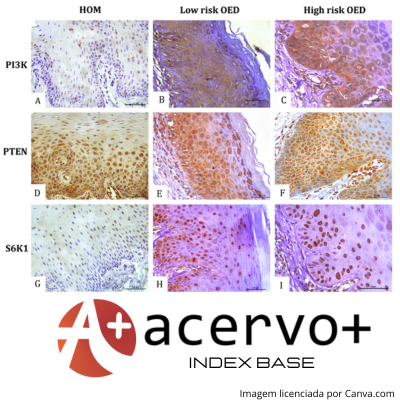
Objetivo: Evaluar la inmunoexpresión de las proteínas PI3K, PTEN y S6K1 en displasias epiteliales orales (DEO). Métodos: 20 casos de DEO con diferentes grados histológicos y 20 casos de mucosa oral sana (MOS) fueron sometidos a reacción inmunohistoquímica utilizando anticuerpos anti-PI3K, anti-PTEN y anti-S6K1, los cuales fueron analizados semicuantitativamente. El análisis estadístico se llevó a cabo mediante la prueba exacta de Fisher o la prueba ji al cuadrado de Pearson para las variables categóricas, y la prueba de Mann-Whitney o la prueba de Kruskal-Wallis para las variables cuantitativas. Resultados: Se observó una mayor frecuencia de inmunotinción positiva para PI3K y S6K1 en DEO, junto con una disminución de PTEN nuclear y citoplasmático en DEO en comparación con MOS. Además, se observó un mayor número citoplasmático medio de células que expresaban PTEN en los DEO de bajo riesgo en comparación con los de alto riesgo. Conclusión: El aumento de la expresión de PI3K y S6K1, asociado a la disminución de la expresión de PTEN, puede estar relacionado con el desarrollo y la progresión del DEO. En consecuencia, estos marcadores pueden tener valor diagnóstico, ayudar en la estratificación del riesgo y contribuir a la determinación del pronóstico.
Referencias
BADWELAN M, et al. Oral Squamous Cell Carcinoma and Concomitant Primary Tumors, What Do We Know? A Review of the Literature. Current Oncology, 2023; 30(4): 3721–34.
CHAVES FN, et al. Loss of heterozygosity and immunoexpression of PTEN in oral epithelial dysplasia and squamous cell carcinoma. Exp Mol Pathol, 2020; 112: 104341.
DELGADO L, et al. p-S6 as a Prognostic Biomarker in Canine Oral Squamous Cell Carcinoma. Biomolecules, 2022; 12(7): 935.
ESTEVA FJ, et al. PTEN, PIK3CA, p-AKT, and p-p70S6K Status. The American Journal of Pathology, 2010; 177(4): 1647–56.
GIUDICE FS, SQUARIZE CH. The determinants of head and neck cancer: Unmasking the PI3K pathway mutations. J Carcinog Mutagen, 2013; Suppl 5: 003.
GUIMARÃES LM, et al. The genetic basis of oral leukoplakia and its key role in understanding oral carcinogenesis. J Oral Pathology Medicine, 2021; 50(7): 632–8.
HAN EJ, et al. Piperine Induces Apoptosis and Autophagy in HSC-3 Human Oral Cancer Cells by Regulating PI3K Signaling Pathway. IJMS, 2023; 24(18): 13949.
IDRIS A, et al. Relative Frequency of Oral Malignancies and Oral Precancer in the Biopsy Service of Jazan Province, 2009-2014. Asian Pacific Journal of Cancer Prevention, 2016; 17(2): 519–25.
KAUR J, et al. Clinical significance of Phosphatidyl Inositol Synthase overexpression in oral cancer. BMC Cancer, 2010; 10(1): 168.
KUJAN O, et al. Evaluation of a new binary system of grading oral epithelial dysplasia for prediction of malignant transformation. Oral Oncology, 2006; 42(10): 987–93.
LEONEL ACLS, et al. Knowledge and Attitudes of Primary Health Care Dentists Regarding Oral Cancer in Brazil. Acta Stomatol Croat, 2019; 53(1): 55–63.
MARTINS F, et al. PI 3K– AKT – MTOR pathway proteins are differently expressed in oral carcinogenesis. J Oral Pathology Medicine, 2016; 45(10): 746–52.
MIYAHARA LAN, et al. PTEN allelic loss is an important mechanism in the late stage of development of oral leucoplakia into oral squamous cell carcinoma. Histopathology, 2018; 72(2): 330–8.
MOURA ACD, et al. Worldwide prevalence of PI3K-AKT-mTOR pathway mutations in head and neck cancer: A systematic review and meta-analysis. Critical Reviews in Oncology/Hematology, 2021; 160: 103284.
PAGIN O, et al. The importance of a proper selection area to be biopsied in nodular leukoplakia: a case report. Acta Stomatol Croat, 2014; 48(1): 42–7.
RADMAN M, et al. Knowledge of Oral Cancer among the Fourth and Fifth Year Dental Students. Acta Stomatol Croat, 2018; 52(4): 340–7.
VERED M, WRIGHT JM. Update from the 5th Edition of the World Health Organization Classification of Head and Neck Tumors: Odontogenic and Maxillofacial Bone Tumours. Head and Neck Pathol, 2022; 16(1): 63–75.
WANG H, et al. Elevated Expression of Zinc Finger Protein 703 Promotes Cell Proliferation and Metastasis through PI3K/AKT/GSK-3β Signalling in Oral Squamous Cell Carcinoma. Cell Physiol Biochem, 2017; 44(3): 920–34.
WARNAKULASURIYA S, et al. Oral potentially malignant disorders: A consensus report from an international seminar on nomenclature and classification, convened by the WHO Collaborating Centre for Oral Cancer. Oral Diseases, 2021; 27(8): 1862–80.
WILS LJ, et al. The role of differentiated dysplasia in the prediction of malignant transformation of oral leukoplakia. J Oral Pathology Medicine, 2023; 52(10): 930–8.
WU J, et al. PLAC8 inhibits oral squamous cell carcinogenesis and epithelial-mesenchymal transition via the Wnt/β-catenin and PI3K/Akt/GSK3β signaling pathways. Oncol Lett, 2020; 20(5): 1–1.